




Interfaith commission - why fear it?
A two-day (Feb 24-25) national interfaith conference to discuss the formation of an Interfaith Commission of Malaysia (ICM), initiated by the Bar Council human rights sub-committee, and attended by more than 200 representatives from over 50 religious groups, political parties and civil societies and individuals, was convened in Bangi despite being boycotted by several Islamic groups .
However, before the draft bill for the ICM is submitted to the government, Prime Minister Abdullah Ahmad Badawi passed the verdict that the proposed commission be deferred and its proponents were advised to focus on interfaith dialogue instead.
Earlier, Deputy Prime Minster Najib Razak reminded all parties concerned to consider the sensitivities of Muslims when making suggestions which could be seen as interfering in Islam-related matters.
The hue and cry against the proposed establishment of the commission has mainly come from PAS and other Islamic groups, such as the Allied Coordinating Committee of Islamic NGOs (Accin), a loose coalition of 13 Muslim NGOs.
PAS Youth is extremely sensitive about the issue of murtad (apostasy) being discussed openly and by non-Muslim groups and individuals. Its deputy chief Idris Ahmad said he finds it ridiculous that apostasy is seen as an option for Muslims under the pretext of freedom of religion.
He insisted that government agencies such as the National Fatwa Council and Islamic Development Department are in the best position to discuss such matters, which touches directly on the sensitivities of Muslims and Islam.
A two-day (Feb 24-25) national interfaith conference to discuss the formation of an Interfaith Commission of Malaysia (ICM), initiated by the Bar Council human rights sub-committee, and attended by more than 200 representatives from over 50 religious groups, political parties and civil societies and individuals, was convened in Bangi despite being boycotted by several Islamic groups .
However, before the draft bill for the ICM is submitted to the government, Prime Minister Abdullah Ahmad Badawi passed the verdict that the proposed commission be deferred and its proponents were advised to focus on interfaith dialogue instead.
Earlier, Deputy Prime Minster Najib Razak reminded all parties concerned to consider the sensitivities of Muslims when making suggestions which could be seen as interfering in Islam-related matters.
The hue and cry against the proposed establishment of the commission has mainly come from PAS and other Islamic groups, such as the Allied Coordinating Committee of Islamic NGOs (Accin), a loose coalition of 13 Muslim NGOs.
PAS Youth is extremely sensitive about the issue of murtad (apostasy) being discussed openly and by non-Muslim groups and individuals. Its deputy chief Idris Ahmad said he finds it ridiculous that apostasy is seen as an option for Muslims under the pretext of freedom of religion.
He insisted that government agencies such as the National Fatwa Council and Islamic Development Department are in the best position to discuss such matters, which touches directly on the sensitivities of Muslims and Islam.
Anti-Islam charge
Accin, on the other hand, emphasised that the position of the Malay Sultans as the heads of Islam in their respective states should be recognised and respected, and any attempts to dilute the Sultan's power and position as the head of Islam would not be tolerated.
Accin's chairperson Mustapha Ma was reported as saying that the mechanisms to protect the freedom of religion in our country is sufficient, for example, the non-Muslims can go to Suhakam if their rights are challenged, whereas the Muslims are subjected to the laws of Syariah, thus there is no need to establish any other body.
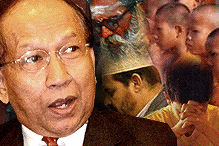 However, these Islamic groups have been urged by Culture, Arts and Heritage Minister Dr Rais Yatim not to discount the proposal for a national interfaith commission without first listening to its proponents and understand the details.
He said that we should not be so prejudiced even before knowing what the issue is. Other religions also have the right to state their views, and added that if the notion of working together intra-religiously is not accepted, that itself is questionable.
Despite the prime minister's advice that the commission idea be put on hold, the interfaith commission steering committee's chair Malik Imtiaz Sarwar is still confident that the government will accept the proposal to form such a commission once certain misconceptions are cleared up.
Malik reiterated that the committee does not have any intention to bring Islam under the jurisdiction of the ICM, which is merely a consultative, advisory and conciliatory body in nature .
He regretted that the initiative has been severely misunderstood. He was confident that once the government goes through the documents - the plenary statement, draft bill and conclusions it will understand that there is nothing sensitive about the initiative.
The initiative was condemned by the detractors as anti-Islam and the proponents were accused of using the platform of dialogue as a guise to undermine Islamic teachings and Muslims in our country. These controversial and rather inflammatory accusations were put up to pressure the authorities concerned so that the proposed commission be nipped in the bud.
Apostasy issue
But how could ICM, a consultative, advisory and conciliatory body without jurisdiction power such as the Human Rights Commission of Malaysia (Suhakam), by means of recommendations, be able to give validity to changes of faith or apostasies as accused, other than as already set out in the Federal Constitution?
To say that Muslims are subjected to Syariah also needs further explanation in our country. Although Islam is the religion of the Federation, the truth is that Islamic laws are mainly confined to the laws of marriage, divorce, and inheritance.
In other words, when Islamic injunctions are in conflict with the secular laws of our country, in theory at least , Syariah should give way to the Federal Constitution to act as the highest law of the country to adjudicate, not the contrary.
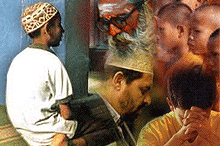 Apostasy, if seen in the context of freedom of religion under the Federal Constitution, besides being a Muslim-related matter, it can be the concerns of other religions as well, and human right advocates would never hesitate to come to the defence of those who want to change their faiths but are denied from doing so, Muslims or non-Muslims alike.
Using the position of Islam as religion of the Federation to gag all non-Muslims from discussing Islamic issues which may affect them, as if our country is already an Islamic state like Iran or Pakistan, is not only unjustifiable, but can be seen as a manifestation of hegemonic attitude of the dominant religion - unwilling to treat other religions as equals, and participate in interfaith dialogue or in mechanisms like ICM as equals.
May be this is why the Bangi conference was boycotted by certain Islamic groups, party and individuals. Nevertheless, representatives from Ahmadiyya Muslim Jamaat, Forum Iqra, Jabatan Agama Islam Kelantan and Sisters in Islam, and a number of Muslim individuals who were present in should be applauded for their willingness to dialogue and discuss the pros and cons of the formation of ICM, true to the spirit of democracy and equality!
Hence, the inclusive attitude to confine the discussion of Islamic issues only to Islamic institutions such as the National Fatwa Council and Islamic Development Department, is negligent of the importance of interfaith interactions and co-operations based on the common values extracted from the tenets and teachings of all religions concerned, to say the least; and insensitive to the urgent needs to resolve religion-related misunderstandings, controversies, or even conflicts at times, and to promote inter-religious understanding and unity, through a statutory mechanism like ICM .
Trying to nip the ICM initiative in the bud is to go against the will of civil society. Now all parties concerned seem to agree that interfaith dialogues are necessary. If that is the case, why be afraid of an institutionalised mechanism, where not only interfaith dialogues could be held whenever the need arises, but also function as a consultative, advisory and conciliatory body.


