




The fight of their lives
For women in conflict zones like Sudan, Afghanistan and Iraq, the struggle for political representation and legally sanctioned gender equality is eclipsed by an urgent need for immediate protection from physical and sexual abuse.
Government ministers and advisors from UN Development Fund for Women (Unifem) regional outposts to participate in an international conference to assess progress on women's equality in the last decade paint a difficult, yet still hopeful picture of the state of women's affairs in these three
troubled countries.
"Women are smiling with one eye and crying with another," said Ruth Kibiti, programme officer for Unifem in Sudan, regarding the newly brokered peace agreement there.
For women in conflict zones like Sudan, Afghanistan and Iraq, the struggle for political representation and legally sanctioned gender equality is eclipsed by an urgent need for immediate protection from physical and sexual abuse.
Government ministers and advisors from UN Development Fund for Women (Unifem) regional outposts to participate in an international conference to assess progress on women's equality in the last decade paint a difficult, yet still hopeful picture of the state of women's affairs in these three
troubled countries.
"Women are smiling with one eye and crying with another," said Ruth Kibiti, programme officer for Unifem in Sudan, regarding the newly brokered peace agreement there.
While the north is relatively stable, in the south and the west, and specifically in the Darfur region, women are used as weapons of war and often raped in a conflict that has resulted in the deaths of least 70,000 and, according to some recent estimates, more than 300,000 people, the vast majority of them
Muslim Africans.
Khartoum is accused of directing the counter-insurgency campaign against the African Darfurians, carried out by Arab militias called Janjaweed.
Kibiti stressed the need for regional and international involvement in restoring the lives of Sudanese women and children, especially refugees fleeing brutal Janjaweed raids.
"When there is conflict, men run away, but women stay back" to take care of their families, she said.
With funding from the Norwegian government, Unifem is facilitating a number of national conferences. But the problem remains of unifying the three unstable regions of the country to ensure the involvement of women from the north, west and south.
Centuries-old problem
Topping the agenda in Afghanistan, whose women were silenced and brutalised for nearly a decade under the Taliban regime, is achieving lasting peace and security, says Homa Sabri, the national policy and programme advisor for Unifem in Kabul.
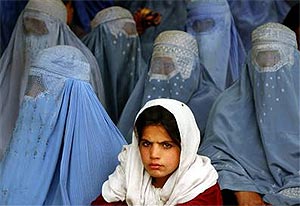 "Without it, women's issues cannot move forward," she said at a panel discussion this week.
In the three years since the Taliban was toppled, Afghan women have struggled to find their footing in an environment where women's human rights violations were rife even before the 20 years of conflict that subsumed the country.
"These problems are not from years or decades, but through centuries," Dr Massouda Jalal, minister of women's affairs in Afghanistan told IPS .
When asked about the dire social situation for women outside the capital of Kabul - tales of self-immolation following rampant sexual abuse and the forced marriage of girls as young as 12 have been reported in the media - Jalal conceded that the Hamid Karzai administration still has much to do.
The Revolutionary Association of Women in Afghanistan (Rawa) contends that "women are still imprisoned for running away from home" under Karzai's government.
According to a report from the Afghanistan Independent Human Rights Commission (AIHRC), rape and trafficking of women and children remain prevalent, as are the "honour killings" that exemplify extrajudicial justice in many rural areas of Asia and the Gulf region.
"These problems have been internalised (among the rural population) and they think it's okay," said Jalal.
She told IPS that continued US aid is key to "get at the root" of this ingrained gender inequality, a problem the government will also tackle as part of its 2005 directive to focus exclusively on the provinces.
Advances have been made in some sectors of Afghan society. The AIHRC is headed by a woman, Dr Sima Samar, and Karzai has appointed a woman as governor of the central province of Bamiyan, marking the first time a woman has held a provincial government post.
Indeed, Sabri assigns crucial importance to finding a voice for women in political affairs, particularly the newly drafted constitution, something she believes is highly important for morale.
"Men and women have equal rights and opportunities before the law," she said, a stipulation that is symbolic on paper but needs to be fully integrated into Afghan society.
In his recently released report on the situation of Afghan women and girls, UN Secretary-General Kofi Annan said that "while the status of women and girls has improved, overall progress has been uneven."
"The volatile security situation and traditional social and cultural norms continue to limit women's and girls' role in public life and deny them the full enjoyment of their rights," Annan said.
Sabri sums up the situation in this male-dominated society thus: "The God power is the hand of man power. If they want to change things, they can. If they want to destroy, they can destroy."
In a country with a 90 percent illiteracy rate among women, experts agree that education is critical, especially since women are afraid to send their children to school amid a tenuous security situation in which much of the country is governed by warlords from three factions - the Northern Alliance,
Communist Party, and Taliban, who maintain a continued presence despite Washington's declaration of victory.
Market of terror
One bright spot has been the recent Afghan presidential election, which saw women's suffrage for the first time in the country's 5,000-year history.
Sabri calls Oct. 9, 2004 "one of the most beautiful days for the Afghan nation. I think God was with us."
Iraq's election also marked a brief moment of triumph, with women gaining 31 percent of the seats in the National Assembly.
While Saddam Hussein's Baathist regime had been progressive compared to neighbouring governments, with women comprising 20 percent of its ministries, female members of opposition parties were often branded as "prostitutes" and executed or imprisoned, recalled Narmin Othman, state minister for women's affairs in Iraq, at a briefing held by the New York-based Freedom House
last Thursday.
Now, she says, "Iraq is a market of terror. No one is safe."
Othman said that an increase in the donning of hijabs , or religious Muslim headscarves, among secular and Christian women has been because of an outgrowth of fear from the radical Shias who now dominate the government.
The problem began when the power vacuum created by the removal of the Baathist regime left Iraqi society susceptible to Sharia law, adhered to by both Sunni Arab extremists and Shia radicals.
In 2003, regional courts began recognising the strict Islamist judicial tradition despite the burgeoning democracy in Baghdad, a situation that propelled a fledgling network of Iraqi women activists into existence.
Most women, reports Basma Al Khateeb, Unifem's national programme coordinator for Iraq, had taken their modern lifestyles for granted, and with the threat of Sharia law hanging over their heads, they took to the streets, proving to be a very powerful lobbying force.
Their efforts paid off, and with the Coalition Provisional Authority behind them, Sharia law was abandoned as an official governing standard.
Condoned abuses
But according to a Unifem report, violence against women in Iraq, as in Afghanistan, "is deeply rooted in the Iraqi cultural structure and is condoned. Many families have refrained from sending their daughters to schools, and many women prefer to stay home" due to the deteriorating security situation.
Unifem has resolved to address these issues with a 20-step battle plan that involves, among other things, the formation of an Iraqi Union of Women's Organisations, the promotion of women to positions of high authority, and the establishment of a national centre for women's human rights, which will
monitor and document abuses.
But the situation is precarious. Violence and kidnappings by both insurgents and religious radicals have made targets of modern women in Iraqi society.
Songul Chapook, a politician from Kirkuk, told Newsweek recently, "If we don't act now, we could lose our rights forever."
Indeed, Al Khateeb says there is a window of opportunity that must be seized if women are to have a voice in Iraqi affairs. "This window," she warned, "closes very quickly."
Othman echoed, "We have no time," urging the Bush administration to provide real funding - as opposed to the last-minute financing of a women's suffrage campaign in the media that arrived a mere week before the election.
- IPS


