



Brexit’s impact on Britain and Malaysia
QUESTION TIME Now that Britain has voted to exit (Brexit) the European Union or EU, what does it matter to Malaysia if at all? That would depend on how the rest of the world will be affected by the move, starting with Britain itself, the EU and global ripple effects it would create.
It is curious that among the four components of Britain - Wales, Northern Ireland, Scotland and England - two voted for Brexit in the national referendum and two against.
Scotland, which itself had a referendum in September 2014 on whether to remain part of Britain - it opted to remain by 55.3 to 44.7% - voted by an overwhelming 62% to 38% to stay in the EU. Now Scots may want another referendum on whether to stay in Britain or not.
Scotland’s first minister Nicola Sturgeon was quoted as having said that it was “democratically unacceptable” that Scotland may have to leave the EU when they opted to stay in Britain and that a second referendum on whether to leave Britain is highly likely.
Northern Ireland, which voted to stay in the EU by 55.8% to 44.2%, faces similar problems with its Deputy First Minister Martin McGuinness talking about a vote on the reunification of Northern Ireland with the Republic of Ireland. However Northern Ireland Secretary Theresa Villiers has ruled out the call from Sinn Féin (a long-standing organisation dedicated to uniting Northern Ireland with Ireland) for a poll, saying the circumstances in which one could be called did not exist.
England did not vote as strongly to leave the EU as either Scotland or Northern Ireland to stay, voting in favour of Brexit by 53.4 to 46.6%, as did Wales, with 52.5% of the vote for leaving and 47.5% remaining. It is of note that London voted 59.9% to 40.1% to stay, only eclipsed by Scotland in terms of support for staying in the EU. This led some Londoners to call for a referendum among them to exit the UK!
QUESTION TIME Now that Britain has voted to exit (Brexit) the European Union or EU, what does it matter to Malaysia if at all? That would depend on how the rest of the world will be affected by the move, starting with Britain itself, the EU and global ripple effects it would create.
It is curious that among the four components of Britain - Wales, Northern Ireland, Scotland and England - two voted for Brexit in the national referendum and two against.
Scotland, which itself had a referendum in September 2014 on whether to remain part of Britain - it opted to remain by 55.3 to 44.7% - voted by an overwhelming 62% to 38% to stay in the EU. Now Scots may want another referendum on whether to stay in Britain or not.
Scotland’s first minister Nicola Sturgeon was quoted as having said that it was “democratically unacceptable” that Scotland may have to leave the EU when they opted to stay in Britain and that a second referendum on whether to leave Britain is highly likely.
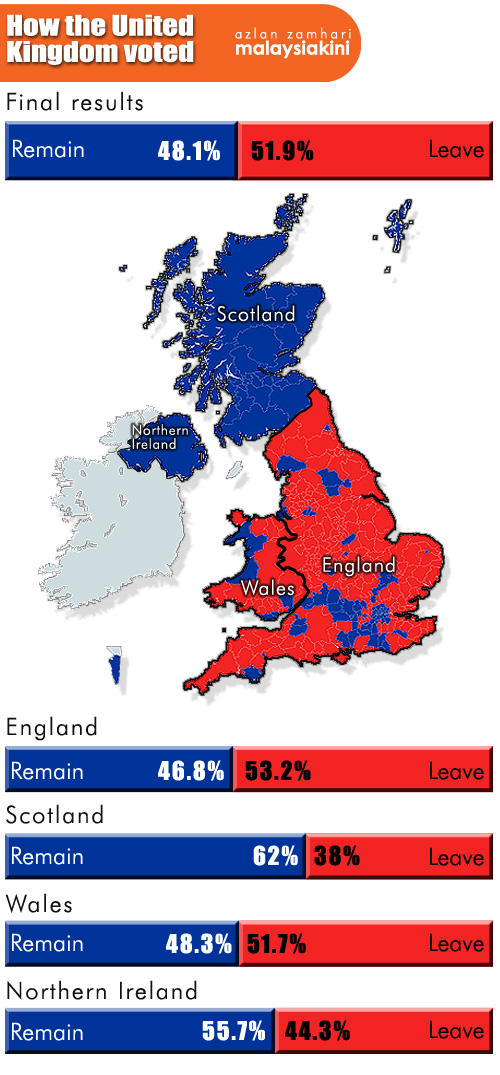 Northern Ireland, which voted to stay in the EU by 55.8% to 44.2%, faces similar problems with its Deputy First Minister Martin McGuinness talking about a vote on the reunification of Northern Ireland with the Republic of Ireland. However Northern Ireland Secretary Theresa Villiers has ruled out the call from Sinn Féin (a long-standing organisation dedicated to uniting Northern Ireland with Ireland) for a poll, saying the circumstances in which one could be called did not exist.
England did not vote as strongly to leave the EU as either Scotland or Northern Ireland to stay, voting in favour of Brexit by 53.4 to 46.6%, as did Wales, with 52.5% of the vote for leaving and 47.5% remaining. It is of note that London voted 59.9% to 40.1% to stay, only eclipsed by Scotland in terms of support for staying in the EU. This led some Londoners to call for a referendum among them to exit the UK!
Overall, the score for UK leaving EU was 51.9% to 48.1% but it was a vote which left Britain aka United Kingdom terribly divided. It would be no exaggeration to say Brexit is tearing Britain apart with deep differences among Britons on their position in the EU.
Those who wanted to leave the EU would have been swayed by emotive arguments that immigration from lower income EU countries was playing havoc with local jobs while Britain was paying more to EU than receiving. Those who wanted to stay felt Britain would benefit more from continued access to free markets and efficiencies from free movement of capital, labour and goods.
David Cameron has resigned as prime minister and will stay on only as long as another leader comes to the fore. And Britain’s exit from the EU is not going to take place immediately - negotiation for an orderly exit can take as long as two years.
In the meantime, it will be prolonged agony and uncertainty for Britain which is going to be quite badly affected in terms of sentiment at least for the next two to three years at least. That will mean that the pound will continue to take a beating until it becomes clear that it can weather Brexit in the longer term and Britain’s capital markets will be roiled and in turmoil.
Minimal impact
Will Brexit be better for Britain in the longer term? Difficult to say. Curbs on capital and labour may scrimp productivity increases and lack of free and fair access to the EU market may affect trade and exports from UK. On the converse side, local labour wages may be safeguarded by restrictions on immigration.
While Britain may be in a pickle for a while, a concerning factor for the rest of the world and EU in particular is whether Brexit will trigger referendums for other countries to exit the EU, a prime example of economic and political regional integration. If that happens and more countries hold similar referendums, the very existence of the EU may be called into question.
That may presage a tendency for countries to withdraw into their own shells and become more protective, which is generally seen as a move which is not only disruptive to capital markets and trade in the short term as trade blocs and alliances crumble across the world but bad for the long-term growth of trade and the world economy.
Given such uncertainties that Brexit entails, there may well be a move towards safe haven currencies such as the US dollar and the Japanese yen and to assets such as gold. That is already happening but the question is whether they will continue to do so.
Much will depend on how events unfold over the coming months and whether there are rumblings of further referendums on the cards either for exit from the United Kingdom or from the EU.
Markets tend to overreact in the short term and then tend to correct according to how the fundamental factors emerge over the months and years. For emerging markets such as Malaysia that means some currency weakness versus the US dollar now as funds move towards safe haven currencies and instruments.
But fundamentally, Malaysia is not directly affected by Brexit with an estimated trade of just 1% of total trade with Britain. But there may be currency weakness against the US dollar in the short term even as it appreciates against the battered pound.
For Britain, there may be a prolonged period of weakness for its currency unless it becomes obvious it has weathered the effects of leaving the EU well - an event which can only be seen at least three years from now when some of the impacts will become clear.
That means the ringgit should appreciate against the pound over the medium term - good news for those who have children studying there but bad news for those who have earnings stream in pounds or investments there.
But the overall impact on the Malaysian economy will be minimal because there is little linkage between Malaysia and Britain while Britain does not have a large linkage with the world economy.
P GUNASEGARAM believes that referendums are seldom the best way to rule. Case in point: Guess what we will vote for if we are asked to choose for or against income taxes. And he wonders what the results would be if a referendum was held on whether the Malaysian prime minister should continue in his job.


Are you sure you want to delete this comment?
This action cannot be undone.