




Circle of anger around Malaysia
As far as Malaysia's standing and relations with its neighbours in the Asean region are concerned, at no point in the country's history save perhaps the relatively short-lived period of Konfrontasi (Confrontation) with Indonesia and the Philippines in the early 1960s has the country been more isolated.
While Kuala Lumpur's ties with neighbouring Singapore have improved, the same cannot be said for its relations with Jakarta, Bangkok and Manila.
 Malaysia's ties with Thailand and Indonesia are particularly bad right now, prompting a Bangkok-based political analyst to note that "Thai-Malaysian bilateral relations are so bad at the moment that it will take some time before things can get back to normal".
Indeed, normality is precisely what the region needs, as right-wing nationalist youth groups in Indonesian cities go out into the streets burning the Malaysian flag while chanting the slogan "Crush Malaysia!".
In Thailand the troublesome relationship between the two countries has been elevated to a higher register altogether, with Prime Minister Thaksin Shinawatra going against established diplomatic norms in Asean and claiming that Malaysian authorities are not doing enough to help Thailand with its problems in the restive Muslim provinces in the south of the country.
As far as Malaysia's standing and relations with its neighbours in the Asean region are concerned, at no point in the country's history save perhaps the relatively short-lived period of Konfrontasi (Confrontation) with Indonesia and the Philippines in the early 1960s has the country been more isolated.
While Kuala Lumpur's ties with neighbouring Singapore have improved, the same cannot be said for its relations with Jakarta, Bangkok and Manila.
 Malaysia's ties with Thailand and Indonesia are particularly bad right now, prompting a Bangkok-based political analyst to note that "Thai-Malaysian bilateral relations are so bad at the moment that it will take some time before things can get back to normal".
Indeed, normality is precisely what the region needs, as right-wing nationalist youth groups in Indonesian cities go out into the streets burning the Malaysian flag while chanting the slogan "Crush Malaysia!".
In Thailand the troublesome relationship between the two countries has been elevated to a higher register altogether, with Prime Minister Thaksin Shinawatra going against established diplomatic norms in Asean and claiming that Malaysian authorities are not doing enough to help Thailand with its problems in the restive Muslim provinces in the south of the country.
Part of the problem stems from Malaysia's own doing: The government's plan to round up and deport scores of illegal migrant workers from the other Asean countries (said to number anything between 1 million to 2.5 million) was a haphazard affair of fits and starts, made all the more embarrassing thanks to a number of delays, lukewarm amnesties and an apparent lack of political will.
The methods of detention and arrest were also a cause for concern, for Malaysian law allows not only for the arrest of illegal migrants, but also whipping something that irked the sensibilities of Indonesians and Filipinos who have relatives working illegally in the country.
When the crackdown on migrants finally took place, the predictable reaction ensued. Hostility towards Malaysia was further compounded by Indonesia's claim on the group of Ambalat islands to the east of Borneo (which Malaysia claims as well). The Ambalat islands dispute was the spark that ignited the tinderbox of bellicose ethno-nationalism on both sides, and some right-wing Indonesian groups have gone as far as mobilising squads of volunteers to go to the islands and reclaim them for their country.
Thai wrath
Then there is the problem of Muslim separatism in the four Malay-Muslim provinces of Patani, Jala, Satun and Narathiwat in southern Thailand to deal with. The southern Thai problem has been a constant thorn in the side of Thai-Malaysian relations for decades and since the 1940s Thai Muslims in the south have been calling for greater autonomy from Bangkok.
What compounds the Patani problem is the fact that this notorious grey zone between the two countries has also been the stomping ground for other subversive and underground movements, from criminal smuggling networks to the banned Communist Party of Malaya. For decades Malaysian and Thai army, police and security/intelligence units have been operating in the region, monitoring a host of criminal and separatist movements.
But successive Malaysian governments have failed to recognise the perennial question of the conduct of the Thai army and the widely-reported brutal tactics that have been employed there.
Working on the basis of the convoluted (and not to mention hypocritical) Asean understanding that no government has the right to interfere in the domestic affairs of a neighbouring country, successive Malaysian leaders have said and done nothing to help improve the situation in southern Thailand.
This culture of mutual consensus and turning a blind eye to each others' problems came to an end with the rise of Thaksin, who promised not only to rebuild the Thai economy but also to project his country to pole position within the Asean region.
 But for Thaksin to succeed in his quest to project Thailand's image and standing in the region, he feels the need to settle the Patani problem once and for all. His methods have involved the use of both a rather unappetising carrot and a disproportionately large stick to clobber the Patani Muslims.
The recent deaths of more than 80 Thai Muslims at the town of Tak Bai was a case in point, showing up the brutal methods that have been favoured by the Thai army all along.
Having failed to win the hearts and minds of the Thai Muslims, Thaksin has directed his wrath at Malaysia instead, accusing Malaysians living in the north of the country of collaborating with Thai separatists and demanding that the Malaysian authorities hand over a wanted Thai suspect Jehku Mae (Abdul Rahmad Ahmad) to the Thai police.
Thus in both Bangkok and Jakarta, some disgruntled quarters are pinning the blame for all that is wrong in Thailand and Indonesia on Malaysia. As much as it might add to the inflation of the national ego, it would be an exaggeration to say that Malaysia is so influential as to be able to impact directly on the internal developments of its neighbouring countries.
People's Asean
The Malaysian government is partly to be blamed for its own failure in dealing with the illegal migrant worker issue (and a host of Malaysian companies that were directly responsible for illegally smuggling in these workers have yet to be brought to book).
And while it could have spoken louder to protest the goings-on in Patani, it would be erroneous to suggest that Malaysia is the cause of all of Indonesia's and Thailand's woes.
The lesson to be learned from all this is the simple fact that in the globalised world we live today the internal developments of and in any country is bound to have an impact on its neighbours, sooner or later.
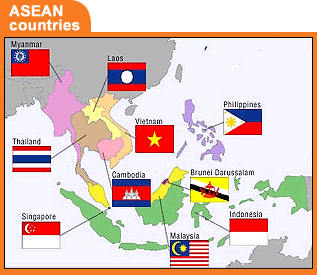 For too long the governments of Asean have operated on the Westphalian logic of the primacy of the nation-state and government, and neglected the development of a common political culture that transcends the frontiers of the state.
We are nowhere closer to creating a people's Asean today than we were in 1967, when the Association of Southeast Asian Nations was launched.
It is this failure to create a common sense of pan-Asean consciousness that accounts, in part, for the ease with which national demagogues like Thaksin can go around whipping up public anger and antipathy against neighbouring countries.
It has also helped in the rise of right-wing nationalist groups that resort to the politics of flag-burning and bellicose hyper-patriotism whenever the nation is in crisis.
Can the peoples of Malaysia, Indonesia, Thailand and the Philippines see beyond the narrow confines of the logic of the state and governmentality?
This will require an epistemic leap that thus far seems to be beyond the capacity of their leaders. But as long as this does not happen, the bullying tactics of governments and the divisive results of such actions will continue. And for now at least, Malaysia is encircled by angry neighbours instead.
Dr FARISH A NOOR is Visiting Chair of Asian Studies at Sciences-Po Paris, France, and a malaysiakini columnist.


Are you sure you want to delete this comment?
This action cannot be undone.