




Tortured by Kempetai
On the night of Jan 28, 1945, Suriani Abdullah was sleeping in a wooden house near Tanjong Tualang in the Kinta Valley, Perak. It was an unplanned arrangement.
According to the original plan, she was to have spent the night in a safe house but, due to illness, she was unable to continue with the journey to the location prepared for her.
"That night, Japanese fascists came to conduct a sook ching (cleansing and purification) operation in the village...," Suriani recalled the incident, her voice filled with emotion.
On the night of Jan 28, 1945, Suriani Abdullah was sleeping in a wooden house near Tanjong Tualang in the Kinta Valley, Perak. It was an unplanned arrangement.
According to the original plan, she was to have spent the night in a safe house but, due to illness, she was unable to continue with the journey to the location prepared for her.
"That night, Japanese fascists came to conduct a sook ching (cleansing and purification) operation in the village...," Suriani recalled the incident, her voice filled with emotion.
"They searched door to door and finally, they came to our house. When my bodyguard saw the Japanese soldiers in uniforms, she immediately opened fire. I was awakened and in the hurly burly, I slipped out of the house through the back door.
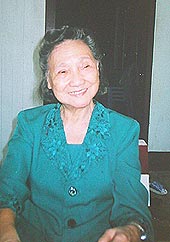 "Just when I thought I could escape again, I fell. A few Japanese soldiers tried to overwhelm me. I shot at them twice, but the pistol didn't work."
Her bodyguard was killed while Suriani was detained in the Kempetai headquarters in Ipoh for the next six months.
"While under detention, I tried to sing aloud and make noises to register my protest ... but whenever I did that, the Kempetai would come into my cell and splash hot water on me...They also took away from me all personal belongings that I might use to commit suicide.
"Almost everyday, I was interrogated and tortured. They beat me so hard all over that I vomited blood. Having failed in their hard ways, they resorted to soft tactics: they called in traitors and turncoats who knew me to persuade me to co-operate with them. I scolded all of them.
"To be honest, some of the Japanese volunteer force personnel were quite humane. They secretly brought in roti canai at night for me and other detainees."
She revealed that she did not suffer the dreaded water torture, but that some of her fingers were burnt. Today, some 60 years later, the scars remain.
Publicist role
 Suriani (
photo
) was released after the Japanese soldiers heard the broadcast of Japan's surrender on Aug 15, 1945.
Suriani (
photo
) was released after the Japanese soldiers heard the broadcast of Japan's surrender on Aug 15, 1945.
"I walked out to Ipoh town and took a bus back to Tanjong Tualang. In Ipoh, Tanjong Tualang and along the way, I saw underground MPAJA and our civilian comrades emerging in groups from hillsides, bushes and villages. When I arrived in Tanjong Tualang, a huge crowd had already gathered there to welcome me.
 "Later, when I went to visit Pusing as party's publicist, I saw - to my disbelief - all shops and most of the private houses were displaying the red flags of either the party or the MPAJA...
"Whenever our armed forces emerged, people in towns and villages lined up to welcome them. Three restaurant bosses in Pusing offered all MPAJA personnel and communists free meals and drink for one month! We could just go into any one of those restaurants any time to eat and drink whatever we liked.
"Then I met (RG) Balan, Rashid (Maidin) and Abdullah (CD)... They all joined my group of publicists. I was their leader."
 According to Suriani, Balan (
photo
) was a communist underground publicist during the Japanese occupation in the Kampar-Tapah area, printing and circulating anti-Japanese pamphlets in Tamil. He was affiliated with a clandestine group under the directive of Wu Tien Wang.
According to Suriani, Balan (
photo
) was a communist underground publicist during the Japanese occupation in the Kampar-Tapah area, printing and circulating anti-Japanese pamphlets in Tamil. He was affiliated with a clandestine group under the directive of Wu Tien Wang.
(Balan was detained by the colonial authorities on May 30, 1948 and was not released until 1961. He was elected CPM central committee vice-chairman in 1955, in absentia.)
Suriani looked elated when describing the victory procession in Ipoh, which she said is not widely recalled by younger generations of Malaysians.
"There was a military band ... two persons holding the flags of the Communist Party of Malaya and the MPAJA respectively walked alongside the bandAbout 1,000 MPAJA personnel participated in the procession with new uniforms and weapons air-dropped by Allied Command during the last few months of the occupation."
Victory procession
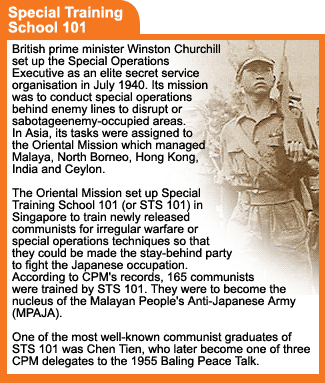
On Dec 31, 1943, the CPM and the Allies' South East Asia Command reached a written agreement in Blantan at Bukit Bidor, Perak. The MPAJA agreed to assist in the re-taking of Peninsular Malaya and Singapore by British-led Allied forces in return for supplies of uniforms, medicines, weapons and financial resources.
"I was there (in the Ipoh procession) with Commander Itu (Liao Wei Chung) in a car ... we were followed by hundreds of our civilian supporters. The towkays (bosses) were at the rear of the procession ... We were very, very happy.
 "Before the war,
towkays
always walked in front in public processions, but now poor people like us led the way ... the world had changed ... I was later invited by the British to board a military helicopter...," Suriani said.
"Before the war,
towkays
always walked in front in public processions, but now poor people like us led the way ... the world had changed ... I was later invited by the British to board a military helicopter...," Suriani said.
(Liao, a commander of the 5th Independent Regiment of MPAJA, was nicknamed Itu by both the British and communists during the occupation because he was given a code for secret communication, E2. He was arrested by the British at the beginning of the 'Emergency' and banished to China. According to Chin Peng, Liao died in China in late 1980s.)
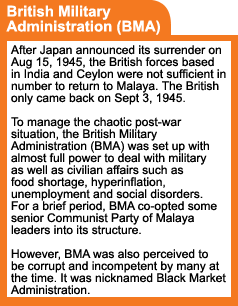
But soon there were anti-hunger demonstrations all over Perak, including in Ipoh and Taiping. According to Suriani, immediately after the war ended, there was inflation, unemployment, shortage of food and public anxiety over the legal status of Japanese wartime currency, and many people became very restless.
In one of the anti-hunger demonstrations in Ipoh, Suriani was elected to be one of the five people's representatives to negotiate with the British Military Administration (BMA) on how best to help the people.
"The British were apologetic, saying that they had just come back and did not have enough resources ... They said the Communist Party of Malaya could help to mobilise resources to feed the people with rice and salted fish."
Meeting with Sukarto
In the post-war months, Suriani was attracted by the Indonesian armed struggle. In her printed biography circulated within the party, it was recorded that, in 1947, she visited Indonesia and met president Sukarno, Shariffuddin (an Indonesian communist who became Sukarno's minister of defence) and other Indonesian communists.
When the 'Emergency' was declared by the British on June 20, 1948, Suriani was transferred by the party to Johor. Later, she was re-assigned to Pahang. Since 1953, she began to be part of the Malay-majority 10th Regiment of the Malayan National Liberation Army and also appointed a member of the military command.
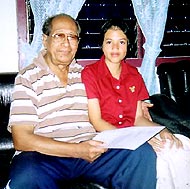 In February 1955, Suriani - whose Chinese name was Eng Ming Ching - married Abdullah CD (
photo, with granddaughter
) and gave birth to a daughter a year later.
In February 1955, Suriani - whose Chinese name was Eng Ming Ching - married Abdullah CD (
photo, with granddaughter
) and gave birth to a daughter a year later.
In 1975, Suriani was elected for the first time as a member of the CPM central committee. Suriani was also a delegate of CPM to Haadyai on Dec 2, 1989 to witness the signing of the peace accords between the party and the Malaysian government.
As CPM chairman, Abdullah CD was one of the three signatories to the peace accords, in addition to Chin Peng and Rashid Maidin.
In 1999, Suriani and Abdullah CD went to Mecca to perform the haj . After the signing of the 1989 Peace Accords, she twice visited Malaysia with her husband. They were once granted an audience by Perak Sultan Azlan Shah.
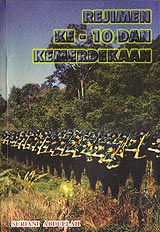 Suriani is also the writer of the official history of the 10th Regiment, entitled
Regimen Ke-10 dan Kemerdekaan
(Hong Kong, Nan Dao, 1999). The book is published in Malay and Chinese.
Suriani is also the writer of the official history of the 10th Regiment, entitled
Regimen Ke-10 dan Kemerdekaan
(Hong Kong, Nan Dao, 1999). The book is published in Malay and Chinese.
Asked if she has ever felt regrets over joining the anti-Japanese resistance which has irreversibly changed her life, Suriani replied with a categorical "no".
"When we began the fight, we were isolated and few in number but when the war ended, our forces had increased to 10,000 with 50,000 civilian activists and reservists. We fought the fascists. We liberated Malaya. I am proud of it," she declared.
In a memorial service held by the Chinese community to honour the memory of 18 resistance partisans in Kuala Lumpur in 2003, it was recalled that during the 44 months of Japanese Occupation, about 70,000 people of all ethnic communities were killed.
Another 80,000 perished as a result of torture and imprisonment, while an additional 300,000 died because of malnutrition and physical exhaustion due to forced hard labour.
Tomorrow: At 87, Rashid Maidin can still crack jokes
JAMES WONG WING ON is chief analyst of Strategic Analysis Malaysia. He is a former DAP member of parliament for Kampar (1990-1995) and a former columnist for the Sin Chew Jit Poh Chinese daily (now Sin Chew Daily ). He read political science and economics at Monash University in Melbourne, Australia.


