




Post-tsunami scenario of conflicts in Aceh and Sri Lanka
While the recent tsunami did not differentiate between ethnic groups and classes in terms of its effect, it nonetheless produced different ways in which countries, groups and classes dealt with conflicts. In other words, it had a differential impact on politics and management of conflicts.
Coincidentally, places like the province of Aceh in Indonesia and Sri Lanka that have witnessed bloody ethnic conflicts over the past two decades were the places that were most devastated by the impact of the tsunami in terms of lives lost and damage to property. While the tsunami internationalized these places by getting the sympathy and concern of the international community and donor agencies, it however did not have the same effect in providing an appropriate framework for the management and resolution of these long-standing nationalist conflicts. On the contrary, the tsunami due to its differential impact might have complicated the resolution of these conflicts, although there are clear differences in the evolution of the political scenario in both these places.
 When the tsunami struck last Dec 26, there was on-going civil war between the forces of GAM (Gerakan Aceh Merdeka, Free Aceh Movement) and the government of Indonesia (GoI). The destruction brought by the tsunami temporarily halted the conflict between them both, especially when some of the camps of the Indonesia armed forces were literally wiped out. The priority given to humanitarian assistance and the relaxation of immigration rules of entry temporarily re-focused the energies of the Indonesian state from war. While the internationalisation of Aceh was more in terms of humanitarian assistance, the need for an early solution to the nationalist conflict was not totally lost. It was in this context, some overtures were made by the Finnish government to bring both the sides to the negotiating table. The first and the second round of talks aimed at resolving the conflict were held in the Finnish capital of Helsinki in February and the third round of talks are scheduled in mid-April.
However, when the talks resumed in Helsinki, the Indonesian armed forces are once against active in the war against GAM. Military assaults, the arrests of innocent citizens and torture are once again employed to weaken and militarily defeat GAM. Although the GoI has not been able to militarily defeat GAM even before the tsunami, it wants to show to the international community that it would not compromise on any challenges to its national sovereignty. According to reliable sources, GAM's guerrilla units are still strong in the hills and the interior; there are no visible signs that it has been weakened by military operations, mass exterminations of villagers, tortures and imprisonments of its members.
While the recent tsunami did not differentiate between ethnic groups and classes in terms of its effect, it nonetheless produced different ways in which countries, groups and classes dealt with conflicts. In other words, it had a differential impact on politics and management of conflicts.
Coincidentally, places like the province of Aceh in Indonesia and Sri Lanka that have witnessed bloody ethnic conflicts over the past two decades were the places that were most devastated by the impact of the tsunami in terms of lives lost and damage to property. While the tsunami internationalized these places by getting the sympathy and concern of the international community and donor agencies, it however did not have the same effect in providing an appropriate framework for the management and resolution of these long-standing nationalist conflicts. On the contrary, the tsunami due to its differential impact might have complicated the resolution of these conflicts, although there are clear differences in the evolution of the political scenario in both these places.
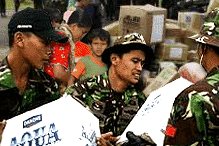 When the tsunami struck last Dec 26, there was on-going civil war between the forces of GAM (Gerakan Aceh Merdeka, Free Aceh Movement) and the government of Indonesia (GoI). The destruction brought by the tsunami temporarily halted the conflict between them both, especially when some of the camps of the Indonesia armed forces were literally wiped out. The priority given to humanitarian assistance and the relaxation of immigration rules of entry temporarily re-focused the energies of the Indonesian state from war. While the internationalisation of Aceh was more in terms of humanitarian assistance, the need for an early solution to the nationalist conflict was not totally lost. It was in this context, some overtures were made by the Finnish government to bring both the sides to the negotiating table. The first and the second round of talks aimed at resolving the conflict were held in the Finnish capital of Helsinki in February and the third round of talks are scheduled in mid-April.
However, when the talks resumed in Helsinki, the Indonesian armed forces are once against active in the war against GAM. Military assaults, the arrests of innocent citizens and torture are once again employed to weaken and militarily defeat GAM. Although the GoI has not been able to militarily defeat GAM even before the tsunami, it wants to show to the international community that it would not compromise on any challenges to its national sovereignty. According to reliable sources, GAM's guerrilla units are still strong in the hills and the interior; there are no visible signs that it has been weakened by military operations, mass exterminations of villagers, tortures and imprisonments of its members.
Bitter lessons
The Helsinki Talks seeks to provide a framework in which both sides could discuss and resolve their problems. The talks are not expected to produce results overnight for the resolution of the conflict, but lay the groundwork for many subsequent meetings. Although it is not clear as to the agenda, there are hints from reliable sources that the both sides are given the opportunity to explore issues relating to autonomy, self government, federalism as to secure the best possible option for the resolution of the problems within an united Indonesia. GAM may not be favourably predisposed to these ideas given its strong stand on the need for a separate state, but it wants to have a dialogue with the GoI and ultimately wants to impress the latter on the need for a democratic solution by way of referendum for the Acehnese people.
GAM has learnt some bitter lessons from the earlier failure of peace talks initiated by the Henry Dunant Center (HDC), a Swedish non-governmental organization, in 2002. The GoI's insistence on autonomy, the naivety of some HDC officials, and the call for decommissioning of weapons were some of the important factors that contributed to derailment of this peace process. Even if GAM does not insist on its ultimate objective, it would certainly steer in the direction of ultimately obtaining a democratic solution and just solution for its people in Aceh.
Before the tsunami struck Sri Lanka, the government of Sri Lanka (GoSL) was coming under increasing pressure from the international community to begin peace talks with the LTTE (Liberation Tigers of Tamil Eelam) on the basis of the latter's interim administration proposal. However, the devastation wrought by tsunami changed the political map of Sri Lanka in general and the attitude of the government of President Chandrika Kumaratunga in particular. Given the international sympathy for the nation as whole, she found it very convenient to delay the peace process.
Moreover the international community's insistence on both the government and the LTTE to agree to a joint mechanism for the distribution and management of funds meant for the Tsunami victims sidestepped the core issue of peace talks.
Recently, the LTTE, it seems, is quite agreeable to the proposal presented by the Norwegian government on the development of the joint mechanism, but the government is still dragging its feet. The division between the JVP (Janatha Vikmuthi Peruma) and the government over various issues such as the joint mechanism for the distribution of the tsunami funds, peace talks with the LTTE and the intentions of the Kumaratunga to amend the Constitution have contributed to the delay in the peace process.
Unlike Aceh, there is ceasefire in place in Sri Lanka between the LTTE and the GoSL arrived in 2002. Although there has been relative peace in the island since the ceasefire, low intensity conflicts are almost daily occurrences especially in the highly sensitive eastern region of Amparai-Batticoloa. The recent killings of some notable members of the LTTE particularly in the eastern region have brought about much tension between the both the parties. While the LTTE is accusing the government and its armed forces for being behind these killings, the latter is putting the blame on some dissident Tamil groups for being responsible.
However, a recent report in one of the influential newspaper in Sri Lanka highlighted the fact that some of the dissident Tamil groups are not operating independently as alleged by the government, but within the vicinity of the army camps.
Failure of government
In the aftermath of the tsunami, whatever goodwill and trust that existed between the LTTE and the GoSL has vanished. The failure on the part of the government to respond positively for the commencement of peace talks, the dragging of its feet on the proposed joint mechanism for the distribution of aid and not the least the killings of selected LTTE personnel in the east have complicated the political situation in the county.
In a recent tour of some European countries, the LTTE's political head, SP Thamilselvan openly told that his outfit has exhausted all avenues for the peaceful settlement of the Tamil problem with the GoSL. Implicitly, he has left to the international community to decide whether the LTTE should go for a separate state or when there is another possible opportunity to engage the government of Sri Lanka in peace talks.
While the political situation for GAM is much less clear than for the LTTE, the former has received some international limelight, thanks to the tsunami. It is going to be a long road for GAM to gain international recognition so that it could effectively represent the interests and aspirations of the four million Acehnese. Furthermore unlike the LTTE which has formidable armed strength and de facto state, GAM strength is not that strong at least in conventional terms. Ultimately, the strength of GAM and its ability to deal with the powerful Indonesian state will depend on factors such as its international profile and armed strength.
The post-tsunami scenario for the management and resolution of conflicts in Acheh, Indonesia and Sri Lanka is not very clear-cut. While the devastation brought by the Tsunami gave international recognition to nationalist conflicts in these places, the way to move forward is not very clear.
In the case of Aceh, an opportunity has been provided for a new round of negotiations between the two opposing forces, although it is not clear whether any solution is insight. Meanwhile, despite the negotiations, the GoI has mounted fresh offensives against GAM positions.
In Sri Lanka, the tsunami gave rise to a sympathy wave that was fully exploited by the government to delay indefinitely the peace process. Even with the change of priority, there has been no substantial progress to get a joint mechanism to function to distribute the Tsunami related funds. And not the least, the systematic killing of selected Tigers have raised doubts of the GoSL's sincerity in going for a negotiated settlement.
P RAMASAMY is a professor of political economy at the Centre for History, Political Science and Strategic Studies, Universiti Kebangsaan Malaysia, and has academic interests in labour, Malaysian politics, globalisation and ethnic/nationalists conflicts. His writings are currently focused on the impact of globalisation on labour and the management of ethnic/nationalist conflicts in Aceh and Sri Lanka.


