




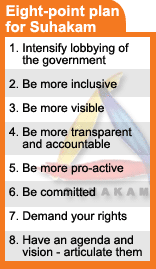
Our eight-point plan for Suhakam
 There are three tiers to the human rights agenda in Malaysia - the first tier: awareness, the second tier: advocacy/articulation and the third tier action - which compels us to progress beyond awareness. We should not rest easy at the first tier.
Whilst there are signs that we are progressing to the second tier, such progress is marked by many stops and starts, and the transition is expected to be an uneven and difficult one. The way to tackle any problem is to firstly identify and acknowledge it. At the moment, we have identified eight areas besetting your role in developing human rights in Malaysia.
1. Intensify lobbying of the government
Our immediate hope for the moment is that you will intensify your lobbying of the government to debate and act on your reports. Surely the intent of Parliament, when designating it your duty, pursuant to section 21 of the Human Rights Commission of Malaysia Act (HRCMA), to submit reports to it, is for the reports to be digested, discussed, debated and acted upon, and not for them to lie abandoned in the August building, collecting dust.
 You should personally and directly lobby government ministers or Members of Parliament to answer issues raised in your reports. It is insufficient to just write letters to them and expect a favourable reply. Just as rights do not fall into people's laps, your right for your report to be taken seriously must be claimed by you. NGOs (non-governmental organisations) and CSGs (civil society groups) can only provide support, you yourself must act on it first.
You should progress from merely issuing general statements on human rights to initiating high-level talks with policy-makers on what is needed to accomplish your human rights agenda. A viable strategy which you should adopt is to call for and hold regular roundtable dialogues and meetings with the government and its departments. This is to ensure constant communication and frequent access in, and effective monitoring of, the implementation of human rights in Malaysia.
We believe the Attorney-General's Chambers has now set up under its International Affairs Unit an International Unit III dealing specifically with human rights and international organisations. These dialogues and meetings should as much as possible, include various interested parties such as the Bar Council, NGOs and CSGs.
 There are three tiers to the human rights agenda in Malaysia - the first tier: awareness, the second tier: advocacy/articulation and the third tier action - which compels us to progress beyond awareness. We should not rest easy at the first tier.
Whilst there are signs that we are progressing to the second tier, such progress is marked by many stops and starts, and the transition is expected to be an uneven and difficult one. The way to tackle any problem is to firstly identify and acknowledge it. At the moment, we have identified eight areas besetting your role in developing human rights in Malaysia.
1. Intensify lobbying of the government
Our immediate hope for the moment is that you will intensify your lobbying of the government to debate and act on your reports. Surely the intent of Parliament, when designating it your duty, pursuant to section 21 of the Human Rights Commission of Malaysia Act (HRCMA), to submit reports to it, is for the reports to be digested, discussed, debated and acted upon, and not for them to lie abandoned in the August building, collecting dust.
 You should personally and directly lobby government ministers or Members of Parliament to answer issues raised in your reports. It is insufficient to just write letters to them and expect a favourable reply. Just as rights do not fall into people's laps, your right for your report to be taken seriously must be claimed by you. NGOs (non-governmental organisations) and CSGs (civil society groups) can only provide support, you yourself must act on it first.
You should progress from merely issuing general statements on human rights to initiating high-level talks with policy-makers on what is needed to accomplish your human rights agenda. A viable strategy which you should adopt is to call for and hold regular roundtable dialogues and meetings with the government and its departments. This is to ensure constant communication and frequent access in, and effective monitoring of, the implementation of human rights in Malaysia.
We believe the Attorney-General's Chambers has now set up under its International Affairs Unit an International Unit III dealing specifically with human rights and international organisations. These dialogues and meetings should as much as possible, include various interested parties such as the Bar Council, NGOs and CSGs.
We note that in pages 177-327 of your Annual Report 2003, you have reproduced the government's responses to your observations and recommendations since your establishment. Whilst this is a good start, some of the government's responses are unsatisfactory. You should not leave the responses as they are but should also follow-up on them, for example, by proposing the aforesaid dialogues and meetings. You must take concrete steps to influence a change in government practices and policies to be in line with human rights norms and principles.
2. Be more inclusive
The Bar Council, NGOs and CSGs are strategic partners in the development of human rights in Malaysia. Whilst there has been some interaction between yourself and some of these bodies, it is not enough. Many times, it is only due to "forced" or ad hoc situations that you all meet and work together.
You should start regular roundtable dialogues and meetings with the Bar Council, NGOs and CSGs on the basis, and for the reasons, stated above vis--vis the government. Some organisations or groups may take the confrontational approach towards human rights policing, but do not ignore them for they too have valid points and are invaluable to your work. You should strive to be more inclusive in this regard. A permanent network with the Bar Council, NGOs and CSGs should be formalised for the benefit of all.
Your meetings with the government should include these partners. A leading example of this model was when Working Group "A" of the Special Commission to Enhance the Operation and Management of the Royal Police Force chaired by Mohd Salleh Abbas held closed-door meetings with representatives of the Bar Council and senior police officers on various laws pertaining to police powers. These were, at times, tense but highly effective discussions and led to a greater understanding of the problems faced by both the police and public on the ground.
The aforesaid represents the next step in the human rights struggle and sets the groundwork for a support system. The resulting dialogue between parties will see a broad range of views being represented, and will further provide you with a credible and useful source of information in your dialogue with the government.
3. Be more visible
We feel that you should be more visible and pro-active in the people's and media's eye. Human rights litigation has boomed in Malaysia. Numerous human rights test cases have been filed or are being litigated. The range of matters litigated include issues of freedom of religion, education rights, child rights, women's rights, preventive detention, death in police custody and native land rights.
Why have you yet to appear through counsel or made representations by way of written submissions to the courts in those cases? You have not attempted to intervene in human rights cases or filed an action in court as a plaintiff for human rights violations so far. Why is that so?
You are the human rights body and the statutory authority on human rights in Malaysia - entrusted to promote and articulate the cause of human rights. As such, taking up such cases would be a clear endorsement of the causes you support. Lawyers have on previous occasions offered their services to you on a pro bono basis for this purpose but you have not taken them up on their offers.
It is common practice in countries such as the UK and the US for human rights groups, such as Amnesty International, Human Rights Watch and Liberty, to appear in court to submit their interventions. This was done, for example, in the Guantnamo Bay detainees' hearings and most recently before the House of Lords in A (FC) and others (FC) v Secretary of State for the Home Department and other appeals [2004] UKHL 56 in respect of the detention in the UK of foreign terror suspects without trial.
Some may argue that section 12(2) of the HRCMA bars you from doing so. We beg to differ. That provision only prevents you from inquiring into a complaint which is already before the court, but to either hold a watching brief or make submissions or an intervention in respect of the complaint in court is a different matter and certainly does not constitute commencing an inquiry within the said provision.
Sadly, the reverse has happened. When a suit was brought against you and some of your commissioners for not commencing an inquiry into the infamous Kampung Medan incident vide Subramaniam Vythilingam v The Human Rights Commission of Malaysia (Suhakam) & Ors [2003] 6 CLJ 175, you resisted the suit and raised, among others, a technical objection that the plaintiff had no locus standi. The court accepted your arguments and the suit was struck out.
Numerous complaints prior to the suit have been lodged with you regarding the Kampung Medan incident. Allegations have been made and evidence of human rights abuses were provided. Without going into the merits of the suit, why did you not commence an inquiry?
The plaintiff wanted an inquiry into a serious complaint and you had the power to commence such an inquiry but you did not do so. Had you commenced such an inquiry, you would have been seen to be carrying out your functions pursuant to your mandate. As it stands, it appears that you abdicated your duty and had to rely instead on technicalities to absolve yourself of blame.
4. Be more transparent and accountable
This brings us to our next point. The people do not know how you decide matters before you. It is valid to ask why you would commence an inquiry into a human rights complaint which appears less serious than the Kampung Medan incident, but not the said incident. Do not get us wrong. All human rights complaints must be looked at and considered. But from the perspective of a layperson, some of your decisions have been puzzling.
We wish you to consider drawing up guidelines, policy principles or checklists on how you decide on matters such as when an inquiry should be held or when an investigation should be taken a step further. Time frames for your action should be given as a yardstick and guide to assist in managing the expectations of complainants. This will provide an objective basis for commissioners present and future to act.
There should be as little secrecy as possible in your decision making. After all, you serve the people. The people should be able to know who decided what and why a decision was made this way or that. Minutes of meetings or at least a summary thereof should be published. We should know who attended the meetings, what was said and who was entrusted to carry out the decisions.
There have also been questions asked about the allowances for, and allocation of funds to, your commissioners. Your silence on this issue is disquieting.
5. Be more pro-active
The human rights cause is not about you, the commissioners, the lawyers, the politicians or the activists. It is about the people. It can only be effective if driven by the people. You have to be more pro-active with the people. You must present the human face of human rights to the people.
You should "go-down-to-the-ground" with the people although we are aware that your commissioners are eminent and "important" people in society. Always start at the grassroots. In this regard, all your Commissioners should be approachable by the people.
You should mobilise the people at planned events. If a peaceful demonstration or protest is called for, you should lead it. You have previously stated in your progressive "Freedom of Assembly" report that you were of the "firm belief that it is definitely possible in present day Malaysia to have peaceful assemblies at which participants voice their views about issues that are a matter of concern for them".
You have further recommended that peaceful assemblies are "a healthy way for members of civil society to express dissatisfaction over matters that affect their lives". Your commissioners are after all protected from any action, suit or prosecution by section 18 HRCMA in the course of their duties carried out in good faith.
You should regularly visit and work with the marginalized groups such as the Orang Asli communities, the estate and plantation workers and the disabled; not just visit them when complaints are made to you.
You should also draw up legal policy papers to critically analyse court decisions in Malaysia from a human rights perspective. These papers will be a useful advocacy and lobbying tool for various NGOs and CSGs.
Human rights concerns cannot survive if they are not published. Your public relations with the media, the people and the international community can be improved. Every human rights concern should be lobbied by you personally with the media in order that it is published, and published accurately. Press statements must be made swiftly and your Commissioners must be more media savvy.
Frustratingly, we have read on numerous occasions that your commissioners made certain press statements only to state, on the next day, that they had been misquoted. There should also not be only a handful of commissioners who act as the spokespersons for you, as is the present trend, but all should speak.
Information from the ground is necessary to ensure urgent responses to any incident. You should demand that every governmental organisation have a liaison officer assigned to deal with you, and that the Attorney-General's Chambers establish a human-rights desk.
You should dedicate funds for a Suhakam human rights page or advertisements in every major newspaper. Human rights advertisements are frequent in Thailand. The advertisement we last saw was in the Bangkok Post , Nov 18, 2004, where a full page was taken out for the remembrance of the 18 Thai conservationists and human rights defenders who had been killed. It was titled "As the World Conservation Congress meets in Bangkok today to work for "a just world that values and conserves nature", what has been happening in Thailand these past few years?". Pictures of each activist were printed together with short summaries of their work below the pictures.
6. Be committed
We question the commitment of some of your commissioners who are too engaged with their other responsibilities and neglect their duties at Suhakam. Such neglect raises concern of how seriously you are regarded by your own commissioners. Why were there no commissioners to receive the urgent complaints from the family members of the Simpang Renggam detention camp hunger strikers?
There have been occasions when the commissioners receiving the complaints were not even aware of what the complaints were about even after the incident was widely reported in the media! We humbly suggest that it is time all commissioners be appointed on a full-time basis.
If your commissioners are not committed, they should not continue to be appointed. When we say committed, we mean committed to the human rights cause. You do not need commissioners who are there to ride the wave and use you as a vehicle for personal advancement. You do not need commissioners who will take an idea which is not theirs, and re-package it for themselves and use it to gain personal publicity.
You do not need commissioners who do a disservice to the human rights movement by whitewashing human rights abuses by the government. For NGOs and CSGs to provide "report cards" on your commissioners, information is needed and that is why we call for more transparency in respect of your meetings as stated above.
Your commitment must be beyond doubt. Your "turn-around" time must be swift in terms of processing of and responses to complaints. Further, you have been very quiet on the issues of religion, constitutionalism and the Islamic state in Malaysia. Why? Have you attempted to initiate any inter-faith dialogue or even restate the human rights position on these issues? The Bar Council, along with the NGOs and CSGs have already done so. Your input would be useful in this ongoing debate and your lack of participation is acutely missed.
7. Demand your rights
Just as you set out commendably to educate the people to insist on their rights, you too should do the same where necessary. At present, you lack wide-ranging investigatory and enforcement powers. That should be looked into. You should study the HRCMA and propose changes in line with the above suggestion. You also definitely require more funds and staff. Ask for them.
8. Have an agenda and vision - articulate them
We are of the view that only with a structured agenda and vision will you be effective in you work. The "anything-goes" period is over. You cannot forever be "fire-fighting" which is short-term and ad hoc in effect. You need to draw up two blueprints for the future, mapping out your agenda and goals for the future. One blueprint will cover your work for the next five years and the other for the next 10. These blueprints should bind successive commissioners and will give, not only the people, the NGOs and the CSGs, but also the government, a clear picture as to your direction and development.
The blueprints should include an immediate "shopping list" of what you would like the Government to implement in the next five years or less. Whilst all rights are equally important, they need to be prioritised in accordance with your resources. A list should be drawn up, setting down the issues which you think are the most imperative and realistically achievable at the moment. It could be freedom of the press by abolishing certain restrictive laws, or detainees' rights such as reducing the number of days a person may be remanded pending investigations.
Of course, there should be greater emphasis on the your educational role in Malaysia. Human rights will only prevail when its beneficiaries (i.e. the people) value and appreciate them. Children are an important target group as they are the future of Malaysia. It is encouraging that you are in the midst of completing the human rights syllabus to be incorporated in the national education curricula. We propose that you seek the assistance of the NGOs and the CSGs who have immense experience in training human rights defenders.
Further, there should be greater articulation of your position on the argument that human rights is a Western, rather than Asian concept. The negative connotations of human rights as being anti-establishment, or even anti-Asian should be tackled; as it is anything but. The preservation of human rights is in accordance with the vision of Malaysia's founding fathers, and its spirit is encapsulated in the Federal Constitution, the bedrock of the country's system of government.
The idea of human rights is not unique to the West, but is a universal concept and exists in Confucian and Muslim traditions inasmuch as in Judeo-Christian tradition. The fundamental ideas are universal and cannot be monopolised by any one culture or tradition. Malaysians have the right to freedom of speech, just as Americans do, because we are all sentient beings, each with our own thoughts and ideas.
More education is needed on this as the recent Statement by Syed Hamid Albar, the minister of foreign affairs to the 61st Session of the United Nations Commission on Human Rights on March 14, 2005 at Geneva revealed. On behalf of Malaysia, the honourable minister resisted the recommendation of the United Nations to prepare an annual report on the situation of human rights worldwide in view "of the varying human rights perspectives and different political, historical, social, religious, cultural and developmental characteristics".
Yet, in the same breath, he maintained that not enough is being done to address poverty, underdevelopment, marginalisation and instability as "the universality and indivisibility of all human rights have been accepted as far back as 1993, at the Vienna World Conference on Human Rights". This statement is a contradiction in terms.
Once formulated, the blueprints should be published as an indication of your commitment to staying relevant in the development of human rights in Malaysia. We recognise that the challenges and obstacles facing you are enormous. The Sept 11 attacks leading to increased human rights violations on a global scale have not helped. The struggle for human rights is never-ending. You must not waver in the face of adversity. We hold strong to the belief that, just like us, as an institution created to protect human rights, you too share our optimism.
We trust we were able to offer you some useful thoughts for your attention. We believe your success is integral to the nation's efforts to become a truly democratic nation by 2020. We fervently hope that, just as we are today proud of our nation, we can one day be equally proud of our nation's achievements in the area of human rights.
The nation's stability, harmony, development and progress go hand in glove with the development of human rights of all Malaysians. Though a measure of basic goals such as creating awareness and heightening discourse has been achieved, much more awaits completion.
We remain incorrigible optimists and thank you for taking the time to read our letter.
We very much look forward to hearing from you.
Part 1: An open letter to Suhakam
NIK NAZMI NIK AHMAD comments on current issues, and contributes to the BBC World Service, Channel News Asia and malaysiakini , among others. EDMUND BON, a lawyer and a human rights advocate, is a lover of life and liberal freedom.


