



Dirty cash is the root of all evil
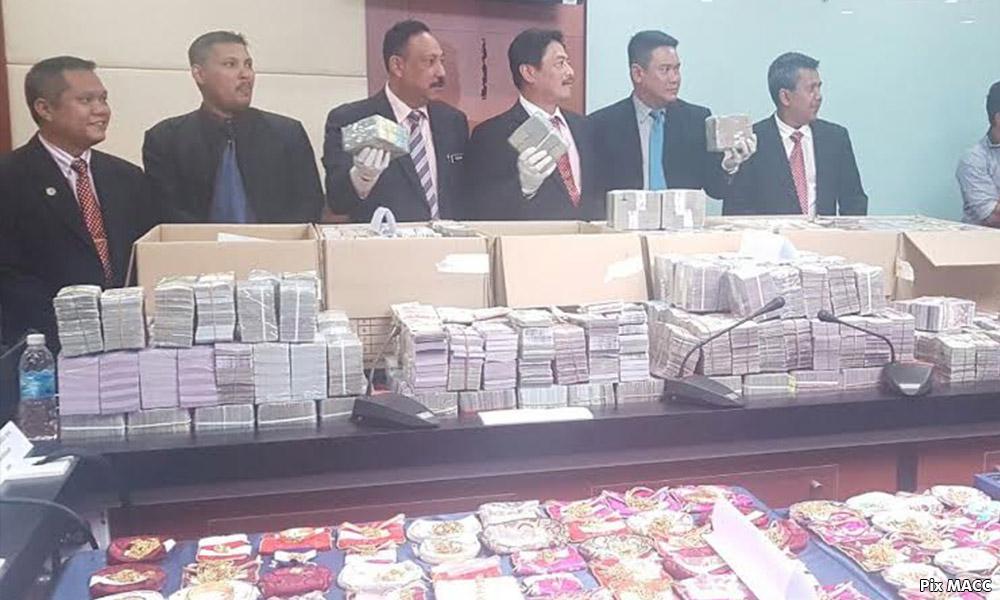
Cash seems to be the trending word of the times. Dirty cash, to be more exact. Millions and billions of it can be found everywhere these days, from clothes and television cabinets, to office rooms and shop lots.
The photos of the stacks of cash that we’ve seen in the media recently sure looks beautiful if we could get our hands on it. Imagine what we could do with it. We could help the poor, improve the country’s infrastructure, subsidise education, create better public transport, etc.
Even better, we could also use that money to go for luxurious holidays, build and renovate mansions, buy expensive sports cars, splurge on expensive branded handbags or marry trophy wives. It depends on what your priority is.
The point here is that everyone can be tempted with cash. It is just so easy to steal, bribe embezzle, hide, stash and do whatever with it. Case in point, look at what happened in Sabah recently with the two top officials of the Sabah Water Department.
If you want an even higher profile case, look no further than the 1MDB scandal that is plaguing Prime Minister Najib Abdul Razak right now. Yes, it’s just too tempting and too easy. It’s like saying, hey, if I can do it, then you can do it too.
That’s why I find what economist Kenneth Rogoff said in an interview with Stephen J Dubner on the Freakonomics podcast so fascinating. He is suggesting that the world go entirely cashless (or cash-less, to be exact) for obvious reasons.
Rogoff, who is a professor at Harvard University and former chief economist at the International Monetary Fund (IMF), says that when there is no cash circulating, there will be less opportunity for tax evasion, money laundering or even just plain theft and robbery...
Cash seems to be the trending word of the times. Dirty cash, to be more exact. Millions and billions of it could be found everywhere these days, from clothes and television cabinets to office rooms and shop lots.
The photos of the stacks of cash that we’ve seen in the media recently sure looks beautiful if we could get our hands on it. Imagine what we could do with it. We could help the poor, improve the country’s infrastructure, subsidise education, create better public transport, etc.
Even better, we could also use that money to go for luxurious holidays, build and renovate mansions, buy expensive sports cars, splurge on expensive branded handbags or marry trophy wives. It depends on what your priority is.
The point here is that everyone can be tempted with cash. It is just so easy to steal, bribe embezzle, hide, stash and do whatever with it. Case in point, look at what happened in Sabah recently with the two top officials of the Sabah Water Department.
If you want an even higher profile case, look no further than the 1MDB scandal that is plaguing Prime Minister Najib Abdul Razak right now. Yes, it’s just too tempting and too easy. It’s like saying, hey, if I can do it, then you can do it too.
That’s why I find what economist Kenneth Rogoff said in an interview with Stephen J Dubner on the Freakonomics podcast so fascinating. He is suggesting that the world go entirely cashless (or cash-less, to be exact) for obvious reasons.
Rogoff, who is a professor at Harvard University and former chief economist at the International Monetary Fund (IMF), says that when there is no cash circulating, there will be less opportunity for tax evasion, money laundering or even just plain theft and robbery.
He is suggesting a system where all payments and money transactions are done digitally and no individual will ever have to use physical cash for anything any more. There are many ways to do this and we can see that, even in Malaysia, attempts at going cashless have already been going on.
We have many examples, such as our Touch ‘n Go system, debit and credit cards, the never-ever-ever-used MEPS cash system and even international e-payment platforms like PayPal that allow us to actually go cashless if we really wanted to.
Under-table money
When everything goes digital and cashless, all our financial transactions will be documented and that, for one, will definitely reduce the risk of manipulation if physical cash was used, which could be done without any records.
There won’t be cash lying around to be distributed during the election season. There won’t be cash that can be handed out ‘under the table’. And there won’t be cash anywhere that thieves and robbers could go around trying to steal and rob.
It could even solve the problem of illegal foreign workers because there won’t be physical cash that can be used by employers to pay their employees off the record. So it does seem cash is the root of all evil! Let’s just get rid of it.
Of course, for societies to go cashless won’t be as easy as it sounds. Currently, there are no holistic systems that can actually facilitate going totally cashless. It is more feasible for larger sums of financial transactions but not for small ones.
Those who are of a lower income level might need to use physical cash in their transactions and if there are no inclusive cashless system, then they would be the first group that will suffer and be oppressed. We can’t have that.
People in general also would experience a culture shock if they suddenly couldn’t have any cash to carry in their wallets or purses. You might be familiar of the Malay term ‘duit semangat’ which refers to a person having at least a few ringgit in the pocket if he or she leaves the house.
Rogoff suggests that cash should be reduced in gradual stages with the large cash denominations being taken out of circulation first. Remember the pictures of the cash from Sabah? Notice that the bulk of the colours were the purple of RM100 and green of RM50.
So this is where the proposal to go cash-less (as in less of cash circulating) rather than cashless (with no physical cash in the system at all), will be a good idea. Personally, I try to conduct all my financial transactions with my debit or credit card. Holding cash is just too troublesome.
But what I do find weird is that there was just an insane amount of hard cold cash in the houses and offices of the two Sabah Water Department officials. It just seems too comical to be real, if you know what I mean.
If they are smart enough to be on the take for so long and for so much money, then they should be smart enough to not have it all on them like that, right? To me, it just smells really fishy and there has to be something more than meets the eye here.
ZAN AZLEE is a writer, documentary filmmaker, journalist and academic. He hates having too much cash in his wallet because it makes it uncomfortable to sit. Visit FATBIDIN.COM to view his work.


