


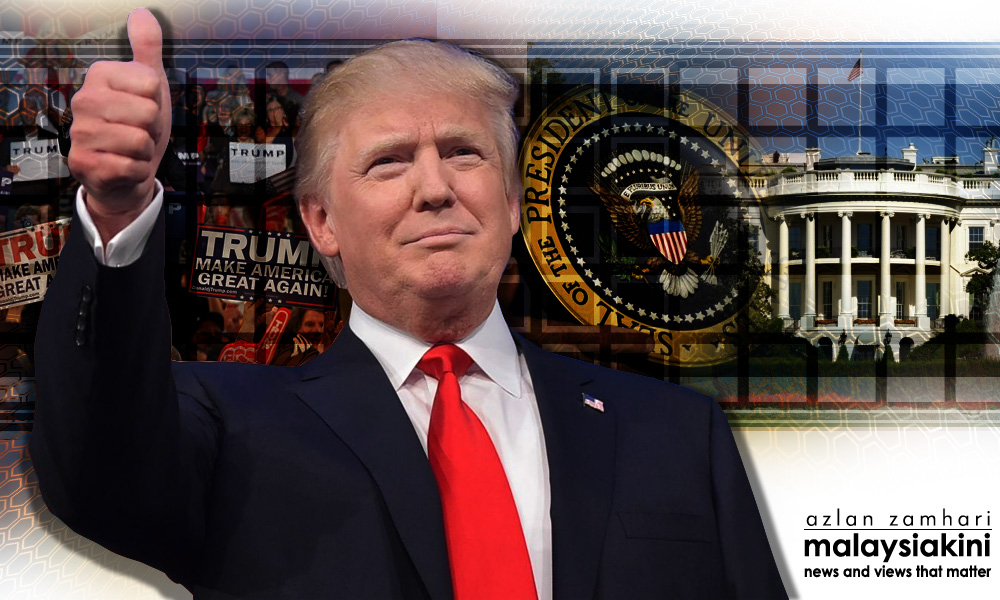

President Trump versus candidate Trump
A terribly anxious world watches as Donald Trump prepares to become the 45th president of the United States, the sole, undisputed, supreme global power. His own people are hopelessly polarised. His statements and conduct since his victory have not allayed that half of the electorate that did not vote for him.
The unprecedented protests in numerous cities post-elections are testament to the fear of ordinary, decent Americans of what is to come following the hate driven campaign he designed and carried out so effectively.
So how would Donald Trump actually exercise his immense powers? Even if there is an established convention in the United States that a president is judged by his election manifesto, like other conventions they do not apply to Trump: a sui generis, maverick candidate par excellence.
Throughout the very long campaign, first, to secure the Republican nomination, then the presidency, Trump never cared for truth or facts. Outrageous, extraordinary statements, without regard to any evidence, were the hallmark of his campaign. Modern society does not seem to lay down markers for lying politicians, and they do not seem to suffer any consequences.
But even by the low standards expected of politicians, there are few politicians in recent times who are so duplicitous, devious and deceitful as Trump. Despite his remarks being on record in today’s Twitter, online world of instant newsfeed, he is prepared to blatantly lie or spin the most incredible yarn. This seems to be a severe character trait. So why should anyone expect him to act on his promises or place any weight on any of his campaign statements?
It is a cardinal rule of politics that one does not know how a president or prime minister will actually discharge his duties until he is appointed to the office. His true character and personality only emerges after he is secure in office, and it is then too late to remove him.
Margaret Thatcher was a terribly unimpressive, quiet education minister in the Edward Heath administration. No one expected her to turn into the controlling, dominant personality that she became as prime minister.
Ask Dr Mahathir Mohamad about how Abdullah Ahmad Badawi and Najib Abdul Razak transformed beyond belief after becoming prime minister. He would describe their changes as unrecognisable. With that important caveat, what will his administration be like?
There are at least two possible scenarios. First, that Trump governs without any regard to his past statements. In other words, President Trump will be very different from campaign/candidate Trump. Alternatively, he may act on some of the issues consistent with his campaign positions, particularly, when they resonate with his hard core Rust Belt electorate. Three areas are discussed - economy, foreign affairs and treatment of minorities.
In the event, Trump feels confident that he has an absolutely free hand to govern without being constrained by his remarks, a ‘carte blanche’ indeed. I suspect he is first, and foremost, a deal maker and a free market businessman.
Two different colliding interests would come to play - the Trump family business and the nation’s economy. Since he has never been concerned about ‘conflict of interest’, a subject that is inconvenient and therefore does not apply to him, he will not draw any line between the two.
National, business interests will merge
The national interest and his business interests will merge. Trump will use the presidency to strengthen and expand the family business. The catchword will be ‘Trump is Open for Business’, in every sense of the word. Thus, the criticism that he levelled at the Clinton Foundation because Hillary Clinton met foreign leaders in exchange for donations will be ignored, and he will do exactly that.
A terribly anxious world watches as Donald Trump prepares to become the 45th president of the United States, the sole, undisputed, supreme global power. His own people are hopelessly polarised. His statements and conduct since his victory have not allayed that half of the electorate that did not vote for him.
The unprecedented protests in numerous cities post-elections are testament to the fear of ordinary, decent Americans of what is to come following the hate driven campaign he designed and carried out so effectively.
So how would Donald Trump actually exercise his immense powers? Even if there is an established convention in the United States that a president is judged by his election manifesto, like other conventions they do not apply to Trump: a sui generis, maverick candidate par excellence.
Throughout the very long campaign, first, to secure the Republican nomination, then the presidency, Trump never cared for truth or facts. Outrageous, extraordinary statements, without regard to any evidence, were the hallmark of his campaign. Modern society does not seem to lay down markers for lying politicians, and they do not seem to suffer any consequences.
But even by the low standards expected of politicians, there are few politicians in recent times who are so duplicitous, devious and deceitful as Trump. Despite his remarks being on record in today’s Twitter, online world of instant newsfeed, he is prepared to blatantly lie or spin the most incredible yarn. This seems to be a severe character trait. So why should anyone expect him to act on his promises or place any weight on any of his campaign statements?
It is a cardinal rule of politics that one does not know how a president or prime minister will actually discharge his duties until he is appointed to the office. His true character and personality only emerges after he is secure in office, and it is then too late to remove him.
Margaret Thatcher was a terribly unimpressive, quiet education minister in the Edward Heath administration. No one expected her to turn into the controlling, dominant personality that she became as prime minister.
Ask Dr Mahathir Mohamad about how Abdullah Ahmad Badawi and Najib Abdul Razak transformed beyond belief after becoming prime minister. He would describe their changes as unrecognisable. With that important caveat, what will his administration be like?
There are at least two possible scenarios. First, that Trump governs without any regard to his past statements. In other words, President Trump will be very different from campaign/candidate Trump. Alternatively, he may act on some of the issues consistent with his campaign positions, particularly, when they resonate with his hard core Rust Belt electorate. Three areas are discussed - economy, foreign affairs and treatment of minorities.
In the event, Trump feels confident that he has an absolutely free hand to govern without being constrained by his remarks, a ‘carte blanche’ indeed. I suspect he is first, and foremost, a deal maker and a free market businessman.
Two different colliding interests would come to play - the Trump family business and the nation’s economy. Since he has never been concerned about ‘conflict of interest’, a subject that is inconvenient and therefore does not apply to him, he will not draw any line between the two.
National, business interests will merge
The national interest and his business interests will merge. Trump will use the presidency to strengthen and expand the family business. The catchword will be ‘Trump is Open for Business’, in every sense of the word. Thus, the criticism that he levelled at the Clinton Foundation because Hillary Clinton met foreign leaders in exchange for donations will be ignored, and he will do exactly that.
Corrupt authoritarian leaders will be welcome at the White House for a photo-session after the suitably million dollar donation is made to the Trump foundation. This is laissez faire capitalism at its best.
As far as the nation’s economy is concerned, the policies would reflect free market principles, befitting a life-long businessman schooled in Wharton. Three priorities are clear. First, repealing regulations for the Wall Street bankers who, despite causing the 2008 global financial crisis, are angry with the minimal legislation introduced by the Barack Obama administration as a sop to public opinion.
Secondly, reducing taxation for the rich elite class that he belongs to. Finally, repealing environmentally-friendly legislation to promote fracking and the building of pipelines for the benefit of the oil industry. All these measures can be taken in the name of respectable conservative free market policies, with minimal governmental interference. The mantra will be - the market is good, and government is bad.
As to his trade policies, how much room he has in the North American Free Trade Agreement (Nafta) re-negotiations with Canada and Mexico will be interesting to observe. Trump will use a carrot and stick approach with Mexico - the wall, the illegal immigrants and Nafta. How much protectionism returns is an open question.
Punishing China as an alleged currency manipulator and imposing 40-45 percent tariff for Chinese goods to be imported into the United States may remain campaign rhetoric, particularly since Beijing is aware that ‘Trump is open for business’ and can be charmed/compromised. After all, China has a brilliant track record in wooing foreign leaders, whether in Africa, Europe, the Philippines or Malaysia.
They are also the largest holders of US debt, and as creditor, China has substantial bargaining leverage.
In foreign affairs, Trump’s softer approach to Vladimir Putin is actually good for world peace. It must be recalled that President Roosevelt had excellent working relations with Joseph Stalin during World War II in their alliance to defeat Hitler. The Cold War only began with Roosevelt’s unfortunate death in April 1945, to be succeeded by the inexperienced hawk, Harry Truman.
Easing global tensions
The resulting Cold War bedeviled superpower relations for some 60 years. Even the fall of the Berlin Wall and the break up of the Soviet Union did not improve their relations. Trump is in an ideal position to pursue productive dealings with Putin which can ease global tension.
The first target for any joint action by them would be Islamic State (IS), which would receive widespread support. Putin can also be a power broker between Trump and Xi Jinping, China’s paramount leader. Reduction of tension between the United States and China, both in the economic front and in the geo-military sphere, is beneficial for the rest of the world. Hopefully, it would also result in less tension in the contested waters of the South China Sea.
The greatest concern of a Trump administration is how non-white minorities would fare - the Latinos, Blacks and Muslims. His appointment of white supremacist Steve Bannon for a key counsellor’s position in the White House does not augur well for minorities. They are easy targets for a populist President who has earned a mandate from the majority of the majority voters, the whites.
The latter are not limited to the red-neck, working class, non-college educated, male, white population. Millions of rich well-educated whites of both genders supported Trump. He is not going to disappoint this solid vote bank. After all, he needs their support for congressional elections in two years, and his own re-election in four years.
The only issue is how far he would go. He has tremendous power in his executive capacity. With the Republicans controlling Congress, enacting or repealing legislation will be easy.
Another concern is a Trump attack on democratic values which have enriched US society - free speech, media, right to protest, abortion and other rights of women, academic freedom, etc. But this is also the land of McCarthyite witch-hunt for ‘perceived’ enemies of the state.
His first act would be to nominate an extremely conservative judge to the Supreme Court. Because Trump is not a natural politician comfortable with personal attacks as being part and parcel of ordinary policies in a western liberal democratic system in the widest sense (indeed he has an incredibly thin and sensitive skin) he would be intolerant of dissenters and protesters.
Trump is a natural demagogue with authoritarian tendencies. That is how he has controlled his business empire for half a century. His character has been clearly developed, and he is not going to change. Why should he, after all it has propelled him to the most powerful public office in the world. And he is averse to advice. Thus, the road to fascism is highly probable.
New meanings will have to be given to the terms ‘nepotism’, ‘cronyism’ and ‘kitchen cabinet’. Apparently, his three children are being considered for cabinet or other high posts and security clearance sought for them. They would literally be in the White House kitchen making the big decisions for the nation and the family.
Trump has become the commander of the most powerful nuclear armed battleship in the world’s history, sailing across unchartered waters. Leon Trotsky’s famous quip that those who desire a quiet life did badly by being born in the 20th century, can be applied with greater vigour for the coming four Trump years, nay eight years of the 21st century.
Part I: Ascendancy of racial politics - Trump's predictable victory
TOMMY THOMAS is a senior lawyer, who occasionally writes on political and economic matters.


