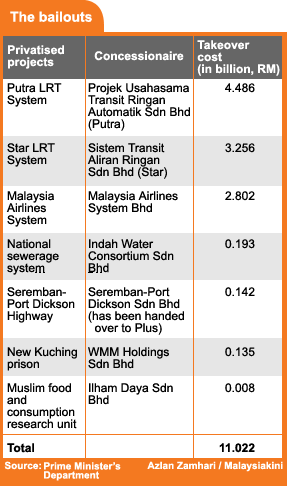
Come one, come all to the Bolehland bailout bazaar!
The cult and culture of privatisation continues in Bolehland. It is being pushed, promoted and peddled by the present government, one which won the general election on a platform of change, but with little to show except for the prime minister's towering humility.
The country's assets are placed in the hands of the handpicked children, 'cousins', cronies and courtiers of the political elite. Only a year in existence, and they are out to sell the last bits of the country's silver.
The promises of privatisation are played up to the full as profitable public utilities are turned into private monopolies as the process of privatisation ironically paves the way for lesser accountability and transparency.
Privatisation's costly price will, quite evidently and eventually, be paid by the people and their children. Blessed are the young, for they shall inherit the country's debts.
The cult and culture of privatisation continues in Bolehland. It is being pushed, promoted and peddled by the present government, one which won the general election on a platform of change, but with little to show except for the prime minister's towering humility.
The country's assets are placed in the hands of the handpicked children, 'cousins', cronies and courtiers of the political elite. Only a year in existence, and they are out to sell the last bits of the country's silver.
The promises of privatisation are played up to the full as profitable public utilities are turned into private monopolies as the process of privatisation ironically paves the way for lesser accountability and transparency.
Privatisation's costly price will, quite evidently and eventually, be paid by the people and their children. Blessed are the young, for they shall inherit the country's debts.
Contrary to what is often portrayed, the history on privatisation in Bolehland speaks little of benefits but far more of huge debts by conglomerates and costly and controversial bailouts by the government.
Often the objective of reduced fiscal burden on the government has backfired, with the government having to pay higher costs with public funds to bail out failed privatisations. We see this in the results of the 'mindless privatisation' of the Mahathir years.
Lest we forget, below are some examples of the wheels of the privatisation express having come off the rails and the people having to pay the price for the privatisation derailments. It's about time that the ' tell-me-the-truth ' prime minister faces the truth about privatisation.
IWK: Pure pong
The citizens of Bolehland can still remember what a stink the former government raised with its RM200 million bailout of Indah Water Konsortium (IWK), the financially hobbled concessionaire managing the national sewerage system.
But that was not all that the country had lost. According to then DAP national chairman Lim Kit Siang, the soft loans granted by the government to IWK amounted to about RM1.4 billion and they were 'clearly irrecoverable losses'.
KPB: Sunken ship
Who can forget former prime minister's Dr Mahathir Mohamd's rescue of Konsortium Perkapalan Bhd (KPB), then owned by his son Mirzan, which was submerged in debts of about RM1.7 billion, by using funds from Petroliam Nasional Bhd (Petronas)?
The Petronas-controlled national shipping carrier Malaysian International Shipping Corporation Berhad (MISC) was used to acquire KPB's shipping assets with cash said to be as much as RM1 billion.
Proton: Sad saga
 The previous government fueled controversy by using Petronas funds yet again to buy 27 percent of the national car maker
Perusahaan Otomobil Nasional Bhd
, or Proton, for about RM1 billion, thereby making it the controlling shareholder.
The previous government fueled controversy by using Petronas funds yet again to buy 27 percent of the national car maker
Perusahaan Otomobil Nasional Bhd
, or Proton, for about RM1 billion, thereby making it the controlling shareholder.
The stake was held by the DRB-Hicom Group Bhd, which was deeply in debt. The deal was announced after Proton, reported a net loss of RM19 million in the nine months to December 31, 1999.
MAS: Ailing airlines
The government bought back a controlling stake in the Malaysia Airlines System Bhd (MAS) at the same price for which it sold it in 1994. But the carrier, which had a light debt load then, was grounded by its RM9.5 billion debt and was headed for a fourth straight year of losses. Bankruptcy was imminent.
It was believed that the government paid close to RM1 billion more than market value for the stake of the airline's then chairman, Tajudin Ramli, a protg of then finance minister Daim Zainuddin. The former chairman had no experience in the airline business before he took over the company and was widely blamed for running the airlines into the ground.
Time dotcom: Damned dot
 The manner in which the government rescued
Time dotCom
, a subsidiary of Time Engineering (then saddled with a RM5 billion debt), itself a publicly-listed company of the Umno-linked Renong Group, added yet another ugly dot to its integrity. In a land where anything is possible, Bolehlanders watched in disbelief when:
The manner in which the government rescued
Time dotCom
, a subsidiary of Time Engineering (then saddled with a RM5 billion debt), itself a publicly-listed company of the Umno-linked Renong Group, added yet another ugly dot to its integrity. In a land where anything is possible, Bolehlanders watched in disbelief when:
- Kumpulan Wang Amanah Pencen (KWAP) or the Pensions Trust Fund (which came under the office of then finance minister Daim Zainuddin) coughed up RM904 million to buy 273.9 million unwanted Time dotCom shares, incurring an instant loss of RM280 million.
LRT: Ride over rails
The rakyat was again taken for a ride over the privatisation express when, in another privatisation reversal, the government raised RM6 billion (in what was known as Malaysia's biggest-ever rescue via bond issue) to bail out Kuala Lumpur's light-rail transit operators Projek Usahasama Transit Ringan Automatik Sdn Bhd (Putra) and the Sistem Transit Aliran Ringan Sdn Bhd (Star) .
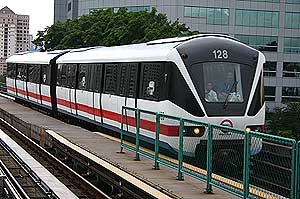 Putra, which belongs to Renong Bhd (former Umno's investment arm), defaulted on its RM2 billion loan in 1999. The government through the EPF again, gave Star more than RM600 million in loans even when the company was operating at a loss resulting in EPF's equity stake of RM135 million being subsequently written off.
Both companies were allowed to continue to operate and manage the LRT systems despite their mismanagement and incompetence. Taxpayers had to foot the mega-bills.
PSC/Navy project: Troubled waters
Recent reports have it that Pak Lah is trying to unwind the country's biggest privatised contract, a problem-plagued RM24.3 billion deal (signed in 1998) for navy patrol vessels awarded to PSC Industries Bhd , a Malaysian company controlled by Amin Shah Omar Shah.
The deal, which also gave PSC control of the government's main naval shipyard and the exclusive rights to service the Malaysian Navy's entire fleet, was intended to be the springboard for Malaysia to create its own marine-engineering industry.
The government, which already has advanced more than RM2.5 billion to PSC, is increasingly skeptical that Amin Shah can deliver the patrol vessels. The first two ships built by PSC have failed to pass pre-delivery trials. PSC itself is in deep financial trouble.
Gov't bails, public wails
Other bailouts which bewildered the citizens of Bolehland included the following:
-
 the perceived
bailout of Renong/UEM
with the EPF's acquisition of UEM equity and UEM's subsequent securing of a RM800 million loan from government and well-connected banks such as Malayan Banking, Bank Bumiputra, Bank of Commerce and RHB to implement a controversial purchase of Renong equity from the company's executive chairman Halim Saad.
the perceived
bailout of Renong/UEM
with the EPF's acquisition of UEM equity and UEM's subsequent securing of a RM800 million loan from government and well-connected banks such as Malayan Banking, Bank Bumiputra, Bank of Commerce and RHB to implement a controversial purchase of Renong equity from the company's executive chairman Halim Saad.
Rope to hang
In light of the depressing scenario described above, the decision by Pak Lah's government to privatise basic services like water and healthcare (which runs contrary to assurances made before the last general election), can only be seen as defying all logic and wisdom.
The string of de-privatised projects make evident the fact that continued privatisation would only serve as more rope for this country to hang itself economically. Privatisation in Bolehland has brought more failure than fortune, more bailouts than benefits.
The only thing that the public gains is private debts. The only clear reality is that the government continues to lack transparency and accountability. This country cannot afford to have more bailouts.
All that glitters is not gold including privatisation - will Pak Lah listen to these truths?
MARTIN JALLEH is a writer and researcher in a non-government organisation. Not affiliated to any political party, he believes that every Malaysian should care enough for his/her country by speaking up and standing up for the truth.
MORE RECENT BAILOUTS