




Higher education: How Indian Msians lose out
Admission to higher education remains and will remain the most controversial, sensitive and problematic aspects of inter-ethnic relations in Malaysia. It is really not so much about education per se, but rather the growing perception among some groups and classes that it has been politicised, manipulated and reconfigured under changing circumstances to suit certain political and ideological interests.
In a more specific sense, given the centrality of ethnic politics in Malaysia, higher education is seen as a vehicle by all ethnic groups as the means for upward socio-economic mobility, status and power. However, if access to higher education is denied or seen to be denied to some groups and opened up for other groups, then it would be become highly politicised.
In this context, the recent decision of the Malaysian Medical Council (MMC) to de-recognize Ukraine's Crimea State Medical University (CSMU) has come to be interpreted by the Malaysian Indian community and to some extent the Chinese community as an attempt to deny medical education opportunities for non-Malays as a whole. It is this perception and the historical squeezing of education opportunities in local universities for non-Malay students that have fueled the present controversy over the de-recognition issue.
Admission to higher education remains and will remain the most controversial, sensitive and problematic aspects of inter-ethnic relations in Malaysia. It is really not so much about education per se, but rather the growing perception among some groups and classes that it has been politicised, manipulated and reconfigured under changing circumstances to suit certain political and ideological interests.
In a more specific sense, given the centrality of ethnic politics in Malaysia, higher education is seen as a vehicle by all ethnic groups as the means for upward socio-economic mobility, status and power. However, if access to higher education is denied or seen to be denied to some groups and opened up for other groups, then it would be become highly politicised.
In this context, the recent decision of the Malaysian Medical Council (MMC) to de-recognize Ukraine's Crimea State Medical University (CSMU) has come to be interpreted by the Malaysian Indian community and to some extent the Chinese community as an attempt to deny medical education opportunities for non-Malays as a whole. It is this perception and the historical squeezing of education opportunities in local universities for non-Malay students that have fueled the present controversy over the de-recognition issue.
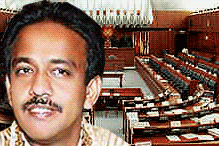 The matter was raised in Parliament and even the otherwise tame MIC members broke ranks to question the sincerity behind the government decision to deny recognition to CSMU. S Sothinathan, the deputy minister for natural resources and environment was suspended by the ruling coalition for breaching the code of ethics, which forbids ruling party members from questioning one another.
From the time of political independence to the present, access to university education has been a very controversial and sensitive issue. There was always the feeling within the conservative Malay circles that Malay upward socio-economic mobility and the formation of a professional class among them faced strong competition from non-Malays.
A sort of compromise
Even before the introduction of the NEP, some powerful Malays within Umno even contemplated the thought of limiting non-Malays access to higher education so as to facilitate the entry of Malays. However, with the onset of the NEP era, with political power virtually in the hands of Umno, the government in power became confident that it would be able to use political power to enhance the political, administrative, economic and educational status of Malays in general.
It was during the NEP era that a sort of compromise was reached by Umno and non-Malay political parties that access to higher education would be determined by a quota system. Although the quota system might not have be really operative in the true sense, it nonetheless allowed for more or less fixed entry of Malays and non-Malays into the public universities.
However, the aggregate figures of ethnic entry into the public universities did not reflect the true picture of the actual distribution of students in various faculties and departments. It was found that during the NEP era and beyond, the strong role of the government ensured that Malay students would be favoured to gain entry into critical disciplines such as medicine, dentistry and sciences. While not many qualified non-Malay students entered into the critical disciplines of their choices, the presence of a quota system assured a minimum representation.
Moreover the availability of educational opportunities in critical disciplines such as medicine in places like India, Singapore, Taiwan and the developed countries assured the non-Malays that opportunity was no completely lost. The most critical factor was the cost of education. India soon emerged as the top choice for many non-Malay students particularly Indians because of the opportunity to pursue education in medicine and dentistry at a reasonable cost.
 Large number of Indians students who did get into local Malaysian universities flocked to India to study medicine and dentistry. The Malaysian government's recognition of some of the universities facilitated the entry of Malaysia students who felt assured that would not face difficulty once they returned back to engage in their profession.
In the 1990s and early 2000, non-Malays particularly Indians were beginning to experience problems in terms of pursuing cheap medical education in places like India. Indian government's regulation of foreign student intake into state universities and the rising cost of private medical schools posed problems for non-Malay particularly Indians coming from lower socio-economic backgrounds. It was during this time, many students started exploring the possibility of pursuing education in places like Indonesia, Trinidad and in the former Soviet republics such as Ukraine and others.
With the formation of student recruitment agencies, medical schools in Russia and Ukraine were aggressively promoted by these agencies with the objective of making quick profit. Since the demand for cheap medical education was high and with the government's recognition of some medical schools in Russia and Ukraine, the flow of Malaysian students particularly Indians and Chinese were accelerated. At the same time, the government also sent a number of Malay students on loans and scholarship to the universities that were recognized by the MMC.
Some consolation
The increase in admission of Malaysian students to Ukraine and Russia was also influenced by changes in the admission procedures for local universities. In the early 2000 the government replaced the quota system of entry into universities with the merit system that sought to equalize the matriculation system and the Sijil Tinggi Pelajaran Malaysia (STPM) on the basis of a grade point average. The equalization of these two systems under the merit system provided much impetus and advantage for Malay students from the matriculation system to enter in larger numbers into local universities.
During the first year of the implementation of this system, the entry of non-Malays was much reduced. What is more, admission of non-Malays was reduced in critical disciplines such as medicine, dentistry and the sciences. The admission of Indian students was badly affected with the operation the new system. Despite the problems posed by the new admission system, the availability of places in foreign universities in Russia, Ukraine and to some extent Indonesia allowed for some consolation.
However, the de-recognition of Ukraine's CSMU that hosts a large number of students from Malaysia particularly Indians has fundamentally altered the landscape of higher education in Malaysia. Despite the assurances and reasons given by the MMC, there is general feeling among non-Malays in general and among Indians in particular that de-recognition of the CSMU has nothing to do with the quality or the non-quality of the medical programme.
Questions are posed as to why should the government recognize and de-recognize the medical programme at CSMU within a short period of time. Why didn't the government provide a full and comprehensive public disclosure of the medical programme before taking a drastic action like de-recognition. Since there is large number of Indians students in CSMU, the Indian community is naturally very agitated over the non-recognition. The Malaysian Indian Congress (MIC) has been visibly upset by this decision.
No medical programme is perfect, even some of the top medical schools in the world have their share of problems. Even if the MMC had some valid reasons, these should have been fully and responsibly disclosed to the public before taking the action to de-recognize the CSMU. It cannot pretend and say that the de-recognition of the CSMU had nothing with ethnicity or the deprivation of the Indian community.
Angry and frustrated
Knowing very well that higher education in Malaysia is such a politicised sphere, even if there are grounds to suspect the quality of the CSMU, the MMC could have followed certain well-laid out procedure first to suggest the improvement of the programme rather than plunge to take a drastic action.
 The entire Indian community is agitated, frustrated and angry. Can it be really faulted when all these years that community has suffered discrimination and marginalization? Indians have contributed so much to the well-being of this country, but what do they get in return - discrimination in the public and private sector employment, difficulty in getting contracts and licenses, constrains in gaining admission into local universities, difficulty in securing loans and scholarships and not the least castigated as criminals, thugs and robbers.
Through sheer hard work and savings, Indians parents sent their children for education abroad, but sooner or later the long arm of the state deprives them of opportunities. This is precisely what happened in the case of the CSMU.
In the ultimate sense, government policies are often measured in terms of their end results. The non-recognition of the CSMU is clear is not going to enhance or improve ethnic relations in the country. It has certainly contributed in alienating the Indian community. How the government is going to mitigate the severe damage is not clear. However, going on the basis of what had developed in Parliament and outside, damage control is definitely not on the agenda.
P RAMASAMY is a professor of political economy at the Centre for History, Political Science and Strategic Studies, Universiti Kebangsaan Malaysia, and has academic interests in labour, Malaysian politics, globalisation and ethnic/nationalists conflicts.


Are you sure you want to delete this comment?
This action cannot be undone.