




Politics and populism in the Indian M'sian community
In the recent Malaysian version of the 'Crimean War', MIC's rising star S Sothinathan was suddenly singled out for punishment over breach of Barisan Nasional (BN) discipline.
 The dramatic episode on June 22 resulted in strong reverberations among Indian Malaysians, as he was suspended for three months from his cabinet post as deputy minister for natural resources and environment.
The controversy reflects the societal and education dilemma of this community. As the Indian political leadership can do little to improve the situation, they are increasingly adopting a populist approach to redirect the disgruntled Indian community.
In the recent Malaysian version of the 'Crimean War', MIC's rising star S Sothinathan was suddenly singled out for punishment over breach of Barisan Nasional (BN) discipline.
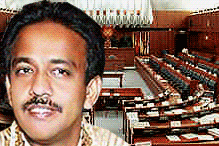 The dramatic episode on June 22 resulted in strong reverberations among Indian Malaysians, as he was suspended for three months from his cabinet post as deputy minister for natural resources and environment.
The controversy reflects the societal and education dilemma of this community. As the Indian political leadership can do little to improve the situation, they are increasingly adopting a populist approach to redirect the disgruntled Indian community.
Indian Malaysians make up about nine percent of the population, but their socio-economic status has been in stagnation since independence. Under prejudiced race-based policies, their social mobility and societal promotion have been largely limited.
Education is the only way out for many to change their circumstances; hence the de-recognition of foreign medical degrees that involve students will definitely arouse anger and despair.
Indian Malaysian youth have limited opportunities to advance, given various social constraints. After the launch of the New Economic Policy (NEP) in the 1970s and the institutionalising of 'bumiputera-ism' within government policy, the numbers and the ratio of Indians joining the public service have fallen sharply.
Whenever Chinese Malaysians fail to gain entry to government and the military-political system, they turn to the private sector or start their own business to advance their socio-economic status.
The Indian community has less resources in terms of capital and human networking, and lacks a conducive business environment. Moreover they receive no help at all from the state. They will face many hurdles even if they want to start their own business.
Education only way out
In these circumstances, ordinary Indian students can only climb the social ladder through education. The community still has an advantage in two professional fields - according to statistics, Indians account for about one-third of the total number of doctors and a quarter of the practising lawyers.
However, the ethnic-based quota system in public universities has narrowed opportunities for Indians students to gain admission and obtain scholarships. The tragedy is aggravated because many of them originate from impoverished estates or working-class families and are unable to afford the fees levied by private colleges or universities.
As such, many can only involved in highly dangerous and polluting jobs that pay low wages and which exploitation labour in estates and factories. Here too, the recent arrival of large numbers of foreign workers have not only depreciated the wages of local labourers, but also destabilised opportunities for work. Indian Malaysians are losing their ability to negotiate with employers.
After the dissolution of the Soviet Union, many independent republics of the former USSR faced financial difficulty and began to reduce military expenditure and the education budget. Hence the ex-Soviet republics are advertising in Malaysia, even through their embassies, to enrol Malaysia students into their medical universities. There is the attraction of cheaper tuition fees and lower academic requirements.
This strategy has certainly attracted many students who failed to enter local public or private universities, including many Indians, who see this traditional field of study as a way to improve their social status.
The government's decision to de-recognise the CSMU's medical degree has shattered their dreams and has certainly irritated the community.
The community's plight has been worsened by the increasing involvement of Indians in criminal activities, alcoholism and gangsterism.
 According to academic Dr P Ramasamy, the government practises ethnic bias in issuing business licenses and tenders; even cleaning and waste management contracts are not being awarded to the Indians. He said the community has been victimised in the nation-building process.
Affirmative action
Criticism has put MIC under heavy pressure, but the party can do nothing about it. From 1970 to 1990, only one percent of the national wealth belonged to Indians. While the figure has risen to 1.5 percent today, it only reflects the wealth of several Indian millionaires, rather than the community as a whole.
 MIC president S Samy Vellu has called on the government many times to formulate an "Indian version" of the NEP to boost the community's share of wealth to about three percent by 2010, but Umno - the dominant party in the ruling coalition BN - has not responded.
At the same time, Samy Vellu has monopolised MIC for years, repelling whoever opposes him. He can be considered a veteran minister who takes his ministerial duties seriously. Although he is quite outspoken and has been in power for more than two decades, he has failed to uplift the Indian society in terms of development as well as resource allocation.
Now the sidelined Indian leaders in BN have to face depressed and disappointed members of their community.
Samy Vellu's outspokenness in recent years has just been a facade to defuse discontent with the use of populist language. He has shrugged off his political responsibility and has instead been building a heroic self-image.
Yet all this cannot conceal the fact that MIC has failed to reform the system and improved resource allocation for the Indians.
Co-incidently, MIC secretary-general Sothinathan's recent 'enthusiastic performance' in Parliament has accelerated populism in Indian politics.
Although he has managed to dilute the pressure and lift his personal profile, the structural problems of the Indian Malaysian society remain unsolved. The sad song of this community is set to be played over and again.
PHOON WENG KEONG, a MA graduate of the Centre of East Asian Studies of Taiwan's Cheng Chi University, is a researcher of the New Era College, Kajang. He recently published his collection of writings entitled Essays on Malaysian Chinese Politics (Mahua Zhengzhi Sanlun) . This article, translated and edited by malaysiakini , was originally written in Chinese and published in Oriental Daily News on June 29.


