




From schoolboy to freedom fighter, terrorist and judge
When Lin Qi Hui and his China-born wife were driven around Kajang town after visiting a memorial monument of his fallen comrades in the Pacific War and 'Emergency', he could not help but feel emotionally nostalgic.
 "After the war ended and before I was arrested, I was often here in Kajang acting as a trade union organiser, recruiter and subscription fee collector; it was a very small town then, and we could go around by walking or cycling," he recalled to his wife.
"Now, look at the big cars, new shops No, something has not changed: Chinese, Malays and Indians are still living together in Kajang; in those years, poor party workers like us could only afford to eat rotai canai or nasi lemak while pau and dim sum in Chinese restaurants were only for the rich men," he said.
Kajang has even deeper meaning for Malayan war veterans like Lin.
When Lin Qi Hui and his China-born wife were driven around Kajang town after visiting a memorial monument of his fallen comrades in the Pacific War and 'Emergency', he could not help but feel emotionally nostalgic.
 "After the war ended and before I was arrested, I was often here in Kajang acting as a trade union organiser, recruiter and subscription fee collector; it was a very small town then, and we could go around by walking or cycling," he recalled to his wife.
"Now, look at the big cars, new shops No, something has not changed: Chinese, Malays and Indians are still living together in Kajang; in those years, poor party workers like us could only afford to eat rotai canai or nasi lemak while pau and dim sum in Chinese restaurants were only for the rich men," he said.
Kajang has even deeper meaning for Malayan war veterans like Lin.
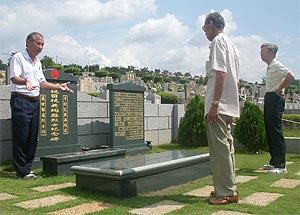
It was not too far away from the town that a memorial monument for some of the Malayan communists highly respected by Lin's generation, like Yang Guo and Liu Yao, is well preserved and taken care of.
The Penang-educated Yang Guo (1919-1956), who is also known in Chin Peng's memoirs as Yeung Kuo, was a MPAJA commander in Selangor during the Japanese Occupation and a right-hand man of Chin Peng during the early years of the 'Emergency'. He was killed by colonial forces on August 26, 1956.
Liu Yao (1915-1948), also known as Liew Yao or Liu Yaw or Lau Yew, was a graduate of Special Operations Executive's Special Training School (STS) 101 in Singapore who returned to Selangor as a commander of MPAJA during the occupation. In 1946, Liu Yao led a MPAJA contingent to London's Victory Parade. On July 18, 1948, less than two months after the proclamation of 'Emergency', Liu Yao was killed by colonial forces.
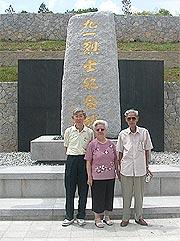 Although several non-Chinese sounding names with Mandarin transliterations like 'Abdul Manan', 'Wahab', 'Tomo', 'Abu', 'Yunus', 'Mat Noor', 'Mohan', 'Iman', 'Aman', 'Majid' and 'Rama' were seen on the tombstone, Lin and his wife solemnly bowed three times to all the names.
A keeper of the memorial monument explained: "They were genuine Malays and Indians who sacrificed their lives together with Chinese comrades. Abdul Manan, for example, was hanged by the colonial authorities in the Pudu Prison in Kuala Lumpur during the early months of the post-war anti-colonial armed struggle".
Later, Lin and his wife also visited the September 1 Martyrs' Memorial Monument at the Nilai Memorial Park.
Followed teacher into jungles
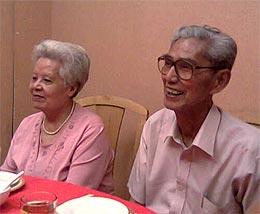
That evening, when Lin and his wife attended a dinner in Petaling Jaya hosted in their honour by old friends, Lin related more of his vicissitudes of fortune.
"When the Japanese fascists invaded Malaya, I was only a 16 or 17 years old and was studying in Muar's Chung Hwa High School, but even long before they came, we had already heard about their atrocities committed in China. One of our teachers was an underground member of the Communist Party of Malaya. In that sense, we had been psychologically prepared to face them long before they moved southward," Lin said.
"So, when they arrived at Johore, the teacher just led five of us in the class into the jungle and joined the guerrilla forces. We just followed him because it was right thing to do under that situation".
According to an established history, the Muar Front, as a gateway to Singapore, was staunchly defended by Australian troops and Muar itself was massively bombed in mid-January 1942 "causing a mass exodus of the civilian population into the countryside".
"I first joined the 3rd Company of the 3rd Independent Regiment of the Malayan People's Anti-Japanese Army. I was given a short-course on how to use and keep weapons. That's it. I learnt while I fought alone. I only joined the Communist Party of Malaya later in the jungle; most of the time, I was in the jungle because I was a wanted person by the occupation forces" Lin said.
There were three or four Malays in his company, he said.
"And there was one British straggler we helped to protect in our camp. We didn't like him at all because he still behaved like a rich man's arrogant son in the jungle during wartime. He wanted only to eat better food. Later, he was transferred to another camp and I never saw him again. Everyone was happy he's gone," Lin recalled.
He added: "MPAJA's 3rd and 4th Independent Regiments had always been under great military pressures from Japanese troops because we were close to Singapore which was the headquarters of the Japan's Imperial Army."
According to an MPAJA regiment-by-regiment history published by veterans in Hong Kong in 1991, the 3rd Independent Regiment which covered northern Johore and Malacca was inaugurated on January 20, 1942, while the 4th Independent Regiment that was responsible for southern Johore was formed ten days later.
"When I first joined my company, we had only nine hunting guns and 11 persons. Later, our rank increased to about 300 with more weapons robbed or stolen from police stations, or purchased in the black markets, "he said.
Banished to China
When the war ended, Lin emerged from his jungle hideouts. After trying to manage the chaotic situations in and around Muar, Lin later joined the communist-controlled labour movement. He was transferred to Selangor.
However, as the Cold War began, Lin's relatively peaceful life was again disrupted. Now, he was wanted by his British ex-allies.
 Not too long after the proclamation of 'Emergency' on June 20, 1948, Lin was arrested in his hometown Muar for being a communist.
"They charged me in court for being a communist but I argued that since I had committed no criminal act, they could not prosecute me on pure ideas alone; moreover, there was no marks anywhere on my body that said that I was a communist also, I said I was their wartime ally. My court case lasted 16 sessions and they still could not find any evidence suggesting I was a criminal," he recalled.
"After failing to convict me in court and being unable to argue with me, they banished me to China. In August 1949, I arrived at southern China which was still controlled by the Kuomintang regime. Of course, I was wanted again but then, southern China was soon liberated by the People's Liberation Army. I was safe again."
Under the new government, Lin was sent to study law in Wuhan. After graduation, he was appointed a judicial officer. Finally, he rose to become a judge. After settling down in China, Lin also quit his membership in the Communist Party of Malaya and joined the Communist Party of China as a citizen of the People's Republic of China.
Lin admitted that he suffered during the 1966-1976 'Cultural Revolution' which he called "the 10-year chaos".
"But, it is all over now," he said with a smile.
Lin revealed that he had already visited Malaysia as a private tourist four times before.
"You know why? The reason is simple: I always love Malaysia because I was born here, I grew up here and I fought here to defend my birthplace, family members, neighbours and childhood friends."


