




Street-fighter Keng Yaik vs polished Kerk
Chinese educationists with the Dong Jiao Zong (DJZ) movement and their grassroots supporters have always sympathised and empathised with political underdogs be it Malay, Chinese, Indian or others.
But the scenario is different with the battle royale in Gerakan between incumbent president Dr Lim Keng Yaik and his long-time deputy Kerk Choo Ting.
Many of the educationists, both in and out of Gerakan, have publicly disassociated themselves and DJZ from Kerk, who was once closely associated with the movement.
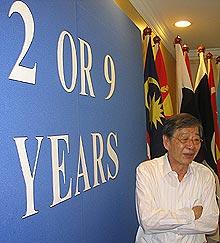
 They said although Kerk (
photo
) was a Chinese educationist and legal counsel for DJZ in the 1970s, he no longer represents the movement, especially in Gerakan's internal strife.
They said although Kerk (
photo
) was a Chinese educationist and legal counsel for DJZ in the 1970s, he no longer represents the movement, especially in Gerakan's internal strife.
Some went a step further and accused Kerk of 'selling out' the cause which he vowed to advance in 1982 when DJZ mobilised hundreds of its grassroots supporters to campaign for his election into the parliament under the Barisan Nasional (BN) ticket.
They cited Kerk's support for various controversial education policies formulated by the Umno-dominated government which were opposed by DJZ and the Chinese community, such as the 'vision schools' and the teaching of science and mathematics in English in primary schools.
They also recalled Kerk's public attack on DJZ in the Chinese media and his support for the demolition of a historical Chinese cemetery in Kuala Lumpur in favour of 'development' in the mid-1990s as further evidences of his 'treachery'.
Why did Chinese educationists, who don't have a soft spot for Lim either, mount the campaign to disassociate themselves from Kerk, at a time when the presidential contest in Gerakan has reached a do-or-die stage?
Chinese educationists with the Dong Jiao Zong (DJZ) movement and their grassroots supporters have always sympathised and empathised with political underdogs be it Malay, Chinese, Indian or others.
But the scenario is different with the battle royale in Gerakan between incumbent president Dr Lim Keng Yaik and his long-time deputy Kerk Choo Ting.
Many of the educationists, both in and out of Gerakan, have publicly disassociated themselves and DJZ from Kerk, who was once closely associated with the movement.
 They said although Kerk (
photo
) was a Chinese educationist and legal counsel for DJZ in the 1970s, he no longer represents the movement, especially in Gerakan's internal strife.
They said although Kerk (
photo
) was a Chinese educationist and legal counsel for DJZ in the 1970s, he no longer represents the movement, especially in Gerakan's internal strife.
Some went a step further and accused Kerk of 'selling out' the cause which he vowed to advance in 1982 when DJZ mobilised hundreds of its grassroots supporters to campaign for his election into the parliament under the Barisan Nasional (BN) ticket.
They cited Kerk's support for various controversial education policies formulated by the Umno-dominated government which were opposed by DJZ and the Chinese community, such as the 'vision schools' and the teaching of science and mathematics in English in primary schools.
They also recalled Kerk's public attack on DJZ in the Chinese media and his support for the demolition of a historical Chinese cemetery in Kuala Lumpur in favour of 'development' in the mid-1990s as further evidences of his 'treachery'.
Why did Chinese educationists, who don't have a soft spot for Lim either, mount the campaign to disassociate themselves from Kerk, at a time when the presidential contest in Gerakan has reached a do-or-die stage?
The disclaimer
It was Kerk who provoked them because he has been widely perceived to be 'manipulating' his 'Chinese educationist' tag in his campaign to challenge the English-educated incumbent.
What troubled them was, if no public disclaimer is made, Kerk's 'defeat' could be construed as a rejection of DJZ, or his 'victory' be interpreted as endorsing him as 'the spokesperson' for Chinese educational issues and policies within the BN and government, eroding the role and function of the more authoritative and non-partisan DJZ.
The disclaimer has adversely affected Kerk's public image and credibility, and may also have effectively alter the balance of power between Lim and him.
 However, Kerk's loss of his 'Chinese educationist' credentials in the eyes of the public and Gerakan members does not mean that his other campaign themes against Lim are not well received.
For example, even many of those who disassociated themselves from him on the Chinese education front agreed with him that Lim has "overstayed" and become "an ageing emperor" who was trying to "divide and rule" and "kill off" his own chosen successor.
According to a report in an English newspaper, Kerk, 64, was quoted as comparing Lim, 66, to China's communist leader Mao Zedong (1893-1976) but to others, they would prefer to compare Lim with capitalist ex-PM Dr Mahathir Mohamad in the years between 1998 and 2003.
The attack of Kerk and his supporters on Lim's alleged nepotism in promoting his son in Gerakan politics also reverberated through the Malaysian society, which has become uneasy about powerful and ageing politicians allegedly trying to control their parties through their offsprings and relatives like those neo-feudal and right-wing landowning aristocrats in the 'banana republics' in Latin America before the 1980s.
What is even more damaging to Lim is Kerk's revelation that twice in 1995 and 2002, Lim agreed to have Kerk as his presidential successor.
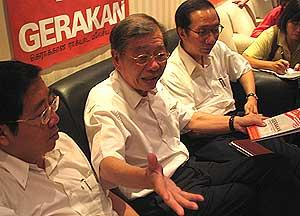 What guarantee is there that Lim would step down in 2007 or 2008 and allow his newly anointed successor Dr Koh Tsu Koon to take over? This line of attack has the effect of impeaching Lim's public credibility and political trustworthiness.
In any case, the trading of personal attacks or insults and no-holds-bar invectives in the public domain have done damage to a party that has always prided itself to be middle-classy, 'intellectual', 'technocratic' and 'scholarly' which, unlike the chair-throwing MCA and MIC or keris-brandishing Umno, would prefer to reason problems and solutions in a polite, cool and calm manner in seminars or workshops.
Street-fighter rebel
To those who still remember the political background of Lim, there is no surprise at all. He was a youthful rebel in MCA before he was sacked by former MCA president Tan Siew Sin in the early 1970s.
Tan and his conservative supporters in MCA also reportedly accused Lim of associating with groups that had been "infiltrated by left-wing and communist elements and become too narrowly chauvinistic".
Of course, if Tan and his supporters were right, then former premier Abdul Razak must have been very ill informed by the security apparatus when he appointed Lim as minister in charge of the Chinese-predominated new villages in the post-1969 situation.
But Razak seemed to be right in his character assessment of Lim. The latter was, and still is, a popular public speaker in Cantonese and Hakka, the two major Chinese working-class dialects.
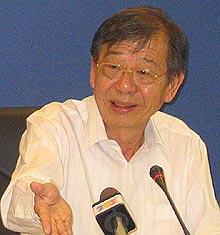 His medical practice among the working classes and political ground work in the new villages made him a true and unapologetic street-fighter. Otherwise, how could he have survived and prospered in the turbulent politics of the Chinese-predominated new villages in the 1970s?
Moreover, after crossing over from MCA to Gerakan in 1973, Lim has successfully beaten off a long list of challengers - Paul Leong (1980), Michael Chen (1984), Dr Goh Cheng Teik (1987) and Joseph Chong (1996).
However, to Lim's credit, he is honest, frank and unapologetic about his street-fighting character and political style.
Unlike Lim, lawyer Kerk is known for his use of a more cultured, classic, poetic and standard Mandarin with no racist or sexist vulgarity. He also likes to project himself as a philosopher-king striving to bridge the Chinese and Western cultural worlds.
However, for those who know Kerk better, they can detect a hidden fighting spirit behind the soft spoken 'ex-lover' of Mao's revolutionary poems. He is also still a fan of the great Chinese left-wing political polemist and satirist Lu Xun .
Kerk still quotes Lu Xun in his campaign against Lim and his supporters. He also has many like-minded intellectual admirers, followers and supporters in Gerakan.
So, the stage is set for two veterans to slug it out tomorrow.


