




Women and smoking in the digital era
COMMENT | The earliest memory I have of seeing a female figure smoking in public was that of my late grand-aunt, my late grandfather’s elder sister.
She was around 10 years his senior, and I saw her smoking a cigarette while talking to my grandfather who came to visit her. He had brought her some kuih for morning tea.
I didn’t realise it at the time, but Malay women smoking while chewing on sirih (betel leaf) was not uncommon for people of that generation.
Though I’ve never known my grandfather to smoke, he didn’t seem to mind at all that his sister smoked, and smoked heavily too.
However, at the same time as I was growing up, I would often see and hear women, young Malay women particularly, being heavily ostracised for smoking.
In just two generations, the attitude towards women smoking has reversed so much, particularly within the Malay community, that even the idea of women smoking is taboo.
The stigma still persists today, when a photo of a Malay woman wearing a tudung who was smoking with a friend went viral on social media last week. It was taken by a stranger who shared it without her consent.
While the sharing of that photo was already an unkind move, there is something else more sinister that happened as a result.
A lot of women smoke, and this is a normal everyday phenomenon. But why are women so disproportionately berated and chastised for the same act that is considered normal for men?
It’s not difficult to see why this is puzzling, since cigarettes clearly have no gender. So why the bias?...
COMMENT | The earliest memory I have of seeing a female figure smoking in public was that of my late grand-aunt, my late grandfather’s elder sister.
She was around 10 years his senior, and I saw her smoking a cigarette while talking to my grandfather who came to visit her. He had brought her some kuih for morning tea.
I didn’t realise it at the time, but Malay women smoking while chewing on sirih (betel leaf) was not uncommon for people of that generation.
Though I’ve never known my grandfather to smoke, he didn’t seem to mind at all that his sister smoked, and smoked heavily too.
However, at the same time as I was growing up, I would often see and hear women, young Malay women particularly, being heavily ostracised for smoking.

In just two generations, the attitude towards women smoking has reversed so much, particularly within the Malay community, that even the idea of women smoking is taboo.
The stigma still persists today, when a photo of a Malay woman wearing a tudung who was smoking with a friend went viral on social media last week. It was taken by a stranger who shared it without her consent.
While the sharing of that photo was already an unkind move, there is something else more sinister that happened as a result.
A lot of women smoke, and this is a normal everyday phenomenon. But why are women so disproportionately berated and chastised for the same act that is considered normal for men?
It’s not difficult to see why this is puzzling, since cigarettes clearly have no gender. So why the bias?
The idea of 'sopan'
Men are simply not expected to have the same level of sopan, or modesty in Malay, as women and this does not stop at smoking.
It doesn’t matter what your personal stance on smoking is, but we have to admit that society becomes very unforgiving when they see women doing it.
In all aspects of social life, acts that are considered masculine are only exclusive to men.
The sight of women doing these “masculine” acts is so rare that they are considered women who deviate from the norm, even though there is nothing that a man can do that a woman cannot.
Female smokers who engage in this typically everyday habit get comments from people who seem to be shocked that women are as capable of deriving pleasure from smoking as men.
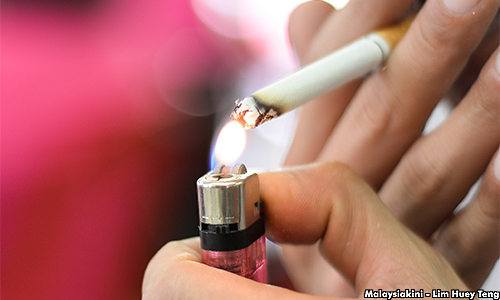
Men are not impolite when they smoke, but women are impolite if they do, even more so if they do it in front of other men.
“Tunjuk macho” (showing off macho-ness), “perempuan jalang” (whore), and “tidak sopan” (immodest) are some of the slurs directed at women who are seen smoking.
The issue here is the politics of space for women. This includes the digital space today. Not only is physical space itself shrinking, the diversity of women who are allowed to be visible is also shrinking rapidly.
It seems society goes out of its way to police women and restrict their behaviour, which ultimately limits their participation in public life.
For Malay women today, it is rare to see a role model that is outside the “perempuan Melayu terakhir” (the last Malay woman) trope, which embodies the ideal Malay woman, typically of demure and feminine character. Women who do not conform to such limiting ideals are actively shunned, both online and off.
Revisiting cultural traditions
Today I work and play with women who smoke. I notice that the women who do smoke around me are often feminists, whose worldview informs them that the social taboo against women smoking is unwarranted.
Smoking alone is not indicative of women empowerment, obviously. But how one views smoking by different genders would indicate the progressiveness of the society that a person lives in.
I do not think a woman needs to be a feminist for her to be comfortable with smoking, either for herself or other women.
My late grand-aunt smoked heavily for decades, and she probably had never even heard of the word “feminism” in her entire life.
However, the society in her generation understood that smoking was a cultural tradition, along with sirih, or working the paddy field, or cooking. These acts do not determine gender roles. They were all part and parcel of an egalitarian society that was the norm for hundreds of years before colonisation.
If women empowerment is what we seek, but feminism is such a taboo entry point, all we have to do is revisit our cultural tradition before it was tainted by patriarchy.
But have we got the guts to do it? That remains to be seen.
MARYAM LEE is a writer with a chronic tendency of getting into trouble. What she lacks in spelling when writing in English is made up for with her many writings in Bahasa Malaysia. She believes in conversations as the most valuable yet underrated cause of social change. She wants people to recognise silences and give them a voice, as she tries to bring people together through words.
The views expressed here are those of the author/contributor and do not necessarily represent the views of Malaysiakini.


Report this comment
Are you sure you want to delete this comment?
This action cannot be undone.