


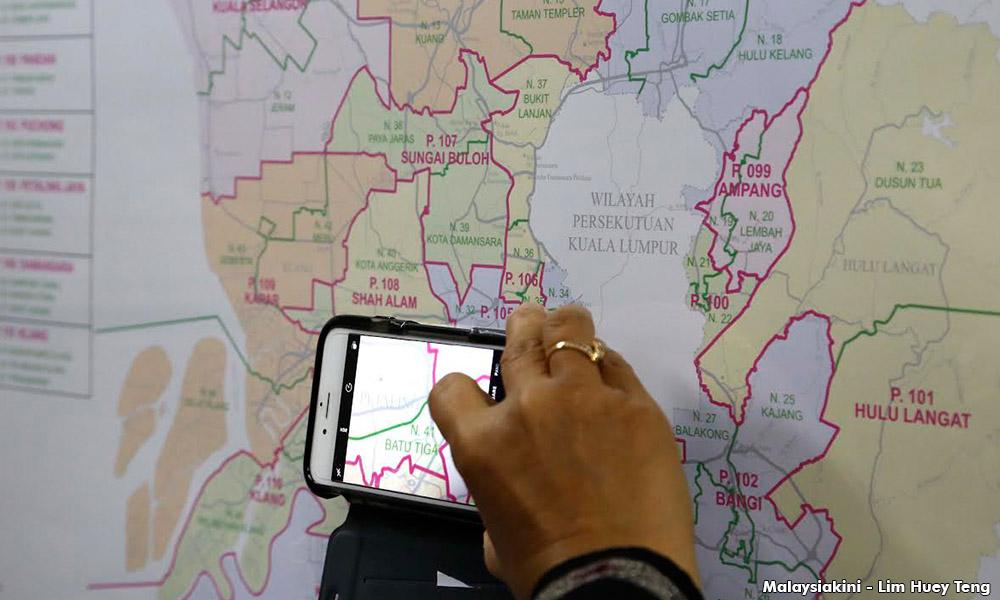

Why 98pct of S’gor voters untouched by redelineation?
COMMENT | It is outrageous to learn that the Election Commission scheduled 31 objections to the delineation of Selangor on Feb 27, so that its proposal may be tabled in Parliament in time for the new boundaries to be used for the 14th general elections.
The EC’s ridiculous haste in hearing objections means that the inquiry process provided by the 13th Schedule of the Federal Constitution is made completely hollow.
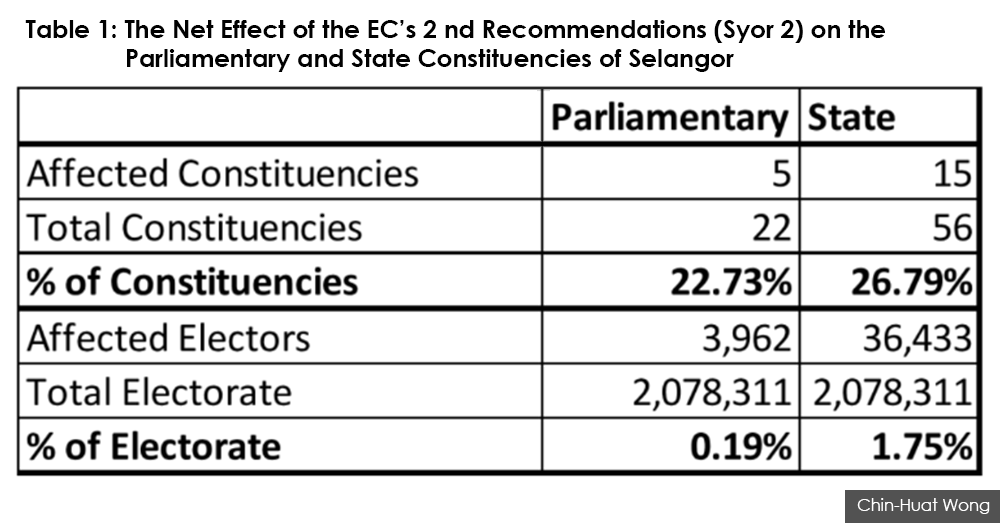
One of the best-kept secrets of the EC’s Second Notice on the Selangor redelineation exercise (Syor 2), is that it will leave more than 98 percent of Selangor electors untouched from the status quo.
As only five federal and 15 state constituencies would have their boundaries changed, as little as 3,962 voters (0.19 percent) would have their parliamentary constituencies changed, while 36,433 voters (1.75 percent) would have their state constituencies changed.
In other words, the delineation recommendations by the EC almost have not happened, and its haste now to rush through the second round of inquiry is nothing but a cover-up.
For the unsuspecting public, including many opposition politicians, the negligible change from the status quo appears to be good news.
To them, it means that the EC has conceded to the pressure mounted by both vigorous objections and the Selangor state government’s legal suit to reverse most of its proposals.
Deliberate violation of Article 113(2)
But what does the Federal Constitution say? It provides for three types of constituency delineation reviews to serve different purposes:
- To correct constitutional non-compliance that occurs over time (Article 113(2));
- To accommodate changes in the territorial composition of Malaysia, for example the creation of Federal Territory of Putrajaya (Article 113(3));
- To accommodate changes in the number of seats in Parliament and/or state assemblies (Article 113(3A)).
The delineation reviews for the States of Malaya (of which Selangor is a part), which have seen no seat increase at both federal and state levels, are conducted under Article 113(2), which reads:
"Subject to paragraph (ii) [on interval], the Election Commission shall, from time to time, as they deem necessary, review the division of the Federation and the States into constituencies, and recommend such changes therein as they may think necessary in order to comply with the provisions contained in the Thirteenth Schedule; and the reviews of constituencies for the purpose of elections to the Legislative Assemblies shall be undertaken at the same time as the reviews of constituencies for the purpose of elections to the House of Representatives." (Emphasis added)
Its meaning cannot be clearer to anyone who upholds the Federal Constitution. When such a review is conducted under this clause, the EC must:
- Propose changes to correct or reduce all instances of constitutional non-compliance;
- Not propose other changes that may aggravate constitutional non-compliance...
COMMENT | It is outrageous to learn that the Election Commission scheduled 31 objections to the delineation of Selangor on Feb 27, so that its proposal may be tabled in Parliament in time for the new boundaries to be used for the 14th general elections.
The EC’s ridiculous haste in hearing objections means that the inquiry process provided by the 13th Schedule of the Federal Constitution is made completely hollow.
One of the best-kept secrets of the EC’s Second Notice on the Selangor redelineation exercise (Syor 2), is that it will leave more than 98 percent of Selangor electors untouched from the status quo.
As only five federal and 15 state constituencies would have their boundaries changed, as little as 3,962 voters (0.19 percent) would have their parliamentary constituencies changed, while 36,433 voters (1.75 percent) would have their state constituencies changed.
In other words, the delineation recommendations by the EC almost have not happened, and its haste now to rush through the second round of inquiry is nothing but a cover-up.
For the unsuspecting public, including many opposition politicians, the negligible change from the status quo appears to be good news.
To them, it means that the EC has conceded to the pressure mounted by both vigorous objections and the Selangor state government’s legal suit to reverse most of its proposals.
Deliberate violation of Article 113(2)
But what does the Federal Constitution say? It provides for three types of constituency delineation reviews to serve different purposes:
- To correct constitutional non-compliance that occurs over time (Article 113(2));
- To accommodate changes in the territorial composition of Malaysia, for example the creation of Federal Territory of Putrajaya (Article 113(3));
- To accommodate changes in the number of seats in Parliament and/or state assemblies (Article 113(3A)).
The delineation reviews for the States of Malaya (of which Selangor is a part), which have seen no seat increase at both federal and state levels, are conducted under Article 113(2), which reads:
"Subject to paragraph (ii) [on interval], the Election Commission shall, from time to time, as they deem necessary, review the division of the Federation and the States into constituencies, and recommend such changes therein as they may think necessary in order to comply with the provisions contained in the Thirteenth Schedule; and the reviews of constituencies for the purpose of elections to the Legislative Assemblies shall be undertaken at the same time as the reviews of constituencies for the purpose of elections to the House of Representatives." (Emphasis added)
Its meaning cannot be clearer to anyone who upholds the Federal Constitution. When such a review is conducted under this clause, the EC must:
- Propose changes to correct or reduce all instances of constitutional non-compliance;
- Not propose other changes that may aggravate constitutional non-compliance.
To do otherwise and preserve or aggravate non-compliance would invalidate the constitutionality of the delineation review for all States of Malaya, including Selangor, in any court that upholds the Federal Constitution.
Note that Clause 2(i) exclusively governs the conduct of the EC, with no mention of Parliament at all.
To argue that the EC can ignore the demand of Article 113(2) and draw any constituency boundaries at whim and let Parliament decide whether to accept the EC’s proposal is to deliberately misunderstand the Federal Constitution, if not lie through one’s teeth.
Non-compliance with the 13th Schedule
The provisions in the 13th Schedule which are relevant for assessing non-compliance are subsection (2)(c):
The number of electors within each constituency in a State ought to be approximately equal except that, having regard to the greater difficulty of reaching electors in the country districts and the other disadvantages facing rural constituencies, a measure of weightage for area ought to be given to such constituencies;
and subsection (2)(d):
Regard ought to be had to the inconveniences attendant on alterations of constituencies, and to the maintenance of local ties. (Emphases added)
The Federal Constitution states that there must be at least an eight-year gap between redelineation exercises. Why does the constitution expect non-compliance with sub-sections 2(c) and 2(d) of the 13th Schedule to occur after at least eight years?
For 2(c), as voters grow in number and move across constituencies, constituencies that were once approximately equal may grow to be vastly unequal.
For 2(d), socioeconomic and infrastructural developments over time may redefine local ties and necessitate boundary changes for better representation.
By proposing that 98.25 percent and 99.81 percent of Selangor’s 2,078,311 electors should just stay put in their parliamentary and state constituencies respectively, the EC is saying that the electorate growth and movements in the past 15 years since the last delineation review in 2003 are insignificant.
Is this implied insignificance the unbelievable truth, or is the EC simply unbelievable? Let’s just look at compliance with 2(c).
Testing 'approximately equal'
Whether the apportionment of parliamentary and state constituencies in Selangor is “approximately equal” can be easily assessed by calculating the ratio between the largest and the smallest constituencies. If the ratio is “approximately equal” to one, then subsection 2(c) is complied with.
From 1962 to 1973, the maximally allowed ratio was two. In other words, the largest constituency can be twice as large the smallest constituency because “two is approximately equal to one”.
With the quantifiable cap removed in 1973, if the largest constituency is 2.1 or 2.2 times larger than the smallest one, it cannot be declared unconstitutional. In other words, the removal of the quantifiable cap spares borderline cases from unconstitutionality.
Does it give a blank cheque for the EC to declare any number as “approximately equal” to one?
Can you even persuade a kindergarten kid that “five is approximately equal to one”, and that she should trade five of her candies for one from you?
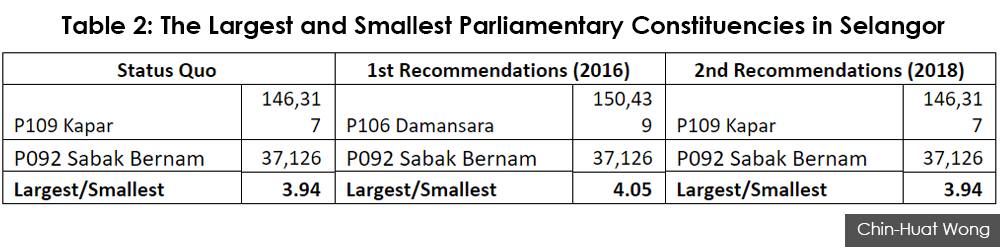
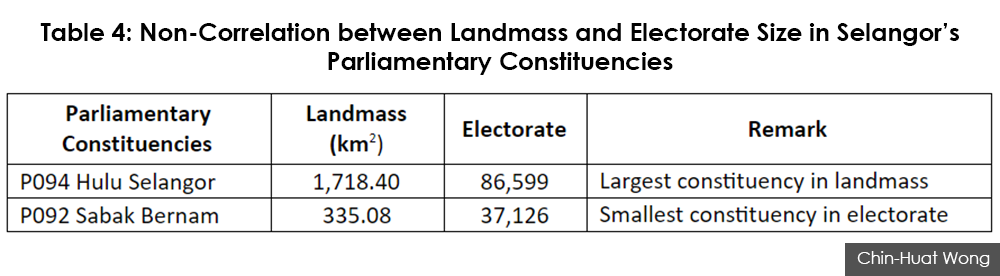
Let’s look at the number. At status quo, the largest parliamentary constituency, Kapar, has 146,317 voters, which is 3.94 times the number of voters (37,126) in the smallest constituency, Sabak Bernam.
Is 146,317 voters (or 3.94) approximately equal to 37,126 voters (or one)? Without any doubt, this is an outright example of non-compliance with subsection 2(c).
In its first recommendations (Syor 1) gazetted on September 15, 2016, the EC created an even larger constituency than Kapar. This larger constituency was Damansara (currently Petaling Jaya Utara) with 150,439 voters, which of course aggravated the non-compliance to a new height of nonsense, unless we can believe “4.05 is approximately equal to 1.”
After proposing the ridiculous change, the EC reverted back to status quo and expected us to swallow this “alternative reality” – that 3.94 is approximately equal to 1.
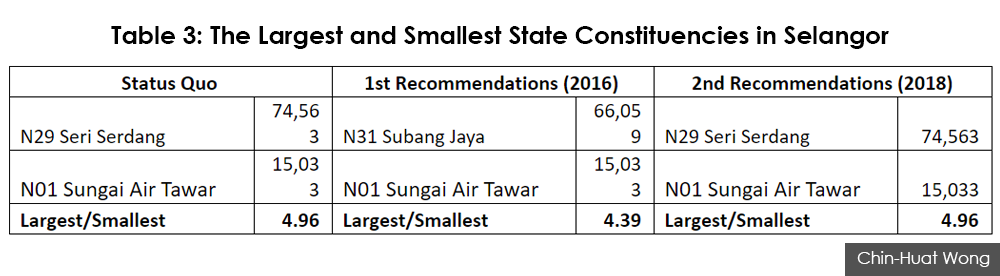
The EC similarly did not correct the non-compliance with sub-section 2(c) in apportioning state constituencies.
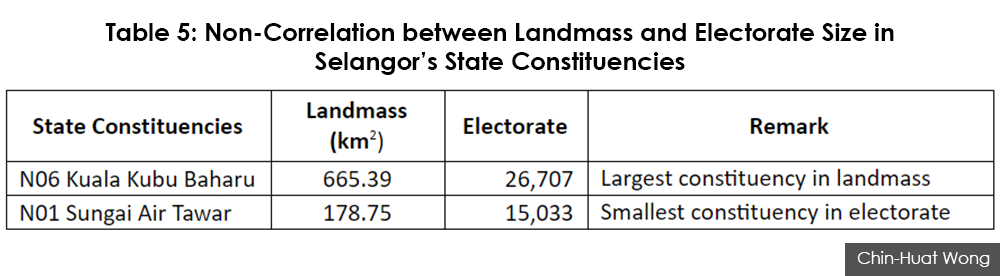
The largest-smallest ratio was an astonishing high of 4.96, which the EC temporarily reduced to 4.39 in Syor 1 and now restored back to 4.96 in Syor 2.
If the EC tries to argue that the smallest parliamentary and state constituencies, Sabak Bernam and Sungai Air Tawar respectively, are rural and hence qualified to have so few voters, that would be another deliberate distortion of the constitutional provision.
The exceptional clause in subsection 2(c), “having regard to the greater difficulty of reaching electors in the country districts and the other disadvantages facing rural constituencies, a measure of weightage for area ought to be given to such constituencies," is based on area (landmass), not ruralness per se.
The constituencies most qualified for area weightage would be Hulu Selangor and Kuala Kubu Baharu (both rural), yet both constituencies have way more voters (close to average) than Sabak Bernam and Sungai Air Tawar despite having multiple times their landmass. If vast landmass does not impede the former, how can it impede the latter to justify their over-representation?
The question of decency
Many people believe that constituency delineation is too technical for common folk. I beg to differ. While this may be true for other countries, it is not the case for Malaysia, with sub-section 2(c) of the Federal Constitution's 13th Schedule.
The phrase “approximately equal” (in Malay, “lebih kurang sama banyak”) is not rocket science. To not understand what it means is not a deficiency in intelligence, but simply a lack of decency.
One needs to be completely devoid of decency to tell a kindergarten kid that “five candies are approximately equal to one candy”, no?
These seven men in the Election Commission are constitutionally tasked to “enjoy public confidence”. Do remember their names:
- Mohd Hashim Abdullah (chairperson);
- Othman Haji Mahmood (deputy chairperson);
- Md Yusop Haji Masor;
- Haji Abdul Aziz Khalidin;
- Haji Sulaiman Haji Narawi;
- Bala Singam Karupiah; and
- Leo Chong Cheong.
They must be asked this question, not only by objectors but any Malaysian who knows or meets them: “Is five approximately equal to one?”
Let them say “Yes”. Let them know we are different – we understand both mathematics and decency.
WONG CHIN HUAT studies electoral, party and identity politics in Malaysia. He is head of the political studies programme at Penang Institute.
The views expressed here are those of the author/contributor and do not necessarily represent the views of Malaysiakini.


