




Trouble brewing in ME again
Fancy worldwide recognition? Do something drastic and controversial.
Precisely what President Mahmoud Ahmadinejad of Iran did in New York recently.
When he won a landslide victory in the presidential elections three months back, journalists around the globe could hardly spell his name.
He did not receive the due attention until a few weeks later, when suspicion of his close involvement in the 1979 hostage crisis in Tehran surfaced, an allegation that has been strenuously denied by both his allies and foes within and without Iran.
Fancy worldwide recognition? Do something drastic and controversial.
Precisely what President Mahmoud Ahmadinejad of Iran did in New York recently.
When he won a landslide victory in the presidential elections three months back, journalists around the globe could hardly spell his name.
He did not receive the due attention until a few weeks later, when suspicion of his close involvement in the 1979 hostage crisis in Tehran surfaced, an allegation that has been strenuously denied by both his allies and foes within and without Iran.
Last month, Ahmadinejad again came under international focus. Addressing the United Nations General Assembly in New York, he upped the ante on the United States, Britain, France and Germany, the European troika, by asserting Iran's right to pursue peaceful nuclear energy, while accusing the US of seeking to divide the world into "light and dark countries".
Such intransigence is no doubt outrageous to the 'hawks' in Washington, and his potential partners within the European Union were utterly dismayed. With that kind of bravura at the UN, any Middle East affairs correspondent failing to pronounce his name should be sent packing.
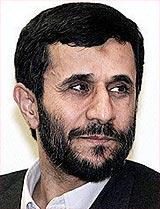 Quite clearly, by consciously raising the tension over the nuclear issue with the West, Ahmadinejad was hoping to kill several birds with one stone. He was certainly eager to let the Americans and the Europeans understand that, as far as acquiring and developing nuclear technology are concerned, Iran was more serious than is popularly perceived by the world - although for what purposes remains everybody's guess.
By increasing the stakes, the Iranian president might be able to force others to sit around the negotiating table. It is reported that, should Tehran resort to oil embargo as a retaliation against possible international sanctions, the barrel of oil could easily reach US$100.
If the average Joe is complaining about the high fuel costs now, he could soon be cursing the human invention of a petrol-devouring monster called, ironically, the automobile.
Secondly, Ahmadinejad may have hoped to divert the public attention within Iran away from the country's economic woes, massive unemployment and rising discontent, and create a (false?) solidarity against the Western "bullies".
Finally, being a greenhorn leader in the global arena, Ahmadinejad could have orchestrated the showdown with a view of gauging the level of support for Iran on the part of his perceived allies.
After all, the terrain of international nuclear politics is fraught with standard hypocrisies, and high mutability of friends and foes alike guaranteed.
A softer stance
The Iranian president must be aware of Israel's decades-long nuclear activities that have escaped international scrutiny, a secret that the US helped keep from the world in the 1960s. On the other hand, after the Hindu nationalistic Indian leader Atal Bihari Vajpayee conducted a series of nuclear tests in 1998, the Clinton administration led the chorus in condemning India to an international pariah status.
 Things have moved on since the Sept 11 terrorist attacks. Two months ago, Washington signed an agreement of nuclear cooperation with New Delhi, to be ratified by the US Congress, grudgingly acknowledging India as a, like it or not, is a nuke kid on the block.
To pressure Iran into taking a softer stance, the International Atomic Energy Agency (IAEA) threatened to pass the Iranian dossier to the UN Security Council for discussion.
It is, however, worth reminding here that during the quagmire surrounding Iraq in 2002, British Prime Minister Tony Blair plagiarised an Iraqi dossier to convince his parliamentarians of the imminent threat posed by Saddam Hussein.
As James Naughtie, author of The accidental American: Tony Blair and the presidency, has written, the word "dossier" now represents 'a special sort of public relations disaster' to civil servants. Internationally, it is only to be met with a cynical smile.
Thanks to the miscalculations of his own, President Ahmadinejad now has to swallow the bitter pill served by his allies in the developing world, whom he had counted on to defy the pressure from the Americans and the Europeans.
India, which enjoys close ties with Iran, surprisingly voted for the IAEA resolution that will refer Iran's nuclear activities to the UN, despite the promise by Natwar Singh, Indian External Affairs Minister, to support Iran's nuclear programme for peaceful purposes.
After the show is over, everyone is an expert. With the benefit of hindsight, it is not too difficult to make sense of India's u-turn at the eleventh hour. Having entered the agreement of nuclear cooperation with Washington and hence winning the much-courted recognition of a nuclear power, New Delhi is anxious to project itself as a responsible member of the nuclear club. The IAEA vote over Iran came to symbolise a test case for the Indians.
Like other rapidly developing countries such as China and Brazil, India, quite naturally, has its own concern over rising oil prices and may look to Iran as a reliable source of supply. But why risk alienating the Europeans and the Americans when, in the long run, nuclear energy will prove far cheaper?
All the wrong reasons
Russia - which had sent out signals that it was ready to back Iran - also failed Ahmadinejad. By abstaining, Moscow has made it clear that, for all its strategic partnership with Tehran, it is still not prepared to allow its vital economic relations with the G8 countries to turn sour.
China, adhering to its pragmatic diplomatic ambivalence, washed its hands of the affair too. The only country that voted an unequivocal 'no' was Venezuela, which only confirms that there is no love lost between Bush and Hugo Chavez.
Nobody is having the last laugh yet, although the neo-cons around President Bush are now rejoicing their tentative victory. Bush always keeps his options open, so does Blair. And it takes more than a mere coincidence for the British governmenbt to accuse Iran of instigating Iraqi insurgents.
Now, expect the US hawks around the world, who gave their full and unfaltering support for the war on Iraq, to build up the momentum for a standoff between Iran and the 'international community'.
Meanwhile, it looks like President Ahmadijenad is gaining greater global recognition for all the wrong reasons indeed.


