




Best and worst of policing
Some of the best policing in the world is found in the Commonwealth, and also some of the worst. But by and large, its 1.8 billion people do not have the policing they deserve.
Too many governments are failing in their primary duty to provide the public with an honest, efficient, effective police service that ensures the rule of law and an environment of safety and security.
Police reform is now too important to neglect and too urgent to delay. The conduct of the police is an important barometer of the state of governance, and their performance can significantly shape the social health of nations.
Some of the best policing in the world is found in the Commonwealth, and also some of the worst. But by and large, its 1.8 billion people do not have the policing they deserve.
Too many governments are failing in their primary duty to provide the public with an honest, efficient, effective police service that ensures the rule of law and an environment of safety and security.
Police reform is now too important to neglect and too urgent to delay. The conduct of the police is an important barometer of the state of governance, and their performance can significantly shape the social health of nations.
What distinguishes good from bad policing is the commitment to protect the civil and political freedoms of individuals while helping to create an environment that will maximise the enjoyment of economic, social and cultural rights as well.
The only legitimate policing is one that helps build an environment that is free from fear and is conducive to the realisation of human rights, particularly those that promote unfettered political activity, which is the hallmark of a democracy.
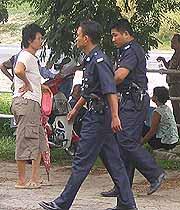 Given the weight of evidence it would be easy to paint the police across the Commonwealth in monochromatic black. This would be entirely unfair. In many countries the police are a very trusted and well-respected public service and in many more they do a hard and thankless job in difficult circumstances.
Nevertheless, barring a few honourable exceptions, there is too much wrong with policing in the Commonwealth for the association and its member states to persist in closing their eyes to the fact that the continued presence of unreformed policing - powerful, unaccountable, coercive, biased and corrupt - remains a badge of long gone colonial subservience rather than a mark of confident sovereignty.
What ails the police
Repeated citations of police wrongdoing, ranging from individual bad behaviour to institutionalised criminality, are undermining the principles of the Commonwealth Harare Declaration, to which all members have committed to abide. Abusive policing methods damage democracy, weaken the rule of law and lead to gross violations of human rights.
Rising crime, greater perceptions of vulnerability and fear of victimisation in all parts of the Commonwealth demand improved policing. Unprecedented security concerns have created more room for heavy-handed policing methods and tighter internal security regimes.
This has generated new problems in police community relations and torn at the interface of policing, democratic values and human rights.
Routine disobedience to procedural law is a prevalent feature of abusive policing. This includes detaining people without reasonable cause and/or for longer than permissible periods without bringing them before a designated authority; carrying out indiscriminate arrests; and even taking innocent family members hostage to coerce those wanted for questioning to turn themselves in.
Corruption too, is impeding police functioning in large parts of the Commonwealth. A bribe is often a prerequisite to registering a crime - or for looking away, with payments made to help 'steer' investigations.
 Equally disturbing is the stifling of legitimate political activity. Too often acting as agents of the ruling elite, police marginalise political opponents, assist in toppling governments in some places and help them stay in power in others. Trampling key human rights through police bias against ethnic, religious or linguistic minorities is a major cause of concern as well.
Crimes against women abound but are often met with a poor response, with stereotyping of women and patriarchal attitudes prejudicing the way police handle cases.
All too frequently, chilling reports surface of police resorting to extra judicial killings as a 'quick fix' device. Faced with mounting public frustration at their inefficacy in controlling crime or low-level conflicts, police seek to solve deep-rooted security challenges by simply liquidating the problem without the need to go through the 'inconvenience' of the legal process.
Most alarmingly, regular reports from all regions of the Commonwealth show that torture is a widely prevalent incident of custody.
 Perhaps the greatest public resentment and disappointment over bad policing is reserved for impunity - the safety from punishment provided by authorities and supervisors to errant police. This includes a boundless tolerance for poor performance in delivering safety and security and protecting the rule of law.
Given that the police are largely governed by the political executive - and in many jurisdictions closely controlled by it - impunity persists not by accident, but by design.
Serious breaches of law and accountability arise out of nurtured relationships of patronage. Undoubtedly, government is entitled to provide police with policy direction and set standards for performance. However, the distinction between appropriate executive direction and inappropriate political interference in operational matters is frequently transgressed to the detriment of the rule of law.
Improving policing
Democratic nations need democratic policing. This gives practical meaning to the Commonwealth's promise of democracy and good governance and is applicable to any context - rich or poor, large or small, or diverse or homogenous.
Member states have signed up to many international laws and standards that provide a framework for democratic policing. In practice, national constitutions and police laws are more immediately relevant to the conduct of police officers and organisations. As such, it is vital that legislation reflects these international standards and establishes police that serve to protect, rather than impede, freedoms.
The very purpose of the police is to provide a safe, orderly environment in which these freedoms can be exercised. A democratic police force is not concerned with people's beliefs or associates, their movements or conformity to state ideology. It is not even primarily concerned with the enforcement of regulations or bureaucratic regimens. Instead, the police force of a democracy is concerned strictly with the preservation of safe communities and the application of criminal law equally to all people, without fear or favour (United Nations International Police Task Force, 1996).
The Commonwealth has inspiring examples of reform, despite often very deep initial resistance to such change. The end of conflict in Northern Ireland, for instance, provided a moment for redesigning a new kind of police capable of sustaining the confidence of a diverse and divided community. Countries like South Africa, Sierra Leone, Fiji and Nigeria that have undergone dramatic transitions from authoritarianism to democracy have begun to showcase some of the seminal lessons for police reform.
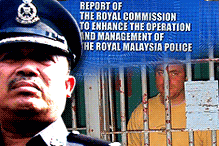 Depending on the context, police reform has entailed wholesale review of legislation and redefinition of role, as well as restructuring aimed at making the organisation less militaristic and hierarchical and more merit-based. Reform has sought to change the internal sub-culture in matters of ethics and discipline to bring about changes in attitude aimed at moving the police away from its frequently fortress-like mentality to becoming inclusive and responsive. Recruitment has been improved to be more representative.
Training now inculcates knowledge of human rights, nurturing initiative, honing new skills and creating professional specialisations. Reform has addressed the need for improved service conditions of the rank and file, and given attention to their career advancement based on good performance rather than patronage.
It has also harnessed technology, reassessed available financial and human resources, and devised strategies to make optimum use of scarce resources while putting in place rigorous oversight systems that ensure financial integrity.
Vital to new systems is their ability to insulate police from illegitimate outside interference, permitting officers functional autonomy coupled with management responsibility for delivering overall good services. This has involved careful demarcation of roles between political authorities and security agencies.
Democratic policing
Reform requires a shift from 'regime' policing to 'democratic' policing. This entails an approach founded on principles of equity and equality, accountability, transparency, participation, respect for diversity, the accommodation of dissent, protection of individual and group rights, and encouragement of human potential.
A 'democratic' police organisation is one that:
 - is accountable to the law, and not a law unto itself; those who break the law face consequences both through internal disciplinary systems and the criminal law;
- is accountable to democratic governance structures and the community;
- is transparent in its activities through scrutiny and regular reports to outside bodies and with information placed in the public domain;
- gives top operational priority to protecting the safety and rights of individuals and groups, especially those who are vulnerable and marginalised;
- protects human rights to life and dignity of all, freedom of speech, association, assembly, movement, and freedom from arbitrary arrest, detention and exile;
- provides society with professional services guided by a strong code of ethics and professional conduct and answerable for delivering high quality services; and
- is representative of the communities it serves in order to enjoy their confidence, and earn the trust of vulnerable and marginal groups who most need their protection.
Democratic policing not only protects democratic institutions and supports an environment where activities essential to democracy can flourish but also demonstrates democratic values in its own institutional structures and processes.
Tomorrow: Space for fresh dialogue
CHRI is an international NGO working for the practical realisation of human rights in the Commonwealth.
This is the first edited extract from its report, Police Accountability: Too Important to Neglect, Too Urgent to Delay , to be presented to the Commonwealth Heads of Government Meeting in Malta next month.


