


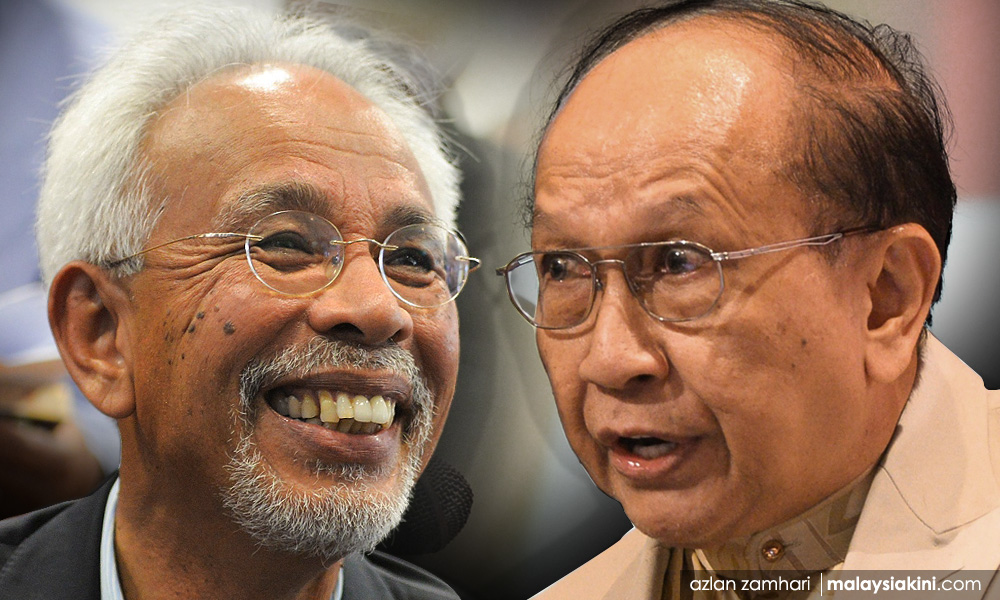

Contrasting paths of Shahrir Samad and Rais Yatim
COMMENT | In the late 1970s and early 1980s, there emerged from the folds of the party a coterie of Umno leaders who showed promise of capability to run with the baton that an older set could well bequeath them.
Among this set were the young hopefuls, Shahrir Samad and Rais Yatim.
Their youth, education and, more importantly, their apparent capability was a reassuring contrast to the situation that obtained some 10 years earlier.
This was when Dr Ismail Abdul Rahman, effectively the Umno No 2, after head honcho Abdul Razak Hussain, confided to his diary his worries – upon being apprised he had cancer in addition to a heart condition – over a perceived dearth in leadership material for the party.
Ismail's troubled musings must have escalated into pervasive anxiety when he became privy to what was then known to a very few - that the skipper of the crew was also stricken with cancer.
It was an anxious time as the country was grappling with momentous questions of how to proceed on issues of nation-building, wealth creation and distribution.
Upon the launch of the New Economic Policy, regarded as a panacea for the polity's ills as evidenced in the May 13, 1969 racial riots, there arose the need for implementers from within the political and bureaucratic strata - people who could give the NEP its leading edge.
Shahrir and Rais, and a host of others, emerged to fit the bill.
They were bright, articulate and capable; Ismail's apprehensions of a decade before seemed happily misplaced.
This reporter was witness to glimpses of the potential of both young talents.
An intimation of Rais' potential was seen as early as 1976 when as a ranking official in the Ministry of Culture, Youth and Sport, he stood out at a briefing the minister Ali Haji Ahmad held for the press at the ministry’s headquarters in Jalan Semarak.
It was a time when a minister was not averse to being outshone by an underling; looking like a coiled spring, it was plain to see that Rais was eager to prove his mettle and destined for better things to come.
Lawyer Rais just did go on to better things; he positively exuded it in the roles he went to...
COMMENT | In the late 1970s and early 1980s, there emerged from the folds of the party a coterie of Umno leaders who showed promise of capability to run with the baton that an older set could well bequeath them.
Among this set were the young hopefuls, Shahrir Samad and Rais Yatim.
Their youth, education and, more importantly, their apparent capability was a reassuring contrast to the situation that obtained some 10 years earlier.
This was when Dr Ismail Abdul Rahman, effectively the Umno No 2, after head honcho Abdul Razak Hussain, confided to his diary his worries – upon being apprised he had cancer in addition to a heart condition – over a perceived dearth in leadership material for the party.
Ismail's troubled musings must have escalated into pervasive anxiety when he became privy to what was then known to a very few - that the skipper of the crew was also stricken with cancer.
It was an anxious time as the country was grappling with momentous questions of how to proceed on issues of nation-building, wealth creation and distribution.
Upon the launch of the New Economic Policy, regarded as a panacea for the polity's ills as evidenced in the May 13, 1969 racial riots, there arose the need for implementers from within the political and bureaucratic strata - people who could give the NEP its leading edge.
Shahrir and Rais, and a host of others, emerged to fit the bill.
They were bright, articulate and capable; Ismail's apprehensions of a decade before seemed happily misplaced.
This reporter was witness to glimpses of the potential of both young talents.
An intimation of Rais' potential was seen as early as 1976 when as a ranking official in the Ministry of Culture, Youth and Sport, he stood out at a briefing the minister Ali Haji Ahmad held for the press at the ministry’s headquarters in Jalan Semarak.
It was a time when a minister was not averse to being outshone by an underling; looking like a coiled spring, it was plain to see that Rais was eager to prove his mettle and destined for better things to come.
Lawyer Rais just did go on to better things; he positively exuded it in the roles he went to play.
After resignation from the civil service, he became menteri besar of Negri Sembilan, and after narrowly missing out on a veep slot at the pivotal Umno elections of June 1981, he became a minister in Dr Mahathir Mohamad's cabinet in the wake of the 1982 general election.
Differing points
Cut to 1981, this reporter was present at a rugby gathering at Shahrir's residence in Petaling Jaya at which he delivered an after-dinner speech that sported all the embellishments of the art.
Speaking off the cuff, Shahrir's remarks combined flashes of wit – mostly the best type which is self-deprecating – gentle twitting of the foibles of some of those present, and a round-up of what needed to be done, by him and his collaborators, to advance the interests of the Kuala Lumpur Rugby Union.
If in as humdrum a context as the one that evening, an extemporaneous speech as elegant as the one Shahrir delivered could be had, what euphorically more could one reasonably expect?
By 1982, with both Shahrir and Rais as ministers in Mahathir's ‘Bersih, Cekap dan Amanah’ administration, a lot was in place for the beginnings of an illustrious era.
Then what happened?
It was just as the bard William Wordsworth cautioned in one of his poems, that what “begins in gladness, thereof comes despondency and madness.”
Broadly, two factors interposed to warp the career trajectories of Shahrir and Rais.
The rise of Islamist politics in Umno on the promptings of a Mahathir-sponsored Anwar Ibrahim and the escalation of an authoritarian strain in the top man himself that eventually locked Umno in the straitjacket of “hear no evil, speak no evil, and see no evil” among the subset.
The upshot: the grotesquerie that the country is now faced with – a kleptocracy that's not embarrassed by its exposure on the domestic and international fronts, with the words of Macbeth on its lips when confronted by Banquo's ghost: “Thou can't say that I have done it.”
What's passing strange about things now is that two of the shipwrecked of the Mahathir years – Shahrir and Rais – are inhabiting differing points on the reaction spectrum.
Shahrir has become an unabashed defender of the status quo while Rais, after having tasted bitter defeat and yielding to the dubious consolations of fellow travelling, is now floating intriguingly beyond the reflexive partisanship of the average Umno leader – he's airing his reservations.
Oh, sigh for the what-might-have-been.
TERENCE NETTO has been a journalist for more than four decades. A sobering discovery has been that those who protest the loudest tend to replicate the faults they revile in others.
The views expressed here are those of the author/contributor and do not necessarily represent the views of Malaysiakini.


