




Eat that ice cream, kill an orangutan
The orangutan is seriously endangered by the dietary habits of his nearest - the vast quantities of palm oil man needs to fry foods have steadily led to Southeast Asia's forests being turned into oil palm plantations, claim environmental activists.
But support for the orangutan has arrived in the shape of international non-governmental organisations (NGOs) that have mounted a new campaign against the felling of forests in Malaysia and Indonesia to make way for large-scale cultivation of oil palm.
The orangutan is seriously endangered by the dietary habits of his nearest - the vast quantities of palm oil man needs to fry foods have steadily led to Southeast Asia's forests being turned into oil palm plantations, claim environmental activists.
But support for the orangutan has arrived in the shape of international non-governmental organisations (NGOs) that have mounted a new campaign against the felling of forests in Malaysia and Indonesia to make way for large-scale cultivation of oil palm.
 The lobby claims that if anyone buying common household items such as crisps, ice cream, detergents, bread, lipstick and soap that contains palm oil, would be helping to drive orangutans to extinction.
The campaigners say that as the demand for palm oil grows, so does the felling of forests and in turn the destruction of orangutan habitats and exposure of the animal to poachers.
So ferocious is the campaign - which holds that orangutans will become extinct by 2020 if oil palm plantations continue to replace forests - that it has shaken government officials and producers in the two countries, which are the last refuge of the animal.
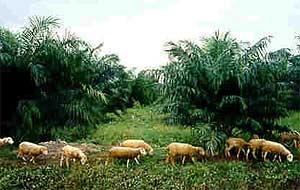 In Malaysia, currently the world's largest producer of palm oil, officials and producers worry that the campaign would affect world demand for the product, the country's second-biggest foreign-exchange earner after petroleum.
Last year, it produced nearly 14 million tonnes of palm oil, or half the global output, from 3.8 million hectares of plantation area.
And then there is competition. Indonesia is expected to overtake Malaysia as the world's leading producer shortly when new plantations begin production.
Processed-food manufacturers prefer palm oil because it does not need to undergo the costly process of hydrogenisation as with other cooking media. Its stability at high temperatures makes it ideal for deep frying, it gives fried products a longer shelf life and it has a bland taste that brings out natural food flavours.
Consumers held liable
Since the Ape Alliance, a coalition of international NGOs including Friends of the Earth, Borneo Orangutan Survival Foundation and Nature Alert, launched the worldwide campaign earlier this month there have been quick and often blind rebuttals by Malaysian agencies that promote palm oil and conduct marketing search.
Unlike earlier campaigns, the focus this time is not on stopping deforestation and saving an endangered species, but on directly blaming Western consumers for the decimation of orangutan populations.
The anti-palm oil campaign is centered in Britain, which imports nearly a million tonnes of palm oil a year and is therefore in a position to influence changes in the industry.
Already slogans - such as 'Save orangutans from extinction when you next shop' and 'Put an end to the cruelty of palm oil' - are having an impact going by the many queries Malaysian missions have been receiving on palm oil and the orangutan.
The campaigners published their facts and arguments in the widely distributed new report titled Oil for Ape Scandal, which contains gruesome photographs of the gentle animal captured and ill-treated in the plantations of Kalimantan.
Large supermarket chains such as Tesco are being urged by campaigners to certify that their palm-oil stocks came from non-destructive sources, where no forests were burned, only degraded land was used for planting, local communities were respected and, above all, where no orangutans were killed.
"We are not trying to put people out of business. We are simply asking that they do business without destroying the environment," said Sean Whyte, chief of Nature Alert and co-author of the report.
"Already 90% of the orangutan habitat in Southeast Asia has been wiped out and what is left is fast depleting. If we do nothing now our children will see orangutans only in the zoos. Orangutans could become extinct within 12 years."
Ian Redmond of Ape Alliance said: "It is we who will have to explain to our children that the orangutan became extinct because of corporate greed in our time. Oil palm plantations are now the primary cause of the decline in population of the orangutans in Malaysia and Indonesia."
Claim refuted
Experts estimate that about 5,000 orangutans perish each year as a result of habitat loss. Such claims are strongly denied by the Malaysian Palm Oil Association (MPOA), Malaysian Palm Oil Board and Malaysian Palm Oil Promotion Council, which hold that palm oil is a strategic, well-planned agricultural industry that supports the preservation of wildlife including the orangutan.
"These allegations are not well-founded and contain a number of factual inaccuracies," they said in a joint statement last week.
"The industry is far-better regulated, and the orangutan far-better protected than is suggested in the report. We often preserve jungle reserves and wildlife sanctuaries as part of efforts to maintain the existing biodiversity found in plantations."
Citing a recent survey, the industry has tried to show that "thousands" of orangutans remain alive and well in and around the Kinabatangan Wildlife Sanctuary in eastern Sabah state on Borneo Island, which is shared by Malaysia, Indonesia and Brunei.
 The MPOA said Malaysian companies would, in the next two years, adopt standards that would prove their willingness to be transparent about the palm-oil production process. Buyers would be able trace the origins of the palm oil in a product and ultimately to the estate where it was harvested, it said.
But the truth is that Malaysian and Singaporean capital, aided by European banks, has bought up large tracts of Indonesian plantations that were going cheap following the 1997 Asian financial crisis.
Capital from these countries is also opening up more plantations in the same lowland forest in Borneo and Sumatra islands, the only remaining natural habitat of the orangutan.
According to data from the Indonesian Forum for the Environment (Walhi), the Kutai National Park in East Kalimantan - an ideal orangutan habitat - consisted in 1934 of two million hectares but had shrunk to 306,000 hectares by 1957.
In 1997, the park was down to 198,604 hectares, and Walhi estimates it has since lost another 25,600 hectares due to illegal logging. There are currently thought to be only 606 orangutans surviving in the national park.
One answer, say environmentalists, is the Kinshasa Declaration, an action plan announced this month to protect forest areas and save the great apes from extinction.
If the Malaysian and Indonesia government sign this pact and implement it in an open and verifiable manner, it would go a long way to ease the fears of conservation groups worldwide.
- IPS


Are you sure you want to delete this comment?
This action cannot be undone.