


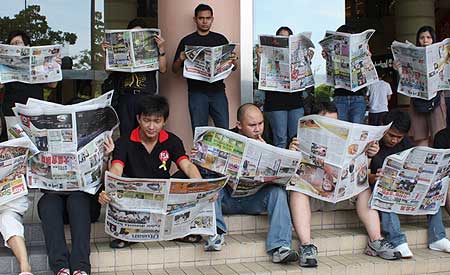

Securing constitutional protection for press freedom in M'sia
COMMENT | In its manifesto, the incoming Pakatan Harapan administration has promised to repeal oppressive legislations like the sedition and publication laws within 100 days of coming to power. It is easier said than done as there are legislative hurdles to overcome first.
In any case we cannot hope to restore press freedom by merely repealing oppressive laws layer by layer, just like peeling onions.
Repeal of oppressive laws by itself is no guarantee that new ones that may equally undermine press freedom would not be re-introduced later. A case of the law giveth, the law taketh away.
Press freedom is nebulous in nature, and every country, even communist regimes, proclaim that they uphold it. Just as we can’t hold water in the hollow of our palm for long, press freedom invariably eludes us. But freedom of the press, just like other civil liberties, are our basic human rights that must be accorded constitutional protection, nonetheless. This is our expectation.
Major overhaul needed
Media reform must, therefore, begin with a major overhaul. Let’s begin with amending the Federal Constitution to provide for a constitutional guarantee for freedom of the press. This can be done by including a provision for constitutional protection for press freedom in that no law shall be passed that would abridge or undermine such freedom....
COMMENT | In its manifesto, the incoming Pakatan Harapan administration has promised to repeal oppressive legislations like the sedition and publication laws within 100 days of coming to power. It is easier said than done as there are legislative hurdles to overcome first.
In any case we cannot hope to restore press freedom by merely repealing oppressive laws layer by layer, just like peeling onions.
Repeal of oppressive laws by itself is no guarantee that new ones that may equally undermine press freedom would not be re-introduced later. A case of the law giveth, the law taketh away.
Press freedom is nebulous in nature, and every country, even communist regimes, proclaim that they uphold it. Just as we can’t hold water in the hollow of our palm for long, press freedom invariably eludes us. But freedom of the press, just like other civil liberties, are our basic human rights that must be accorded constitutional protection, nonetheless. This is our expectation.
Major overhaul needed
Media reform must, therefore, begin with a major overhaul. Let’s begin with amending the Federal Constitution to provide for a constitutional guarantee for freedom of the press. This can be done by including a provision for constitutional protection for press freedom in that no law shall be passed that would abridge or undermine such freedom.
But this would constitute an amendment of the constitution which requires a two-third majority vote in the Dewan Rakyat or lower house. The new ruling coalition has only a simple majority, so such efforts may be blocked by their adversaries who now sit on the opposition bench.
Harapan can try to push through the amendment bill but it still has to get past the Dewan Negara or Senate. The upper house is not elected but appointed largely by the just-defeated BN coalition.
Emeritus professor Shad Saleem Faruqi is quoted as saying senators are not automatically removed by the dissolution of Parliament (to make way for the recently held general elections) and may remain for their entire three-year term, as provided by Article 45 (3) of the Federal Constitution.
The BN-appointed senators could stand in the way of Harapan’s intended legal reforms, such as repealing oppressive laws or seeking additional funds for the government. Already they have said they will not resign.
The senate can withhold approval of such bills and prevent their passage by returning these to the lower house to seek amendments. While the delay is not permanent, it could be enough to seriously retard Harapan’s plans in this area.
“Under Article 68 (of the constitution), the Senate can only be bypassed after 30 days for money bills and after one year for non-money bills,” according to the law professor.
This means the Senate could theoretically delay Harapan’s legal reforms by up to a year before these can be presented to the King for his royal assent.
Dewan Rakyat or lower house may opt to directly bring the bills to the King for his approval, but this would still cause undue delay.
Thus, an attempt to amend to introduce a provision guaranteeing the freedom of the press is likely to take more than the first 100 days.
Looking to the Philippines
In terms of choosing a model for constitutional protection for freedom of the press, about the most appropriate among Asean countries is that of the Philippines. The 1987 Constitution of the Philippines bill of rights states: “No law shall be passed abridging the freedom of speech, of expression, or of the press, or the right of the people peaceably to assemble and petition the government for redress of grievances.”
The cynical may want to dismiss this as merely a copycat of the American bill of rights or its First Amendment. But there is more to it than meets the eye.
Freedom of speech and freedom of the press is very much in the Filipino blood and has a long history.
The 1899 Constitution of the Republic of the Philippines, otherwise known as the Malolos Constitution, points out clearly in Article 20, “No Filipino should be deprived of the right to freely express his ideas or opinions, orally or in writing, through the use of the press or other similar means”.
The First Philippine Republic or the Malolos Republic, was a revolutionary government in the Philippines after 300 hundred years of Spanish colonialism. It was formally established with the proclamation of the Malolos Constitution in 1899, in Malolos, Bulacan. It endured until the capture of President Emilio Aguinaldo by the American forces in 1901, which effectively dissolved the First Republic.
The Malolos Constitution, the work of the Revolutionary Congress, in its Bill of Rights, zealously guarded freedom of speech and press and assembly and petition. But within two short years, the Americans betrayed the Filipinos. They snatched away the very rights to freedom fought with blood, sweat and tears of the Filipino patriots.
It was not until years later that these freedoms returned to the Filipino nation. Unfortunately, they lost the plot and during the Marcos years, press freedom like all other freedoms were snuffed out mercilessly. It was until the people could no longer stomach such deprivation of human rights, the corruption and evil governance, that People’s Power overthrew the Marcos regime and restored freedom of the press.
We can and must take a leaf out of the Filipinos’ book. We have tasted nine long years of fascism under the Najib regime. We deserved the government we never voted for. Freedom is never cheap nor free. Neither can we outsource it to Pakatan Harapan which by some miracle swept BN out of power once and for all.
Freedom of the press is our human right. We must, therefore, see to it that the incoming government, together with the opposition bench, provide a constitutional protection for freedom of the press. This must not be seen as an act of charity. This is the expectation of we, the people.
BOB TEOH is an author and writer. He has an MA in Journalism from the Konrad Adenauer Asian Center for Journalism at the Ateneo de Manila University and was previously secretary general of the Confederation of Asean Journalists.
The views expressed here are those of the author/contributor and do not necessarily represent the views of Malaysiakini.


Are you sure you want to delete this comment?
This action cannot be undone.