




Women speak out against humanitarian law
Women in the December 26 tsunami-hit areas are saying that humanitarian law discriminates against women. In the several sessions and discussions along the corridors of a recently-held Association of Women's Rights in Development (AWID) gathering in Bangkok, women are speaking out.
Humanitarian law springs from the Geneva Conventions and their additional protocols. Humanitarian law is designed to safeguard military personnel who are no longer involved in the hostilities (thus civilians) and belligerents. In the latter case, humanitarian law covers conduct of military operations and limits the means of harming the enemy.
"Humanitarian action" has not been precisely defined but is informed by the international legal regime concerning armed conflict.
Women in the December 26 tsunami-hit areas are saying that humanitarian law discriminates against women. In the several sessions and discussions along the corridors of a recently-held Association of Women's Rights in Development (AWID) gathering in Bangkok, women are speaking out.
Humanitarian law springs from the Geneva Conventions and their additional protocols. Humanitarian law is designed to safeguard military personnel who are no longer involved in the hostilities (thus civilians) and belligerents. In the latter case, humanitarian law covers conduct of military operations and limits the means of harming the enemy.
"Humanitarian action" has not been precisely defined but is informed by the international legal regime concerning armed conflict.
It is unclear from the AWID sessions as to which groups, agencies or governments are relying on humanitarian law or humanitarian action in the tsunami-hit areas. The speakers are mainly activists with grassroots concerns who are battling issues of basic needs at ground zero. The tsunami-hit areas in December included the North-East of Sri Lanka, Aceh in Indonesia and South Thailand.
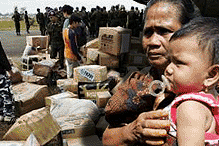 There has been a burgeoning interest in action-oriented research on the impact of natural disasters on women since the December tsunami.
An Oxfam survey conducted in March 2005 of four villages in Aceh Besar, Indonesia showed that surviving males outnumber female survivors by almost 3 to 1. Females accounted for 77 percent or more than three-quarters of the deaths in these villages.
In Cuddalore, India, Oxfam reports that almost three times as many women died as men -391 women died, compared to 146 men. The statistical data of those who perished in Sri Lanka showed a similar disproportion of females over males.
In Malaysia, the Ministry of Health in January, recorded the number of deaths at 11 persons, with 6 deaths of females at ages 55, 60, 70 (2 women), 74 and 76. There were 3 female infants dead, aged 11 months, 5 years and 14 years old. Two males aged 40 and 54 were the other casualties.
Gendered impact
The higher dead count among women is because, most women are at home with children and the elderly on that fateful Sunday, and they lost vital seconds gathering up children and food. Men in some places are out fishing and they survived as the waves passed harmlessly under their small boats.
In some communities, men are migrant workers or refugees away in host countries, leaving women and children at home. In others, men are running errands away from home on a Sunday.
In a 1992 account of floods in Bangladesh, the author Farida Ahkter, recounted that a poor male sharecropper who was holding his five daughters and one son, released his daughters one after the other, "so that his son could survive".
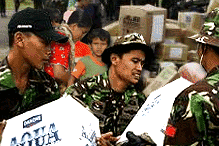 Published research of impact of natural disasters on women points to the fact that women and men face different challenges during natural disasters. Although women and men have many common concerns, disasters do affect women and men differently. This is because of the different roles they occupy in the society or community, the different and responsibilities given to them in life and the differences in their needs, capacities and vulnerabilities.
In the post-tsunami, construction and rehabilitation period, the majority of relief efforts marginalize women's access to relief. The emphasis on women in disaster management seeks to help correct the gender bias in most approaches today to vulnerability assessment and in emergency management.
Limited mandate
As a general rule, humanitarian law (HL) has precise boundaries. HL seeks to limit suffering during times of armed conflict and does not seek to address social inequalities or assist in rebuilding post-conflict communities. It makes no claim to deal with the basis of social structure. It abstains from any attempt to determine the validity of the reasons for a conflict. HL and humanitarian action do not stray into fundamentally political questions which will inevitably, say proponents, compromise the ability to mitigate suffering.
It is in this light that we might better understand the restraint exercised by the office of the United Nations High Commissioner for Refugees (UNHCR) in Kuala Lumpur when asked to comment on the recent influx of 131 Thai nationals (alleged "tourists" in early news reports) across the Malaysian border into the state of Kelantan.
The International Committee of the Red Cross (ICRC) for instance holds that humanitarian action should focus solely on the consequences of war and not aim to resolve conflict.
Advocates of HL and humanitarian action claim that its successes rely on this limited mandate. The survival of as many as possible, the "all-victims approach", lies at the heart of HL. The Geneva Conventions and their protocols, which provides the basis for much of humanitarian action/work are silent on questions on whether or not any war (or armed conflict), is justified, dealing only with rules of conduct.
In reality, humanitarians accept human rights norms as the basis for their work. Human rights work compels the examination of systemic causes and the unequal power relations underlying conflict. Human rights work may have political impact.
Women's rights defenders have taken it a step further. Armed conflict (as in natural disasters), impacts upon men and women in a fundamentally different way. Rules that do not include the reality of women's lives cannot respond to their situation. HL addresses women in terms of their relationships with others and not as individuals in their own right.
Gender-sensitive operations
Advocates of women's rights assert that HL must accede to a gender-based approach/analysis or fail women altogether. Thus, there is a move to push HL and humanitarian action that is committed to relieving suffering to also addressing the underlying causes (in this case, gender discrimination), in armed conflict.
 The UNHCR and the ICRC are two humanitarian organizations with offices in Kuala Lumpur that have considered gender issues in their 'operational work'.
The ICRC's Women Facing War study, seeks to alleviate the plight of women in times of armed conflict, recognizing that females are the most vulnerable victims of war. The UNHCR has its 2003 Sexual and Gender-Based Violence against Refugees, Returnees and Internally Displaced Persons-Guidelines for Prevention and Response.
The jury is still out, at least in the academia and certain 'humanitarian' agencies as to whether these gender concerns in armed conflict would in due course involve HL and humanitarian action in 'political questions' such as resolution of the conflict.
A key tension between a 'strictly humanitarian' approach and 'political engagement' is the worry that a blurring of approaches will compromise the ability of humanitarian agencies to carry out their activities. For example, relief workers in conflict zones main concern is to tend to needs of the victims of conflict in an impartial way free from the parties' political interests.
Women in Sri Lanka and Aceh (and perhaps now in war and quake- torn Kashmir), are however quite adamant that resolution to the conflict must be part of the post disaster reconstruction and management strategy. The discussions at AWID and at a regional consultation facilitated by the Asia Pacific Forum on Women, Law and Development (APWLD) in August suggest that conflict resolution is a priority concern of women in the post-tsunami reconstruction efforts.


Are you sure you want to delete this comment?
This action cannot be undone.