



Overcoming limits of democracy in new M’sia
COMMENT | Much as Malaysians are fawning over the triumph of democracy after the May 9 polls, it is vital to understand that some of the best minds still cannot agree if elections alone can lead to a generally more egalitarian society.
Joshua Kurtlanzick, Larry Diamond and the late Samuel Huntington have all warned of democratic retreat or recession.
Juan Linz and Guillermo O’Donnell once warned of bureaucratic authoritarianism, where after the transition of each election, powerful bureaucratic interests can hijack the agenda of the democratic regime at the expense of democratically elected politicians.
The late Robert Dahl went so far as to argue that democracy alone is not enough, even if it is the "only game in town."
Rather, the value of each vote (i.e., one person, one vote) should be equal, allowing various voters to participate in an informed and thoughtful manner in the whole process.
More importantly, voters should also be given the right to set the agenda of the country. Such a standard is even higher than that defined earlier, as it goes beyond warning of the risks posed by bureaucrats and politicians to returning power to the people.
Only when democracy satisfies these necessary characteristics, Dahl argued, can it become a self-sufficient system of government, which he described as ‘polyarchy’ – a regime where the interest of all is clear, succinct and not overly domineering.
Neither are there any vested interests to overwhelm those of the people – right down to the last man and woman.
With or without 100-day reforms, or even a five-year term, it goes without saying that Malaysia has a long way to go before it can transition from a democracy to a much fairer polyarchy.
Thus, the democratic achievement of May 9, while no doubt a cause to rejoice, should be understood and reflected upon deeply – beyond addressing issues like gerrymandering or bringing back local elections. This is because democratic consolidation requires eternal vigilance...
COMMENT | Much as Malaysians are fawning over the triumph of democracy after the May 9 polls, it is vital to understand that some of the best minds still cannot agree if elections alone can lead to a generally more egalitarian society.
Joshua Kurtlanzick, Larry Diamond and the late Samuel Huntington have all warned of democratic retreat or recession.
Juan Linz and Guillermo O’Donnell once warned of bureaucratic authoritarianism, where after the transition of each election, powerful bureaucratic interests can hijack the agenda of the democratic regime at the expense of democratically elected politicians.
The late Robert Dahl went so far as to argue that democracy alone is not enough, even if it is the "only game in town."
Rather, the value of each vote (i.e., one person, one vote) should be equal, allowing various voters to participate in an informed and thoughtful manner in the whole process.
More importantly, voters should also be given the right to set the agenda of the country. Such a standard is even higher than that defined earlier, as it goes beyond warning of the risks posed by bureaucrats and politicians to returning power to the people.
Only when democracy satisfies these necessary characteristics, Dahl argued, can it become a self-sufficient system of government, which he described as ‘polyarchy’ – a regime where the interest of all is clear, succinct and not overly domineering.
Neither are there any vested interests to overwhelm those of the people – right down to the last man and woman.
With or without 100-day reforms, or even a five-year term, it goes without saying that Malaysia has a long way to go before it can transition from a democracy to a much fairer polyarchy.
Thus, the democratic achievement of May 9, while no doubt a cause to rejoice, should be understood and reflected upon deeply – beyond addressing issues like gerrymandering or bringing back local elections. This is because democratic consolidation requires eternal vigilance.
More importantly, as a trading state, Malaysia cannot be too picky with its friends, especially not when the paring of the national debt is a priority. We have to trade with all.
‘Game of Thrones’
But according to Robert Putnam, in situations such as these, the interests of bureaucrats may come to the fore, with them wanting certain sectors to move forward, at the expense of others. For instance, due to inter bureaucratic rivalry, the aims of the Finance Ministry may not coincide with those of the International Trade and Industry Ministry.
In cases such as these, ministries may resort to working closely with foreign financial agencies like the International Monetary Fund, or credit rating firms like Moody's to push their bureaucratic rivals or central banks in a specific policy direction.
This is a ‘Game of Thrones’ of sorts, where each bureaucratic entity tries to outmanoeuvre the other.
To the degree the people understand that they will not be manipulated, then the exercise of their suffrage can be very meaningful, as the outcome of May 9 showed.
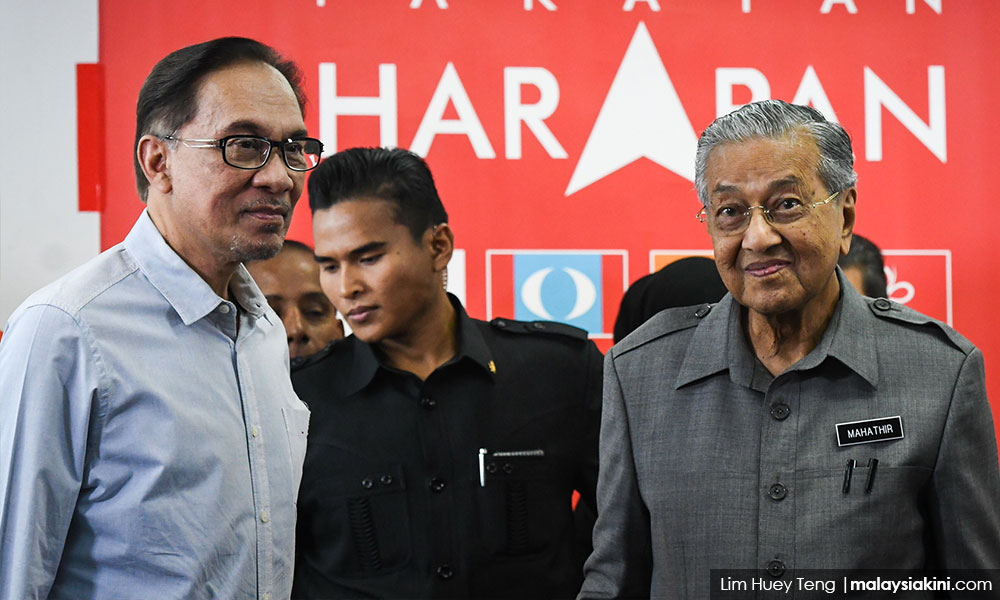
Indeed, the key focus now is not whether Anwar Ibrahim can succeed Dr Mahathir Mohamad – though granted that since this transition has been verbalised, it will continually dominate the news cycle. Rather, what matters above all is national unity and interest, and indeed, the collective pursuit of both.
When a country stays united, it has a higher prospect of pursuing a system of government that can transcend the aforementioned petty interests, and achieve what the Japanese called 'fukoku kyohei' – enriching the state and strengthening the army.
This is what China, South Korea and all 34 members of the Organisation of Economic Cooperation and Development (OECD) are doing as well.
Malaysia has no quarrels with anyone. And with the looming spectre of extremism, Malaysia should indeed focus foremost on enriching itself and enhancing its national sovereignty.
PHAR KIM BENG is a Harvard/Cambridge Commonwealth Fellow, a former Monbusho scholar at University of Tokyo and visiting scholar at Waseda University.
The views expressed here are those of the author/contributor and do not necessarily represent the views of Malaysiakini.


