



Kudos for exiting the Middle East through Yemen
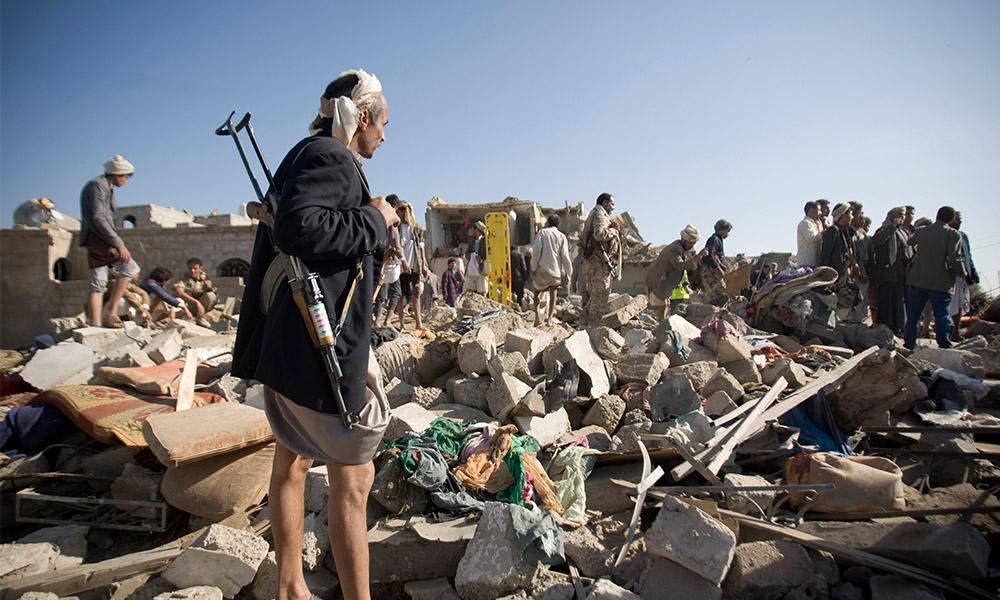
COMMENT | If the reports in the media are anything to go by, Malaysian soldiers deployed in Yemen would soon be recalled. They would be returning home. This is good news. Bringing the troops back, when they haven't suffered any casualties in any form or manner is always a thing to rejoice.
Hence, the announcement of Defence Minister Mohamad Sabu that Malaysia will exit Yemen should be seen through the optic of responsible politics - the form that has begun to acquire some decent shape after the strategic upset of May 9, 2018.
Had Umno and BN won on that fateful day - they lost badly - they would have felt obliged to place the troops on Yemeni soil indefinitely; in light of their entwined interest with Saudi Arabia and United Arab Emirates (UAE), which began with the implosion of the 1MDB fiasco.
No one is saying that Malaysia, Saudi Arabia and UAE are directly responsible for 1MDB. The investigation is still on-going. But perception is politics too.
Part of the paper trails or excuses that money was originally donated by a prince from Saudi Arabia has had Malaysian voters curious about the Middle East, indeed, wondering loudly why was Najib so close to the Middle East, when in fact, every embrace of that region - especially when it is volatile - lead to policy failure.
Take Turkey, for instance. Under Dr Ahmet Davutoglu, the former prime minister of Turkey (2014-2015), he tried to be friendly to all contiguous regions connected to Turkey. This includes North Africa, Europe, Balkans, Caucasus, Central Asia and the Middle East.
While strong and positive relationships could be maintained with all the member states of these regions at first, things began to go wrong when Turkey found itself unable to extricate the country from the turbulence of the Middle East after the aftermath of the Arab Spring that exploded in 2012.
In turn, Turkey found itself unable to maintain good relationship with Egypt, Syria, even most of the Gulf countries, with the exception of Qatar. Before long, Turkey's foreign policy was adrift, and two million refugees from Syria were making a beeline to Turkey, which Turkey is now hosting.
Malaysia cannot absorb any large influx of refugees when things go wrong, not when our national debt and liabilities have reached RM1.09 trillion. By this token, Malaysia should be close to the Middle East strictly in terms of trade. All else should be approached with serious caution, let alone war.
Thus, exiting the 34-member coalition led by Saudi Arabia makes...
COMMENT | If the reports in the media are anything to go by, Malaysian soldiers deployed in Yemen would soon be recalled. They would be returning home. This is good news. Bringing the troops back, when they haven't suffered any casualties in any form or manner is always a thing to rejoice.
Hence, the announcement of Defence Minister Mohamad Sabu that Malaysia will exit Yemen should be seen through the optic of responsible politics - the form that has begun to acquire some decent shape after the strategic upset of May 9, 2018.
Had Umno and BN won on that fateful day - they lost badly - they would have felt obliged to place the troops on Yemeni soil indefinitely; in light of their entwined interest with Saudi Arabia and United Arab Emirates (UAE), which began with the implosion of the 1MDB fiasco.
No one is saying that Malaysia, Saudi Arabia and UAE are directly responsible for 1MDB. The investigation is still on-going. But perception is politics too.
Part of the paper trails or excuses that money was originally donated by a prince from Saudi Arabia has had Malaysian voters curious about the Middle East, indeed, wondering loudly why was Najib so close to the Middle East, when in fact, every embrace of that region - especially when it is volatile - lead to policy failure.
Take Turkey, for instance. Under Dr Ahmet Davutoglu, the former prime minister of Turkey (2014-2015), he tried to be friendly to all contiguous regions connected to Turkey. This includes North Africa, Europe, Balkans, Caucasus, Central Asia and the Middle East.
While strong and positive relationships could be maintained with all the member states of these regions at first, things began to go wrong when Turkey found itself unable to extricate the country from the turbulence of the Middle East after the aftermath of the Arab Spring that exploded in 2012.
In turn, Turkey found itself unable to maintain good relationship with Egypt, Syria, even most of the Gulf countries, with the exception of Qatar. Before long, Turkey's foreign policy was adrift, and two million refugees from Syria were making a beeline to Turkey, which Turkey is now hosting.
Malaysia cannot absorb any large influx of refugees when things go wrong, not when our national debt and liabilities have reached RM1.09 trillion. By this token, Malaysia should be close to the Middle East strictly in terms of trade. All else should be approached with serious caution, let alone war.
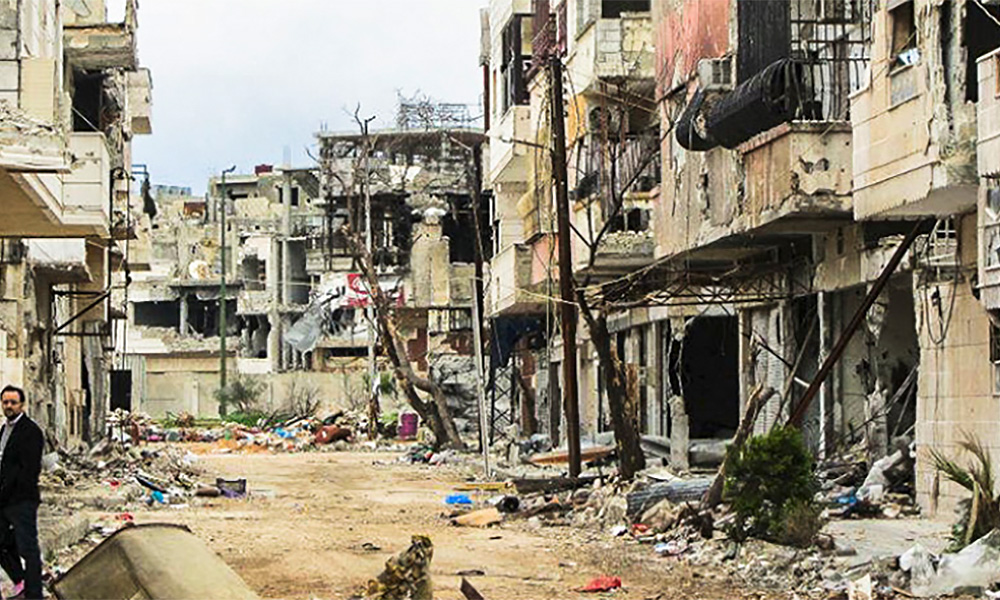
Thus, exiting the 34-member coalition led by Saudi Arabia makes ample sense. It has several advantages too, the best of which is to encourage them to Look East; especially in terms of the deliverables they want to achieve to obtain a durable peace.
Unknown to many people outside of East Asia, the latter has only seen two major interstate armed conflicts since 1945 which were not of the region's own making to boot. The Middle East has a lot to learn from East Asia, invariably, to their own benefit.
For example, the Vietnam War that began with the US involvement in Indochina after the end of the French war of Dien Bien Phu in 1953, was soon followed by the Korean conflict, then armistice, in 1953. Both sets of conflicts were referred by Kim Kyung Won, a professor of political science at the Institute of Social Science in Seoul, as "war of imports."
They became political livewire in the region precisely because the sources of discord rested with the external world: the Cold War rivalry between the US and Soviet Union, indeed, China. In, and of itself, East Asia has very little to go for the jugular of one another.
North Korea and South Korea, for example, did not have to be divided in the first place - if communism was not the central dividing issue. But they did. The Republic of China (Taiwan) and People's Republic of China are also divided by their ideological differences.
Come what may, the interstate conflicts in East Asia have been relatively short, as marked by the short border invasion of China against Vietnam in 1979, a conflict which barely lasted a week. This was again true in the Thai and Cambodian border conflict over the exact demarcation site of the Preah Vihear temple in 2008 whose very location remain contested by the two countries.
Calm and self-restraint
Even the South China Sea issue has been given a unique dimension as of June 19. Speaking to South China Morning Post, Prime Minister Dr Mahathir Mohamad urged that "warships" not be deployed to the sensitive areas that are under various contestations. Instead, claimant states in the South China Sea might want to try "joint patrols" of small boats - not warships. The latter will just heighten the nationalistic passion of all sides unnecessarily.
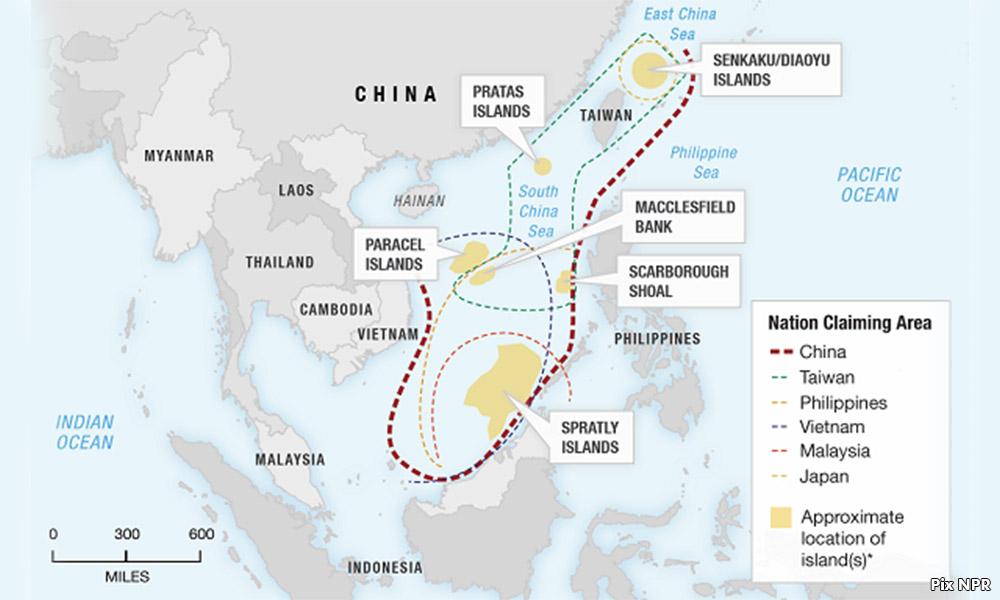
Due to the willingness to talk, as opposed to taking a hardline position, East Asia has done what no countries in the world has achieved. Some 99 percent of the battle deaths that involved the fatalities of the interstate wars in the region have seen a wholesale reduction across the region since 1976. This is something the Middle East should emulate.
Researchers at the Nordic Institute of Asian Studies in Copenhagen, Denmark did not call it the "Asian way," or the “Asian Pacific process." But they have referred to it as the “East Asian peace”. Undergirding this philosophy is the focus on joint development, and common refrain from using fiendish rhetoric to combat any immediate friction.
East Asian peace cannot guarantee an ultimate solution to the quagmire in South China Sea, but what Mahathir is urging appears sensible: calm and self-restraint. It is now up to China to reciprocate with the possibility of a joint patrol with the member states of the Association of Southeast Asian Nations (Asean) to combat any potential piracy problems.
The above are lessons that the Middle East can learn, and perhaps adapt them to their own statecraft.
If need be, starts a dialogue based on track two diplomacy first, which involves a set of trusted think tanks collaborating with each other to take those baby steps ahead. These think tanks must have the trust of the state and civil society. They need to talk privately and candidly before things come to a point where their respective government can sign on to, without which the conflict persists.
Besides, Malaysian soldiers have no business in a hostile conflict like Yemen, where there is a proxy war between Saudi Arabia and the UAE on one side and Iran on the other. Regardless of who wins, this is a zero-sum conflict where hatred will only perpetuate more hatred. Malaysia should not be sucked into the vortex of such destructive politics in the Middle East.
As a trading state, Malaysia can and do want friendly relationships with all countries. That is the threshold to begin Malaysia's engagement with the world, including the Middle East.
PHAR KIM BENG is a Harvard/Cambridge Commonwealth Fellow, a former Monbusho scholar at the University of Tokyo and visiting scholar at Waseda University.
The views expressed here are those of the author/contributor and do not necessarily represent the views of Malaysiakini.


