



Re-imagining Malaysian politics: A road map to deracialisation
COMMENT | Malaysia needs change.
May 9 was the beginning of that journey of change, not the end of it.
Indeed, the road to reform is not a road at all, but a wide, open ocean. For the first time ever, we have new captains at the helm and it falls to all of us to help decide our exact course.
Of the many areas requiring change in Malaysia, the future of our political landscape is perhaps the most undefined and uncharted.
Political fault lines matter. When Malaya was first formed, we had choices to make about how we would organise ourselves politically. The choices we made then shaped the social fabric of our nation for decades.
Having our primary political parties based on race eventually created an obsession which saw every controversy and political conflict through a racial lens - not politicised race, but racialised politics.
The impact this has had cannot be understated - it shaped how we grew apart as a nation, conditioned to see each other as different and distrust one another more and more over time.
With BN having been dealt a decisive blow in GE14, will we now have the courage to right these wrongs and redefine our political landscape in pursuit of genuine national unity? If the answer is yes, then let us explore a number of bold, concrete steps that we can take to make this a reality.
The most obvious step is ...
COMMENT | Malaysia needs change.
May 9 was the beginning of that journey of change, not the end of it.
Indeed, the road to reform is not a road at all, but a wide, open ocean. For the first time ever, we have new captains at the helm and it falls to all of us to help decide our exact course.
Of the many areas requiring change in Malaysia, the future of our political landscape is perhaps the most undefined and uncharted.
Political fault lines matter. When Malaya was first formed, we had choices to make about how we would organise ourselves politically. The choices we made then shaped the social fabric of our nation for decades.
Having our primary political parties based on race eventually created an obsession which saw every controversy and political conflict through a racial lens - not politicised race, but racialised politics.
The impact this has had cannot be understated - it shaped how we grew apart as a nation, conditioned to see each other as different and distrust one another more and more over time.
With BN having been dealt a decisive blow in GE14, will we now have the courage to right these wrongs and redefine our political landscape in pursuit of genuine national unity? If the answer is yes, then let us explore a number of bold, concrete steps that we can take to make this a reality.
The most obvious step is to deracialise our political parties. Umno president hopeful Khairy Jamaluddin has advocated just this, alongside another number of prominent Umno individuals.
The fact that these sentiments are coming even from conservative elements within Umno reflects an understanding of the basic electoral math and modern realities which show that Umno will never again govern Malaysia using the old BN model.
Too many aspects of that old system have fallen apart and has no place in a world where racism is simply more and more unacceptable.
If Umno retains its exclusivity and racist attitudes, it may guarantee itself a (small) presence in Parliament for some time to come, but it will be condemned to being a fringe party, hopelessly unable to find the allies it would need to ever form a government.
If they are willing to step boldly into the new millennium and open themselves up, there is still a chance they can form the core of an effective opposition and government in waiting - something the country badly needs for its long-term health, whether led by Umno or someone else.
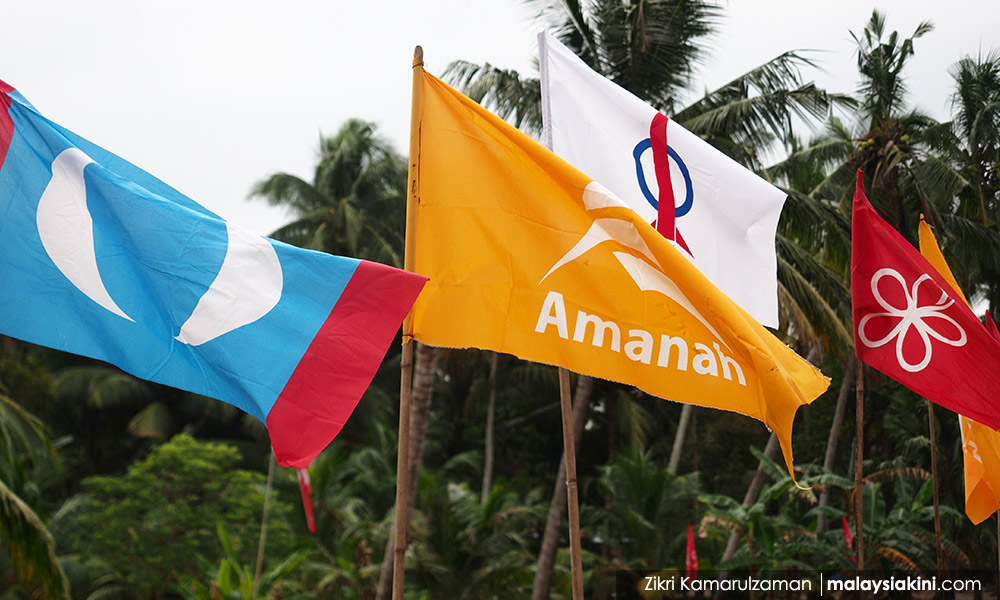
If Umno takes the correct step of going multiracial, then there is absolutely no reason left for Bersatu not to do the same. Indeed, whether or not Umno goes multiracial, the principled, statesmanly thing for Bersatu to do is to open up and go multiracial as well.
They have the political capital to do so, and if they govern as well as they clearly intend to, they will indubitably survive any short-term losses from doing so.
Replacing race with regionalism
If these major political parties deracialise themselves, the obvious question is: how do we fill the ideological vacuum it leaves behind?
Where once race defined our politics, what will define it next? What implications will there be for both inter and intra-coalition political competition?
Here the Malaysian ship wanders into the uncharted waters alluded to above, but here as well, is an opportunity worth seizing. One criterion for differentiation among political parties that has considerable potential is regionalism.
The archaic BN model essentially had one political party for each major race. Imagine in place of that, a model where each major Harapan party was responsible for certain regions and geographical demographics instead.
For instance, Bersatu can be primarily responsible for rural Malaysia, and take the lead in states like Kedah and Johor.
DAP can then reconceptualise itself as being the primary champion of urban issues, and continue to take the lead in Penang, as well as play a major role in highly urbanised states like Selangor and Perak.
PKR can position itself as a bridge-builder specialising in the ‘in-betweens’ similar perhaps to the role it played in Pakatan Rakyat, and continue to lead in states like Selangor and Negeri Sembilan.
This model frees up parties from being tied to racial demographics and opens the door to some important potential blending - blending that may help shed old baggage and open significant new doors.
For instance, this model can encourage more interaction between DAP and urban Malays, allowing it to shed more and more of its Chinese chauvinist image.
Besides maintaining a large segment of its original base, being assigned rural areas would give a newly multiracial Bersatu the opportunity to invest in the welfare of demographics like new villages and rubber estates.
While these leaps may appear hard to imagine at first, it would be a massive step towards building the bridges Malaysia most badly needs.
By happy coincidence, Harapan will also presumably now begin operating under a unified, unique symbol (as opposed to the stopgap measure of using PKR’s).
This is the perfect time to forge new definitions of what that symbol stands for, and how each component party is not limited to certain races. While many parties have said the right things about multiracialism, this initiative can make those words a much truer reality than ever before.
Working across the aisle
If parties like Bersatu might be interested in getting help from some parties with experience in places like new villages and rubber estates, rumour has it that there are some old parties with exactly that experience who are also looking desperately for new political directions.
Under this model, even DAP might be able to engage former urban Umno elements looking to find a place in the new Malaysia. Needless to say, one has to be very, very careful about taking in former BN elements.
The primary expertise of a large number of BN leaders is essentially in being a feudal warlord adept at corruption, patronage and feeding sycophants. Those people are not needed and should be avoided at all costs.
A (precious) few among them though, do actually have some sincerity and experience in doing effective grassroots level work that benefits communities.
In working with impoverished communities, one should also never forget Parti Sosialis Malaysia (PSM) who have been working on the ground tirelessly with ever so stretched resources, and whose impact has been recognised time and again by the communities they work with.
Then there is PAS and Amanah.
By this point, only the very blind would be unable to see that the majority of Malaysians outside of Kelantan, Terengganu and perhaps Kedah are not very interested in a PAS that is going it alone.
If PAS decides that it is content to lead in these two and a half states, then that is probably all well and good. They can continue there, and add to the rich diversity of Malaysian politics.

Should they wish to participate more widely at a national level, then certainly some very extensive internal soul searching and change is in order.
If Bersatu and Umno both go multiracial, this also paves the way for Amanah to potentially play an interesting role.
We do not expect bumiputera-centric thinking to go away overnight. On the Harapan front, perhaps Amanah - not as the core driver, but still a relevant party in the coalition - can exist as an avenue for those still very concerned with the position of Islam and the Malays.
If the current crop of Amanah leaders stays true to their principles, there seems little chance of them flying off the handle and getting swept away in extremism. At the same time, they could potentially allay short-term fears that either Malay or Muslim interests will be severely compromised.
Showcase states
The future of Sabah and Sarawak is likely to be marked by ever greater autonomy. It is likely to be in the interests of the peninsula to allow East Malaysians to continue along this path of self-determination.
As long as Warisan continues to adhere to principles of transparency and accountability, there seems little reason for the peninsular to interfere with what they are doing.
As for Sarawak, it seems unlikely that the former BN parties currently in power should be given a free pass merely because they have decided to leave BN.
Past corruption by said parties and their leaders should most definitely not be given any sort of free pass whatsoever. In the next state elections, Sarawakians should be given the full spectrum of political choices, with minimal or no deal-making clouding the waters.
We should recognise the fact that each major party in Malaysia has at least one head of state - a perfect focal point for each party to showcase their ability to govern.
Indeed, this should be the new basis for competition between political parties, and the primary metric by which they are assessed and compared.
Let us leave behind once and for all the days when each political party tried to outdo one another by seeing who could scream the loudest for ‘their’ race, or belittle other races the most.
Let us then fill that vacuum with competition based on things like who can have the most transparent government, who can stimulate the best, most holistic development in their state, and who can best protect the welfare of their citizens.
What this would entail is something much closer to true political meritocracy - a system centred around performance-based indicators, rather than low brow sentiment stirring.
Battling feudalism
In this new meritocracy, it is also vitally important to take steps to eliminate the culture of feudal warlord-ism.
Some concrete steps can include adopting PKR’s policy of “one member one vote” for party elections or even going so far as to introduce primaries to choose candidates for public office.
On that note, it may be good for PKR to adopt vice president Shamsul Iskandar’s suggestion that Anwar Ibrahim contest the post of president, and leave behind once and for all the undemocratic, vague post of ‘de-facto’ leader - at once upholding democratic principles, and preparing PKR to transition out of its mould of a party based around one man only.
Feudalism survived in Malaysia for so long by creating pyramid structures of power and patronage.
Smashing that pyramid and making the structure more flat will go a long way in ensuring the core of democracy: that critical decisions be made by the many, and not the few.
During the recent Ramadan, there were reports of a number of churches going to neighbouring mosques for bridge-building buka puasa events.
It was incredibly heartening to see so quickly after the election how removing a racist government frees Malaysians to do what they naturally do best: be good, colour-blind neighbours.
We should not let this momentum slow down. Let us keep riding the wave until we are well rid of all the institutional and political vestiges that once worked so hard to divide us.
One of the most important steps in doing so is to make sure that we replace this old political paradigm with a model that works - one that encourages the healthiest possible form of competition, rather than one that thrives on fearmongering and division.
Once we get there, there will be no limits to what we can achieve as a nation united.
NATHANIEL TAN is eager to serve.
The views expressed here are those of the author/contributor and do not necessarily represent the views of Malaysiakini.


Report this comment
Are you sure you want to delete this comment?
This action cannot be undone.