



New Silk Road: Too big to ignore but pitfalls aplenty
COMMENT | China’s new Silk Road initiative is far too big for Malaysia to ignore but there are potential pitfalls. So far three corrupt regimes whose prime ministers who went overboard borrowing heavily from China have fallen – Pakistan, Sri Lanka and Malaysia.
But there are opportunities for smart partnership with China like what Singapore and Indonesia did by hammering out hard bargains with China. In fact, Singapore is the only country in the Silk Road scheme of things where China does not have any footprint in the host country. Instead Singapore is heavily investing and building mega projects on the Chinese mainland. Last year, Singapore has also overtaken the US as the biggest foreign investor in China.
Indonesia, with its archipelago of 17,500 islands, is too strategic a maritime nation for China to ignore. In fact, President Xi Jinping chose Indonesia to unveil China’s Silk Road plan on his first visit there in 2013. Indonesia has been driving hard bargains with China for its Silk Road projects by leaving the option open to borrow yen-denominated loans.
Like his counterparts in Pakistan and Sri Lanka, Najib Razak went with a begging bowl seven times in a row since he became prime minister in 2009. All three leaders have lost their jobs under a dark cloud of unprecedented corruption and recklessly borrowing from China.
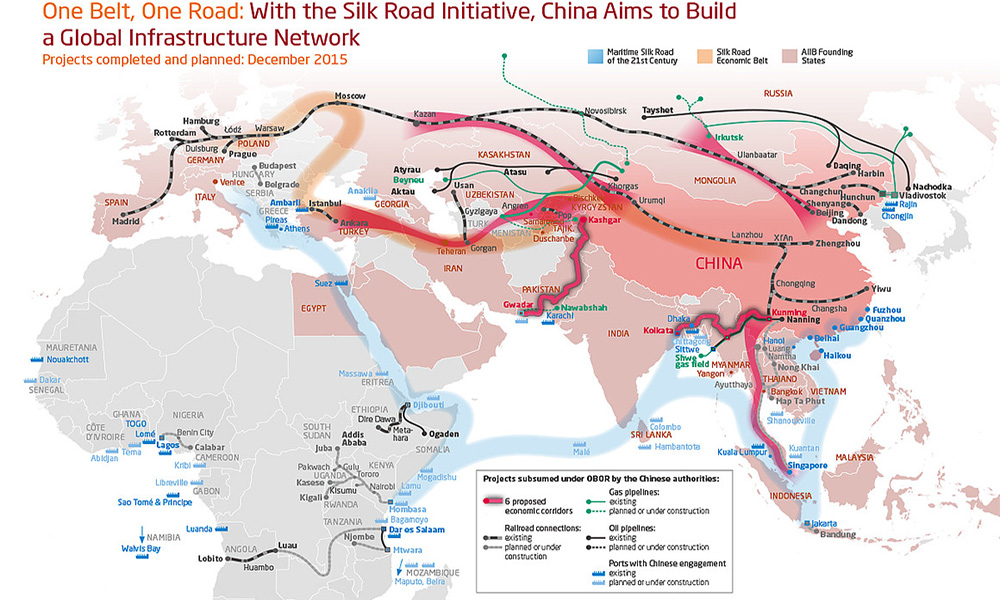
China’s Silk Road is a ginormous project involving US$1 trillion in investment on the back of its mountain of foreign reserves of US$3 trillion. The road crosses at least 65 countries from China through Asia and onward to Europe.
China’s Silk Road, initially billed One Belt One Road (Obor) and later rebranded as Belt and Road Initiative (BRI), actually consists on one belt, one road, one ring and one click.
The road is curiously described as a belt running from eastern China across its poorer inland regions toward its western border and across central Asia before reaching Europe. This is essentially a new path over the ancient silk road. The road includes China’s maritime route stretching over a few oceans and seas from China to Europe, also following the ancient maritime silk road. The ring is China’s Ice Silk Road across the frozen Arctic Ocean accessing from Russia. The one click, of course, refers to Jack Ma’s Alibaba global e-trading platforms.
I cited in my book ‘The Dragon Stirs – China’s Silk Road’ that Xi Jinping’s Chinese Dream is so audacious in its geo-economics scope that the Washington-based Institute for the Analysis of Global Security is quick to notice, describing it as the “most ambitious and all-encompassing economic development project in the history of humanity”.
Goldman Sachs has predicted China’s GDP will match that of the US by 2027, in nine years’ time, and from there probably overtaking the US as the world’s biggest economy.
Within 15 years to 2015, China’s trade with Asean countries grew ten-fold to US$492 billion and this is expected to quadruple to US$1.8 trillion by 2030. China’s overseas direct investment in the Asean region grew 200 percent to US$7.8 trillion in 2014. It is also the largest trading partner in seven out of the 10 Asean countries.
But beyond China’s new geo-economics is its growing geopolitical assertiveness in the disputed Spratly Islands in the South China Sea despite the area is also claimed by Vietnam, the Philippines, Malaysia, Taiwan and Brunei.
Along this vast maritime corridor ply the Japan-based US Seventh Fleet, America’s largest, together with the navies of Japan, South Korea and India. The British Navy has also indicated its interest in sailing into the troubled seas...
COMMENT | China’s new Silk Road initiative is far too big for Malaysia to ignore but there are potential pitfalls. So far three corrupt regimes whose prime ministers who went overboard borrowing heavily from China have fallen – Pakistan, Sri Lanka and Malaysia.
But there are opportunities for smart partnership with China like what Singapore and Indonesia did by hammering out hard bargains with China. In fact, Singapore is the only country in the Silk Road scheme of things where China does not have any footprint in the host country. Instead Singapore is heavily investing and building mega projects on the Chinese mainland. Last year, Singapore has also overtaken the US as the biggest foreign investor in China.
Indonesia, with its archipelago of 17,500 islands, is too strategic a maritime nation for China to ignore. In fact, President Xi Jinping chose Indonesia to unveil China’s Silk Road plan on his first visit there in 2013. Indonesia has been driving hard bargains with China for its Silk Road projects by leaving the option open to borrow yen-denominated loans.
Like his counterparts in Pakistan and Sri Lanka, Najib Razak went with a begging bowl seven times in a row since he became prime minister in 2009. All three leaders have lost their jobs under a dark cloud of unprecedented corruption and recklessly borrowing from China.
China’s Silk Road is a ginormous project involving US$1 trillion in investment on the back of its mountain of foreign reserves of US$3 trillion. The road crosses at least 65 countries from China through Asia and onward to Europe.
China’s Silk Road, initially billed One Belt One Road (Obor) and later rebranded as Belt and Road Initiative (BRI), actually consists on one belt, one road, one ring and one click.
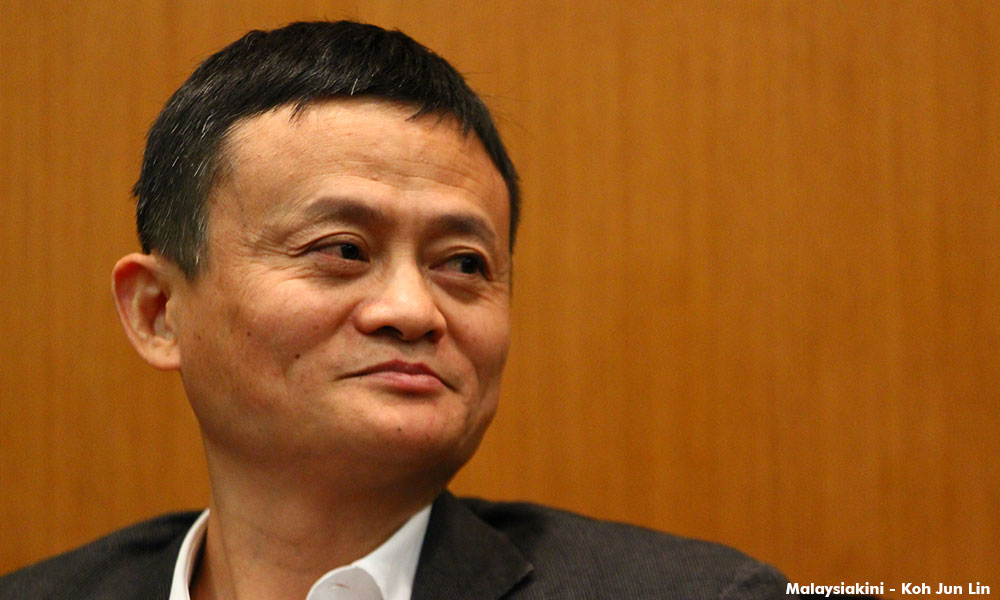
The road is curiously described as a belt running from eastern China across its poorer inland regions toward its western border and across central Asia before reaching Europe. This is essentially a new path over the ancient silk road. The road includes China’s maritime route stretching over a few oceans and seas from China to Europe, also following the ancient maritime silk road. The ring is China’s Ice Silk Road across the frozen Arctic Ocean accessing from Russia. The one click, of course, refers to Jack Ma’s (photo) Alibaba global e-trading platforms.
I cited in my book ‘The Dragon Stirs – China’s Silk Road’ that Xi Jinping’s Chinese Dream is so audacious in its geo-economics scope that the Washington-based Institute for the Analysis of Global Security is quick to notice, describing it as the “most ambitious and all-encompassing economic development project in the history of humanity”.
Goldman Sachs has predicted China’s GDP will match that of the US by 2027, in nine years’ time, and from there probably overtaking the US as the world’s biggest economy.
Within 15 years to 2015, China’s trade with Asean countries grew ten-fold to US$492 billion and this is expected to quadruple to US$1.8 trillion by 2030. China’s overseas direct investment in the Asean region grew 200 percent to US$7.8 trillion in 2014. It is also the largest trading partner in seven out of the 10 Asean countries.
But beyond China’s new geo-economics is its growing geopolitical assertiveness in the disputed Spratly Islands in the South China Sea despite the area is also claimed by Vietnam, the Philippines, Malaysia, Taiwan and Brunei.
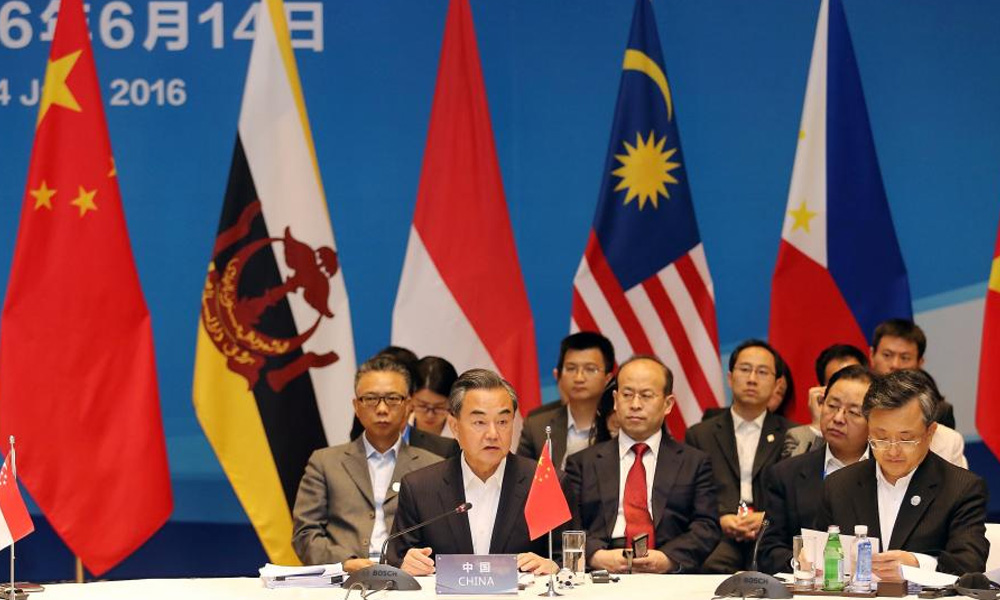
Along this vast maritime corridor ply the Japan-based US Seventh Fleet, America’s largest, together with the navies of Japan, South Korea and India. The British Navy has also indicated its interest in sailing into the troubled seas.
A string of seaports
To counter this, China is building a string of 35 ports covering its Maritime Silk Road. The latest is in Djibouti at the southern entrance to the Red Sea on the route to the Suez Canal. It will be China's first overseas naval base.
In the Indian Ocean, China is funding projects in Pakistan and Sri Lanka. The China Pakistan Economic Corridor (CPEC) includes the deep port of Gwadar in the Arabian Sea. This would allow China to increase its naval presence in the vicinity of the Persian Gulf. But this corridor runs through a restive region so much so Pakistan has to station 13,000 troops to guard it. Locals are also unhappy because China is using its own workers instead of Pakistanis.
In Sri Lanka, China built a US$1.7 billion seaport and airport in the southern city of Hambantota whilst in the Maldives archipelago, China aims to build a port in Laamu Atoll in the southern part of the country.
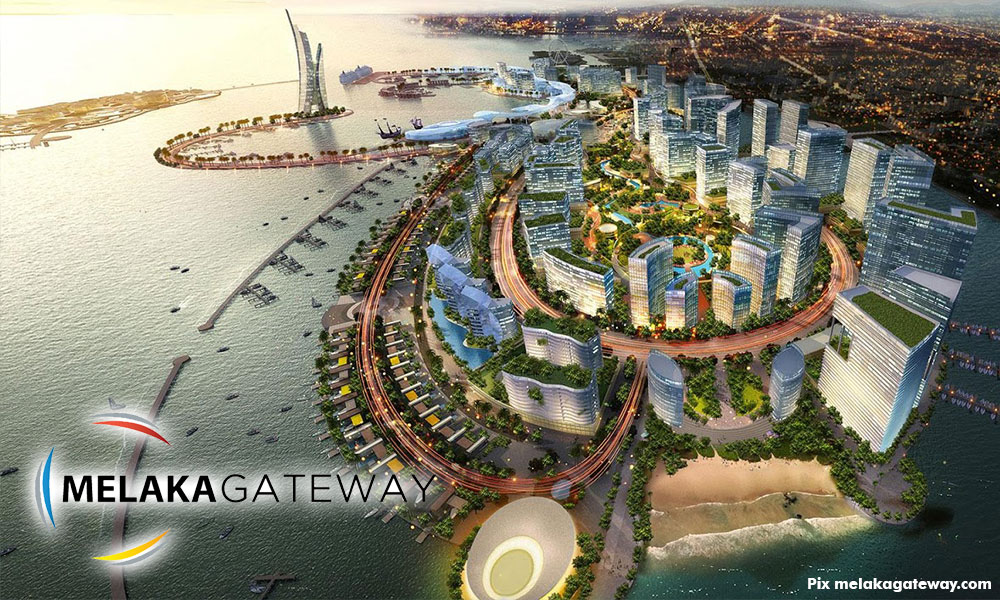
In the highly congested Straits of Malacca, Malaysia is building a massive Maritime Silk Road port complex known as the Melaka Gateway jointly funded by China. According to projections, 100,000 shipping vessels will dock at the port, without having to stop at the monopoly route held by Singapore over the past few centuries.
Last month, a Pakistani anti-corruption court found former Prime Minister Nawaz Sharif guilty of corruption and sentenced him to 10 years in prison and a US$10.5 million fine. Sharif was dismissed as prime minister last July over corruption allegations.
The New York Times reported that every time Sri Lanka’s president, Mahinda Rajapaksa, turned to his Chinese allies for loans and assistance with an ambitious Hambantota Port project, the answer was yes although feasibility studies said the port wouldn’t work. The port attracted only 34 ships in 2012.
Rajapaksa was voted out of office in 2015, but Sri Lanka’s new government struggled to make payments on the debt he had taken on. Under heavy pressure and after months of negotiations with the Chinese, the government handed over the port and 15,000 acres of land around it for 99 years in December.
There is little public knowledge on the viability of the Melaka Gateway project but the new Pakatan government has recently disclosed that the controversial 600km East Coast Rail Link (ECRL) is far more expensive than previously disclosed by ousted prime minister Najib. The total cost is now estimated at RM81 billion instead of RM55 billion.
This works out to be RM135 (US$34) million per kilometre, making it probably the most expensive railway in the world. China is known to be the lowest cost high-speed rail builder with between US$17-21 million/km. Yet it is building the ECRL, which is not a high-speed rail but only a double-tracked electric train, at way beyond what it would cost to build in China.
Is the ECRL sustainable in the long run? Probably not. It would be cheaper to fly from Kuala Lumpur to the east coast by AirAsia. What if we cannot repay China the loan, would it go the same way as Sri Lanka’s Hambantota Port? It’s too early to tell. With Najib gone and Dr Mahathir Mohamad as the new prime minister, the ECRL deal may be reset by the time the prime minister visits China in the coming weeks.
Next: Kouk’s ‘quanxi economic’ key to reset Malaysia-China trade?
BOB TEOH is a media analyst and author of the book ‘The Dragon Stirs - China’s New Silk Road’.


