




Hope for refuge in the law?
The leaked Vatican Instruction, a statement on homosexuals and the priesthood was confirmed last week. It had mixed reactions among the believers.
A gay and celibate Catholic priest writing on Nov 29 in The Vatican's Gay Purge , alleges that the document has a wide ranging ban to any person who thinks himself gay. The only gay men who will enter the priesthood will be either "clueless, closeted or lying".
According to the writer, the document contradicts the Catechism of the Catholic Church "which not only says that gay men should be celibate, but can be celibate". The document represents a purge.
The leaked Vatican Instruction, a statement on homosexuals and the priesthood was confirmed last week. It had mixed reactions among the believers.
A gay and celibate Catholic priest writing on Nov 29 in The Vatican's Gay Purge , alleges that the document has a wide ranging ban to any person who thinks himself gay. The only gay men who will enter the priesthood will be either "clueless, closeted or lying".
According to the writer, the document contradicts the Catechism of the Catholic Church "which not only says that gay men should be celibate, but can be celibate". The document represents a purge.
"Those men who had formerly been encouraging men in their vocations are now being asked to push them out of the door".
 He concluded that the document is an occasion of deep sadness for several; "for those men who will feel forced to leave after years of discernment and prayer", and "for those celibate gay priests who will feel great anguish over their treatment by the Vatican"; and for the people in the pews "who will be deprived of something simple: good men".
My point for this introduction is two-fold. One is the interest generated by the Instruction and the consuming debates that will surely follow which will hopefully highlight the diverse struggles.
The other is related to our own recent struggle of our marginalised transgender community. The law's anxiety over homophobia has been identified in research as a factor which has impeded the recognition of the transgendered identity.
 Deputy Home Minister Tan Chai Ho (
photo
) was quoted as saying on Nov 15 that the 'same-sex marriage' of Jessie Chung (male to female) and Joshua Beh is "illegal" under the 1976 marriage law. It might be more correct to say that the current Malaysian case law does not recognise such unions.
Deputy Home Minister Tan Chai Ho (
photo
) was quoted as saying on Nov 15 that the 'same-sex marriage' of Jessie Chung (male to female) and Joshua Beh is "illegal" under the 1976 marriage law. It might be more correct to say that the current Malaysian case law does not recognise such unions.
No one and no union is illegal. Perhaps the deputy minister has been overly influenced by the rhetoric of his immigration enforcers where humans without documents are classified as 'illegals'.
Bearers of rights
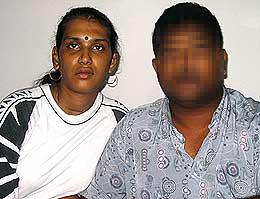 It is well and good that a human rights commissioner has called for the support of human rights of Mumtaz (male to female,
photo left
) when forced to strip by police and subjected to sexually abusive interrogation.
It is well and good that a human rights commissioner has called for the support of human rights of Mumtaz (male to female,
photo left
) when forced to strip by police and subjected to sexually abusive interrogation.
There are expectations of the Human Rights Commission of Malaysia. As a human rights body, it should develop more spine than lip service, in (re)imagining and developing the identity of the transgender self as a bearer of rights.
The fact that a transgender person should not be subject to torture and discrimination sometimes falls short of the recognition that such a person is a rights-bearer in the first place.
The law's preoccupation with 'natural' heterosexual sex presupposes that a transgender being biologically at birth of a particular sex, is still of the "same sex" despite sex reassignment surgery and thus will not recognise, as Tan has put it, "same-sex marriage".
The biological chromosome test: that one is born male or female at birth as per chromosomes, has been viewed as "inhumane" in the Australian courts. In other words, if the law thinks that sex is chromosomes, then the law is an ass. But the courts are not prepared to give genitalia short shrift in the legal (re)construction of sex.
Courts in several jurisdictions including Australia and New Zealand have developed the psychological and anatomical harmony test and there are decisions which ruled inter alia that a post-operative transgender woman is female for the purposes of marriage. The leading decision is the 1995 AG v Otahuhu Family Court (NZ).
Pursuant to this idea, such a consensual union is not void or invalid. The Australia Family Law Act of 1975 for example has provided that the consummation of marriage is irrelevant in nullity proceedings.
Homophobia of law
Legal researchers have noted that the emphasis on the heterosexual capacity of the post-operative transgender body has served to mask or blur the relationship between the requirement for sex reassignment surgery and the homophobia of law.
 The capacity to procreate, the assumed 'essential role of woman in a marriage' is not relevant to the capacity for post-operative heterosexual intercourse.
The contention that a female sex role can only be fulfilled with the 'right' anatomical parts, specifically a vagina, assumes that the role requires penetrative sex. This exposes what researchers call, the phallocentricism of the law, thus confronting feminist politics.
A judicial approach that abandons sex reassignment surgery as a requirement of legal recognition has been used in Australia and Canada. Called the psychological, social and cultural harmony test, this approach has been limited to social security decisions. This approach like the previous one (psychological and anatomical harmony), is still not premised on transgender autonomy.
While a requirement for surgical intervention is dispensed with, the judicial decisions nevertheless emphasise 'coherent' bodies. Both the psychological and anatomical harmony and the psychological, social and cultural harmony tests, insist on the 'wrongness' (therefore transgressive) of the pre-operative transgender bodies.
'Psychological sex'
Medical surveillance of the transgender body is required for the judges to formulate their legal decisions. In a case where there is no sexual reassignment surgery, the court's require the medical/psychiatrist's report of the pre-operative transgender. 'Psychological sex' has been noted in some decisions as distinguishing the transgender person from the homosexual.
In the famous tennis player case of Renee Richards, formerly Richard Raskind (United Sates, 1977), the court said that transsexuals are not homosexual.
"They consider themselves to be members of the opposite sex burdened with the wrong sexual apparatus."
The two tests currently circumnavigating the globe are common law (judicial reasoning/case law/ precedent) approaches. The two tests have been said to represent 'repressive tolerance' in critical legal scholarship. The decisions as they stand in 'reform jurisprudence' ensure the separation of the heterosexual transgender from homosexual interests.
A critical legal study of the rationale informing these decisions will help the transgender community and other groups to consider the costs of an engagement with law. It may be empowering for some and oppressive for some others.
In fact contradictory legal arguments can be useful strategies in specific places and at particular times for all kinds of bodies, the transgender, the unruly bodies, the incoherent and the unimaginable.
Recommended reading: Andrew N Sharpe (2002), Transgender Jurisprudence: Dysphoric Bodies of Law (London, Sydney: Cavendish Publishing Limited).


