



Mahathir the Disappointed Father
COMMENT | Over the (very many) years, Prime Minister Dr Mahathir Mohamed has kept a fairly consistent tone regarding what I suppose he might term the Malay Dilemma - a tone that we saw again during the recently held Future of Bumiputeras and the Nation Congress (KBN 2018), at the Bersatu anniversary, (https://www.malaysiakini.com/news/442386) and a recent interview.
I suppose I might term this tone that of the Disappointed Father.
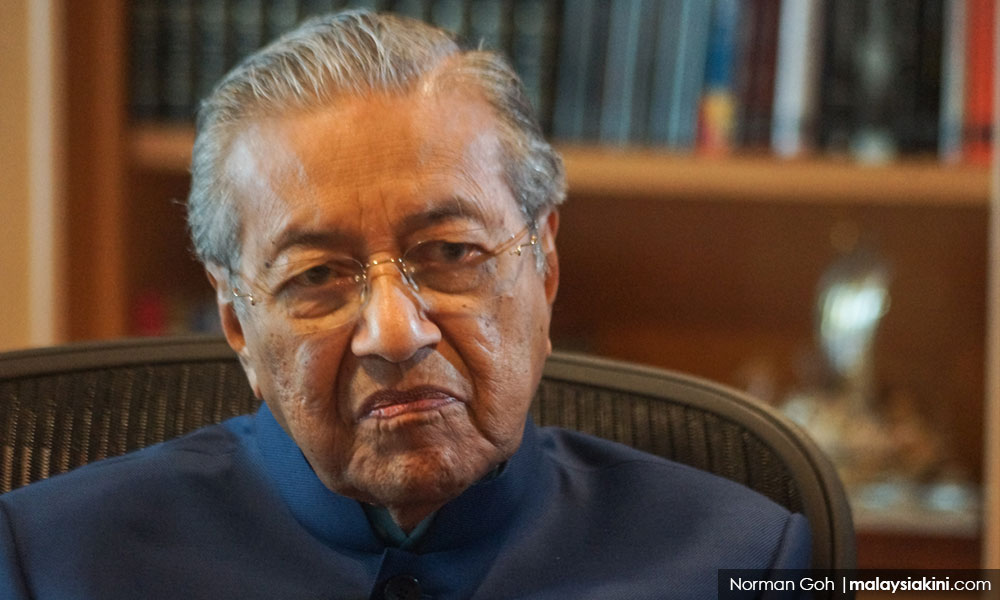
I have this image in my head of Mahathir, himself a successful bumiputera, looking down and shaking his head while sighing, maybe face in hand, constantly disappointed at what he sees to be an endemic failure of his fellow bumiputera to live up to his hopes and expectations.
We get the sense that Mahathir has a very clear idea of the kind of attitude and character you need to succeed as an individual and as a community, and that a big part of his persona seems to be having to deal with his view that the bumiputera do not live up to these standards.
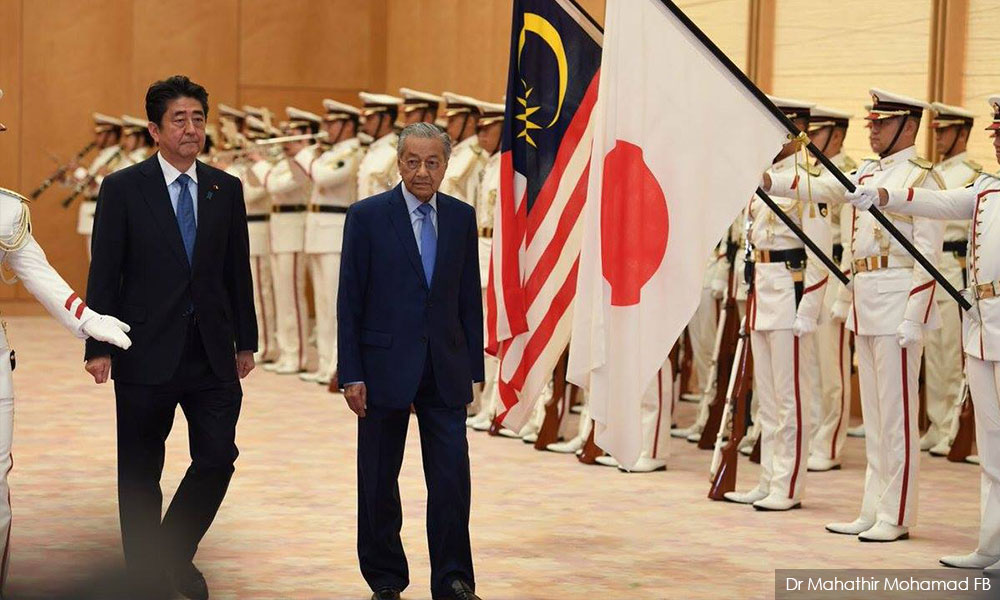
Mahathir’s favourite counterpoint appears to be the Japanese, a fact reiterated by his recent visit to Japan and specifically named once again in the interview, where once he again he has held them up as the paragons of self-sacrificing patriots whose self-worth is tied to how diligently they can contribute to the betterment of their nation.
He then likes to ask: “Why can’t the Malays be more like the Japanese?”, in the same tone perhaps a dad would ask his kid, “Why can’t you be more like your older brother?”...
COMMENT | Over the (very many) years, Prime Minister Dr Mahathir Mohamed has kept a fairly consistent tone regarding what I suppose he might term the Malay Dilemma - a tone that we saw again during the recently held Future of Bumiputeras and the Nation Congress (KBN 2018), at the Bersatu anniversary, and a recent interview.
I suppose I might term this tone that of the Disappointed Father.
I have this image in my head of Mahathir, himself a successful bumiputera, looking down and shaking his head while sighing, maybe face in hand, constantly disappointed at what he sees to be an endemic failure of his fellow bumiputera to live up to his hopes and expectations.
We get the sense that Mahathir has a very clear idea of the kind of attitude and character you need to succeed as an individual and as a community, and that a big part of his persona seems to be having to deal with his view that the bumiputera do not live up to these standards.
Mahathir’s favourite counterpoint appears to be the Japanese, a fact reiterated by his recent visit to Japan and specifically named once again in the interview, where once he again he has held them up as the paragons of self-sacrificing patriots whose self-worth is tied to how diligently they can contribute to the betterment of their nation.
He then likes to ask: “Why can’t the Malays be more like the Japanese?”, in the same tone perhaps a dad would ask his kid, “Why can’t you be more like your older brother?”
Unhelpful comparisons
Mahathir’s other big go to, of course, is to compare Malays with other ethnic groups, notably the Chinese.
A common theme of his seems to be something along the lines of the Chinese are successful because they are hardworking, and the Malays are not, because they are lazy.
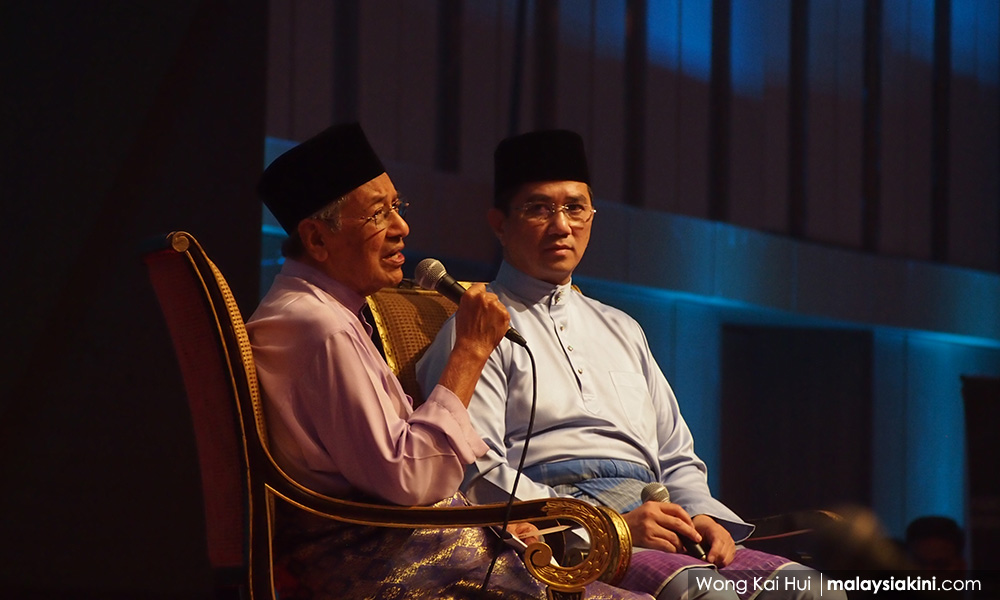
Most recently, at KBN 2018, Mahathir has taken this a step further:
Prime Minister Dr Mahathir Mohamad today questioned whether the bumiputera will be able to compete with a new wave of skilled and business-savvy entrepreneurs from China making their way to Malaysia.
Speaking during a dialogue session on bumiputera economy, Mahathir said the new wave of immigrants will be unlike early Chinese settlers in Malaysia – who were then mostly involved in small businesses, and whose children have now gained control of major developments in the cities.
"These are the Chinese already in Malaysia whose attitudes we can accept.
"But if we bring in three million more people from China, what will happen to us?" he asked.
"They are hardworking and skilled in business. The ones who are coming, they are not labourers, but those who are already successful.
"Will we be able to compete with them?" he said in response to a question on China nationals buying property in Malaysia.”
In the West nowadays, this kind of framing would likely be denounced as having considerable elements of racism.
Sadly, the truth is that this rhetoric retains the culture of fearmongering perpetrated by Umno over so many decades - a variation on the theme that the bumiputera are under constant threat by other ethnic groups.
Mahathir’s approach is marginally better in that his conclusion is not “Therefore you need Umno to protect you” but “Therefore you need to work much harder.”
Of course, this is not to say that Mahathir’s tone has not changed at all. He now says that it is foolhardy to blame other races for the shortcomings of the Malays.
On the whole, though, we should ask: is this a truly helpful approach?
Has Mahathir’s approach worked?
Mahathir’s sincerity is not doubted, and he has a great many strengths. Effective motivation, however, may not be one of them.
His recent comments show that while he has changed in many positive ways, he still seems to rely on a certain amount of BN era fearmongering, his trademark sarcasm, and a degree of condescension.
If you have ever been on either end of questions like “Why can’t you be more like your brother?” being repeated over and over, I think you know the ultimately negative end result - a lot of resentment, and almost never any actual change towards becoming like the said brother.
After all the years of Mahathir’s Look East policy, do we actually see any significant movement of Malays or Malaysians adopting Japanese values? (Anime does not count.)
I am also most curious as to where this idea of letting in three million new Chinese nationals came from. Is this a thing? Or was it plucked from thin air, to be used as the convenient bogeyman?
It’s true that global competitiveness should always be a cause for concern, but bringing up the sceptre of some sort of invasion by foreigners who bear a striking resemblance to Chinese Malaysians in a Malay-only conference could easily be seen as striking the wrong note.
The dichotomy of the ‘successful’ Chinese nationals of today compared to the ‘inferior’ Chinese labourers from whom today’s Chinese Malaysians descended could also rub people the wrong way.
Inspire hope, don’t fearmonger
Some say that the biggest two motivators are hope and fear. One might have hoped that a coalition named Pakatan Harapan might be intrinsically inclined towards one instead of the other.
At the end of the day, Malaysians are Malaysians, and the Japanese are Japanese. Each has their strengths and weaknesses, and each can learn something from one another.
If however, you keep expecting one to become the other - something they simply are not - only disaster awaits. Your children may be siblings, but they are each unique individuals.
Instead of constantly berating or belittling Malays with fearmongering, unflattering comparisons or sarcastic jibes at every turn, think about how you can motivate them positively.
It is good that we start addressing practices like Ali Baba schemes out in the open, but why not focus more on success stories? Highlight successful bumiputera entrepreneurs and how and why they succeeded. Use them as inspiration.
Sometimes all that is needed is the reminder that having only ‘becoming rich’ as the goal is a recipe for failure.
We need only look at the lives of successful Malaysians - from any ethnic group at all - to see that the right goal is to develop the attitude, character and habits that breed success, and that once that goal is achieved, riches come fairly easily.
Abandoning the racial lens
As a Malaysiakini commentator correctly said, it is in the interests of all Malaysians for Malays to be successful.
That said, perhaps a big part of the problem is looking at it as a Malay or bumiputera problem.

Perhaps what we need to solve racial inequality, somewhat counterintuitively, is to stop seeing everything through a racial lens, and stop obsessing about comparing one ethnic group with another.
If for example, you have never met a lazy Chinese, you simply haven’t met enough Chinese.
It’s not accurate to go so far as to say that culture plays zero role in the welfare of a community. Sometimes, historical factors such as living in harsh climates where saving for the winter is essential to survival, breeds a slightly different work ethic than living in temperate climates, where food is easily available all year round.
That said, any type of biological determinism is inherently unhelpful, and not relevant to the question of how we can best move forward.
Play to each individual’s and community’s strengths
People react much better to being inspired and encouraged than they do to being belittled or scared - especially when it comes to becoming self-motivated achievers.
Every sibling has unique strengths and talents to contribute.
The role of the parent is to play to those strengths, encourage those talents, and help each child maximise their potential - on a road that they themselves determine.
Ultimately, helping each Malaysian achieve their unique potential is the single best way to help the Malaysian family as a whole.
The way to do this is to reverse this habit of public dressing downs and bemoaning, and adopt instead an approach that does not ignore reality, but acts on that reality in a manner that is less negative, and more one of positive encouragement.
NATHANIEL TAN is eager to serve.
The views expressed here are those of the author/contributor and do not necessarily represent the views of Malaysiakini.


Are you sure you want to delete this comment?
This action cannot be undone.