




Of promises peddled to the worlds poor
Call it back to the future, but after the Asian financial crisis of the late 1990s, the world economy has been on a somewhat buoyant path to so-called recovery. Yet it's not the kind of recovery about which to crow.
Certainly the golden age of world economic growth is pass, and fewer countries can boast that this is happening in their midst. Sooner or later even China's growth rate will come crashing down. Newton's law. Asia showed this seven years ago rather spectacularly, and much of the region is still struggling to regain its footing.
Since then, as the world economy grew - not spectacularly, mind you - a new optimism also emerged, this one quite spectacularly, and quite predictably.
Call it back to the future, but after the Asian financial crisis of the late 1990s, the world economy has been on a somewhat buoyant path to so-called recovery. Yet it's not the kind of recovery about which to crow.
Certainly the golden age of world economic growth is pass, and fewer countries can boast that this is happening in their midst. Sooner or later even China's growth rate will come crashing down. Newton's law. Asia showed this seven years ago rather spectacularly, and much of the region is still struggling to regain its footing.
Since then, as the world economy grew - not spectacularly, mind you - a new optimism also emerged, this one quite spectacularly, and quite predictably.
The year was 2000, about the time when most economists say the world economy began to turn around after shoving aside the ill-effects of the Asian economic disaster. The United Nations, beleaguered as ever, and still hopelessly rudderless and largely incompetent, found a new buzzword - the Millennium Declaration.
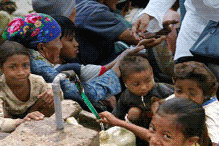 Embalmed in the Millennium Development Goals (MDGs) were a set of eight items that world leaders would move heaven and earth to achieve by 2015: end extreme poverty and hunger; achieve universal primary education; promote gender equality and empowerment of women; eradicate child mortality; improve maternal health; combat HIV/Aids, malaria and other diseases; ensure environment sustainability; and develop a global partnership for development.
I was reminded of this when recently watching a marvellous British movie, The Girl in the Caf . It revolves around the 2005 Group of Eight summit in Reykjavk, Iceland. As anyone who has been to Iceland would know, policy horse-trading has about as much chance of success as politicians trying to sell ice to Eskimos.
But here, remarkably, as the fault-lines opened over policies required to spur world economic growth, another major crack - the old one between North and South states - closed. The MDGs were agreed upon and adopted, but this probably more out of a disturbed moral conscience than any policy pragmatism, as is usually the case. But it was a rare victory, and not one to be found in the annals of post-war history.
The movie was really not that far removed from reality, especially for those who have studied the subject extensively and for those who have written on international economics but with biting scepticism. None of the policy pronouncements since the 1970s have at all delivered the kinds of outcomes that would lift the pain of grinding, gut-wrenching world poverty. In fact, the only thing that has happened is that the rich have become fatly richer and the poorer miserably poorer. As death stares the poor in the face, the rich ponder how much more wealth they can accumulate.
New aid industry
All that the MDGs have achieved is to spawn a new international development aid industry, filled by so-called expert development practitioners and led by none other than scurrilously inept World Bank and lorded over by the desperately myopic International Monetary Fund (IMF).
There was supposed to have been co-ordination of international and national policies to turn around a worsening global trend in living standards for the poor in countries from Asia to Africa to South America as these folks are driven increasingly to the margins of the real economy, exposed to empty pockets and food plates.
Why? Because the World bank and the IMF still impose their insane, illogical structural adjustment and conditionality policies on these developing countries when it has been clear for almost 40 years that their policies and approaches have done more harm than good for general economic development and development assistance.
Their almost imperialist insistence that developing countries wholly subscribe to their own neo-liberal obsession with free-market deregulation has driven many more developing countries to accumulate more foreign debt, not reduce it; place more marginalised people on the scrapheap of long-term structural unemployment than produce sustainable jobs growth; wipe out budgets that in one fell swoop also wipe out schools and hospitals, low-cost public housing, basic but essential infrastructure development, and their basic needs, including personal and food security, as their fundamental human rights.
That is why the UN, the G8 leaders, the World Bank and the IMF should make the momentous move - given all of their abject failures to produce real and positive outcomes for the world's poor, and for their political self-aggrandisement through all of their policy pronouncements so far - to read ActionAid International's report, Whose Freedom?, released in September. In fact all developing country governments should do likewise.
For it is not just the fault of the G8 and the international institutions and organisations that the world has failed to rein in and alleviate so much misery among its global citizens; it is largely also the fault of national governments, who play the same silly games for which the likes of the UN, the World Bank and the IMF have been criticised, and rightly so.
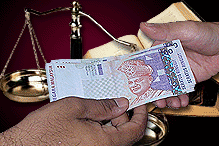 And then there's the scourge of widespread, embedded corruption, too, which none of these governments are capable of nullifying, beause they condone it, because practise it among themselves. And they make laws to protect themselves from criminal prosecution.
The report - the first of its kind in a long time - is different from the rest because it is not written by the Club of Rome types, whose leaders live very comfortable lifestyles amidst great personal wealth.
It is based on interviews of those people directly affected by international and national policies, who point out just how much more miserably desperate their lives have become. Most of them are faced with a crippling, on-going agrarian crisis. This explains why most abandon their farms in search of incomes, however meagre, in cities that are themselves teeming with unsustainable population growth while industry quickly hollows out.
There are no jobs for these new 'migrants'. This only burgeons a constantly floating labour or unemployed population, as in China. And with these come appallingly high social problems that developing counties can do precious little about because of the manic free-market will the World Bank and IMF imposes on national governments.
 Budgets are cut to extremes. The classic case is Zimbabwe, and its murderous president, Robert Mugabe, who clearly does not value the lives of his people, whom he mercilessly bludgeons to death through his Nazi-like security forces. It's the Third World solution. Acceptable collateral damage, as it were. And the hypocritical moralist West barely blinks at this, turns its back to such mass brutalities. Even in China.
The report highlights, very clearly, that all governments and international institutions and organisations that wield policy power are guilty of violating the fundamental human rights of their people who face an increasingly, desperately bleak future and whose lives have been shortened so drastically.
The world and the rich have stopped caring about the poor, and care only about how they can fatten their personal bank balances to splash on their lavish materialistic lifestyles - big flashy houses and cars and world travel, an endless supply of every kind of exotic food, the best medical care and all the rest of this vile self-interest. This is rationality at its best - or worst. And what's worse is that it is worsening year after year.
Little learnt
Almost 60 years after the Bretton Woods system was born, the world has learnt little from the past, and precious little about preserving humanity for humanity's sake. The world's mightiest economic institutions, like governments and those who peddle the promise of infinite prosperity through the Holy Grail of unfettered free-market theology, have failed the world's poor, and are more than likely to fail many more.
And for all the great religions of the world, every one of them boasting how each life is precious, how it ought to be preserved and nourished and made equal: what does each say about the state of our so-called global civilisation as religious lines of conflict, of direct confrontation, are drawn between them, each claiming superiority of value and meaning over others? Or, better still, what about globalisation and all it has peddled in promise: hasn't it turned out to be more neo-liberal its hubris? More procreation of banalities?
The MDGs have failed. Globalisation has also failed. Governments have failed. Politicians have failed. Equally a failure are the gamut of international and national policies that have done nothing more than enter the lexicon of Orwellian policy-speak.
And that says everything about the conviction of our enlightened political leaders. They have delivered a greater insult to these people. Little wonder why these folks hold their political leaders in spectacular contempt and suspicion, and why there is political dissent and violent terrorism. Why there will be more dissent and terrorism.
It's a world of hypocritical political ideals, a world that is morally and ethically bankrupt.
MANJIT BHATIA, an academician and writer, is also research director of AsiaRisk, a political, economic and risk analysis consultancy in Australia. He specialises in international economics and politics, with a focus on the Asia-Pacific.


Are you sure you want to delete this comment?
This action cannot be undone.