




(Still) debating human rights in Asia
On Dec 10, I decided to opt for a lecture on human rights instead of participating in a march. I left my two banners, one which may be confiscated and one other which would probably pass muster, with a marcher at Dataran Merdeka, Kuala Lumpur.
One banner had a graphic image of a person blue in the face as a result of torture, with the words, 'Stop Torture, IPCMC Now'. I took the image off an Amnesty International poster. The other banner reads 'Stop War, Wage Peace' with a patched-on dove and olive branch, a remnant from the anti-war coalition protests of the unilateral action against Iraq.
I do not know if the banners were unfurled during the march which was under police escort. I have not been to a march with police permission. It is too unnerving.
On Dec 10, I decided to opt for a lecture on human rights instead of participating in a march. I left my two banners, one which may be confiscated and one other which would probably pass muster, with a marcher at Dataran Merdeka, Kuala Lumpur.
One banner had a graphic image of a person blue in the face as a result of torture, with the words, 'Stop Torture, IPCMC Now'. I took the image off an Amnesty International poster. The other banner reads 'Stop War, Wage Peace' with a patched-on dove and olive branch, a remnant from the anti-war coalition protests of the unilateral action against Iraq.
I do not know if the banners were unfurled during the march which was under police escort. I have not been to a march with police permission. It is too unnerving.
I made my way to where Prof Vitit Muntarbhorn of Chulalongkorn University was to deliver an address on the culture of human rights. The title of the address had changed since its first announcement. The flyer at the venue noted the theme as 'Through the Looking Glass: An Asian Perspective of Human Rights?'.
Of course it did not enter my mind that the good professor would go on, on Asian values. Not Vitit. He is one of the foremost human rights activists with the academia and has been involved with the community of human rights defenders across Asia and Pacific. He was instrumental in helping to shape the Asia Pacific NGO Declaration on Human Rights in the NGO preparatory meeting to the 1993 UN World Conference on Human Rights (Vienna).
One of the concerns of the NGO lobby was to deny governments in Asia meeting in Vienna, from asserting 'Asian values' in defence of non-compliance to human rights principles and from using Asian values to shield themselves from accountability for human rights violations in their countries.
Arrests during reformasi
At the height of reformasi street protests in 1998, brought about by the sacking of former deputy premier Anwar Ibrahim, top Umno politicians declared that public assemblies and marches are not part of the Asian culture and tradition. The answer lies in the ballot box (they said).
Demonstrations were declared 'illegal' by this alleged standard and people were arrested by the hundreds, charged and sentenced under the Police Act.
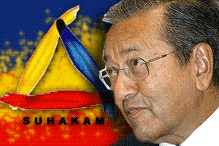 The Human Rights Commission of Malaysia (Suhakam) was born a year later, as we know, to initially contain the situation. Then premier Dr Mahathir Mohamad had no choice but to establish Suhakam to divert grouses of human rights abuses to the commission, instead of facing visible protests to his government practically every week.
The official reason for Suhakam was the government's adoption of a recommendation of the Vienna Human Rights Conference to establish national human rights institutions.
True to form, Vitit noted the non-currency of Asian values especially after the 1997 Asian economic crisis. Observers will note that the Asian (government) value of putting social and economic rights first over civil and political rights had facilitated non-transparent government processes and bred corruption. The muzzling of media and freedom of expression and right of assembly added to the crisis.
Vitit did not eliminate the notion of values of our Asian peoples as providing meanings and premises to human rights. These values once identified as commonly held (reaching a consensus) are not held in contra-distinction to human rights but are a part of human rights. He was, however, curious about posters he saw upon arrival at KLIA announcing Asian values.
Stance re-emerges
I surfed the Internet and found that 'Asian values' has surfaced in relation to the 11th Asean Summit, currently in progress in Kuala Lumpur. These documents do not elaborate on the meaning attributed to Asian values.
The rise of Asian values can be traced to the end of the Cold War. Its chief proponents are the governments of Malaysia (Mahathir) and Singapore (Lee Kuan Yew). China's Jiang Zemin was reported by Far Eastern Economic Review in 1996 as a believer of the same (the China Post-Tiananmen-Confucianism- Nationalism model).
Yash Ghai, professor of public law at the University of Hong Kong and UN Special Rapporteur for Cambodia, explains that before the collapse of Western communist regimes, the discourse on human rights was dominated by the ideological differences between liberal capitalism and socialism. The contest was seen to lie in the competing claims of the primacy of civil and political rights on one hand and economic and social rights on the other.
The collapse of communist regimes was represented as the victory of human rights and democracy. Human rights and democracy based conditionalities began to be imposed on foreign aid and trade relations.
The emphasis on rights and democracy was seen to impact upon state competitiveness in the framework of international trade ushered by globalisation and also seen as a Western conspiracy to undermine newly growing economies.
 China's position is contained in the White Paper of 1991,
Human Rights in China
. It said that "the evolution of the situation in regard to human rights is circumscribed by the historical, social, economic and cultural conditions of various nations and involves a process of historical development". China's principal position is that rights are essentially domestic matters within state sovereignty and are not subject to international interference.
China's position is contained in the White Paper of 1991,
Human Rights in China
. It said that "the evolution of the situation in regard to human rights is circumscribed by the historical, social, economic and cultural conditions of various nations and involves a process of historical development". China's principal position is that rights are essentially domestic matters within state sovereignty and are not subject to international interference.
Other Asian governments' principal response has been cultural, involving an attack on the claim of universality of human rights.
Duties vs rights
Ghai writes a compelling critique of Asian leaders' emphasis on duties over rights. This emphasis serves to enhance the ideology of obedience and subservience and continues to cause unease among the people about to challenge a system that oppresses them. Capitalism in Asia and Asian capitalism overseas have been known to be predatory, often disregarding industrial safety and rights of community, marked by exploitation of labour and the environment. This is not driven by any sense of duty.
The notion of duties was to provide an intellectual justification for a different moral standard to human rights. It serves to downgrade rights which are the vehicles of protest and the justification for equality and justice.
"Nowhere is this more evident than in Singapore where the government is cultivating an ideology with remarkable resemblance to Confucianism - minus the exemplary behaviour of the leaders."
The other critique relates to the Asian political elites' view that communitarian rights should prevail over individual rights. Asian governments however have been known to deny the claims and assertions of communities in the name of national unity and stability.
Ghai, as many other human rights defenders, noted that the rise of the importance of human rights is connected to the rise of centralised power in modern nation states which is the legacy after independence in most Asian states.
The fact that the West has formalised rights and strengthened the legal machinery for their enforcement does not make it either adversarial or individualistic. To assert a right is not a challenge to society. That person does not set herself in opposition to society. Public challenges to the system evidenced the cohesiveness, strength and stability of the community and the nation.
Socialist influence
Khaled Abou el-Fadl discounts the perception that Islam (as mediated by human interpretation of texts), supports duties over rights and advances the communitarian argument.
 When Muslim jurists speak of public rights (
al-haqq al-'amm
), they assert that public rights ought to be given preference over private entitlements. This amounted to an assertion that the many should not be made to suffer for the entitlements of the few. As a legal maxim this was used for the right of public easements (right of way-to be compensated by the state) over private property and in prohibiting unqualified doctors from practising medicine.
When Muslim jurists speak of public rights (
al-haqq al-'amm
), they assert that public rights ought to be given preference over private entitlements. This amounted to an assertion that the many should not be made to suffer for the entitlements of the few. As a legal maxim this was used for the right of public easements (right of way-to be compensated by the state) over private property and in prohibiting unqualified doctors from practising medicine.
The commitment to individual rights, according to el Fadl, will accrue to the benefit of the many private citizens over the few members of the ruling government. God created human beings as individuals. To commit oneself to the safeguarding and protecting the well-being of the individual is to take God's creation seriously.
While jurists have supported the principle that the ruler is owed a duty of obedience, the ruler is expected to safeguard the well being and interests of the ruled. Muslim jurists did not justify the killing or torture of individuals in order to promote the welfare of the state or the public interest. If the state fails in this expectation to protect the ruled and act justly towards them, then the ruled no longer owed the state either obedience or support.
El Fadl accounts for the emphasis in collectivist and duty oriented conceptions of rights as the influence of Socialist and national development ideologies of Muslim countries as under-developed nations in the 1950s and 1960s.
Cultural relativism
Human rights defenders in Asia like Vitit do not discount the cultural pluralism of our communities. However it must be emphasised that cultural practices which derogate from universally accepted principles, including rights of women, must not be tolerated.
This support of cultural pluralism may seem problematic when Asian and Muslim states continue to rile against the so-called Western hegemony of universality and raising the flag of cultural relativism, and doing little or nothing to address and remedy human rights violations within its borders.
 It does not help the cause of human rights when Western governments unilaterally invade countries allegedly in the name of freedom and liberty as in Iraq or dislocating legitimately elected governments in Latin America or hold prisoners in defiance of the Geneva Conventions. This merely strengthens the hand of authoritarian states worldwide. The point to be made is all authoritarian governments must be made accountable under human rights principles.
In the last decade, human rights activists in the field and in academia have resolved to work the tension between universality and cultural relativism. Religion is part of the cultural relativism debate.
The tension poses a practical problem but does not imply moral bankruptcy. It calls not for the rejection of universal human rights standards, but rather for the development of creative moral strategies for universalising such standards which acknowledge and engage seriously the cultural perspectives of traditions committed to diverse premises and world views.
It should be recognised that state actors speak from a position of political power and often represent themselves as speaking on behalf of an entire nation or an entire culture. Their language of relativism is often used as a screen to perpetrate and defend human rights violations and we should be skeptical about appeals by undemocratic states to cultural relativism.
The speech of the ones whose rights are violated by invocation of culture and religion is often drowned out. These voices and perspectives have to be taken into account as authentic witnesses to oppression.
Rights advocates are cautioned to avoid the trap of totalising cultures. This is to avoid colluding with state actors in their totalising rhetoric. It is important to foster human rights dialogues internal to and between cultural traditions as a working methodology to come to a common understanding or consensus of human rights.
The function of human rights in the discourse of human rights and cultural relativism (including religion and cultural beliefs) is the exploration of the core-irreconcilable differences. There is hope in the minimisation of these co- called irreconcilable differences through internal dialogue and cross-cultural exchanges. The constriction of the core will expand the penumbra for human rights.
References
John Kelsey eds. et.al (1994), Religion and Human Rights . (New York: The Project on Religion and Human Rights)
Khaled Abou el-Fadl (2003), Islam and the Challenge of Democratic Commitment . Fordham International Law Journal. Vol 27. No 1 4-71
Yash Ghai (1997), Rights, Duties and Responsibilities in Human Rights Solidarity . AHRC Newsletter. Vol 7. No 4; idem (2001), Human Rights and Social Development:Toward Democratisation and Social Justice (UNRISD: Democracy, Governance and Human Rights. Programme Paper No 5).


