


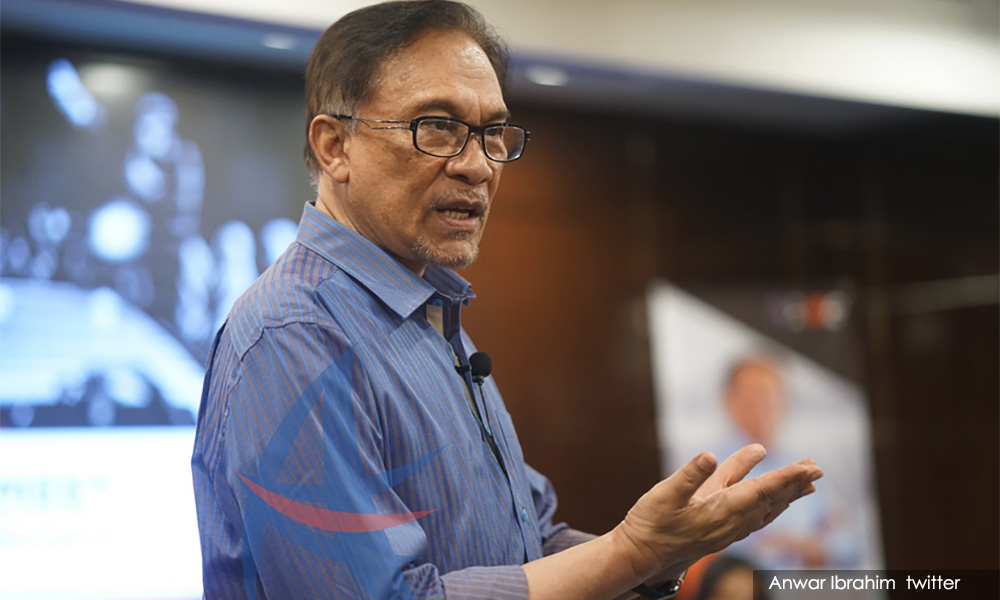

Anwar conflating 'PD Move' critics with 'super liberals' goes too far
COMMENT | We all know what neoliberals and their creed are.
The term refers to proponents of an economic order of unregulated competition which its supporters believe yields the best benefits to society.
Neoliberals have been around for some time.
They are a known quantity though they have come to be beset by bad connotations for reason of their unconcern with what is seen as a byproduct of their system: Stark income inequality.
Unlike neoliberals, “super liberals” is a term of fairly recent coinage.
One can't be sure who coined it, but in recent times it has been deployed by PKR president-elect Anwar Ibrahim as a pejorative term.
He's been spraying the appellation at critics of his stance on a host of issues – from same-sex marriage, to his moorings on race and religion, and his decision to contest a by-election other than one forced by the vacation of seats by his wife and daughter.
From interviews and speeches Anwar has given in the past few days, the term “super liberals” appears to have come in handy for him in tarring his critics with it...
COMMENT | We all know what neoliberals and their creed are.
The term refers to proponents of an economic order of unregulated competition which its supporters believe yields the best benefits to society.
Neoliberals have been around for some time.
They are a known quantity though they have come to be beset by bad connotations for reason of their unconcern with what is seen as a byproduct of their system: Stark income inequality.
Unlike neoliberals, “super liberals” is a term of fairly recent coinage.
One can't be sure who coined it, but in recent times it has been deployed by PKR president-elect Anwar Ibrahim as a pejorative term.
He's been spraying the appellation at critics of his stance on a host of issues – from same-sex marriage, to his moorings on race and religion, and his decision to contest a by-election other than one forced by the vacation of seats by his wife and daughter.
From interviews and speeches Anwar has given in the past few days, the term “super liberals” appears to have come in handy for him in tarring his critics with it.
Ironic use
No small amount of irony resides in his use of the appellation as a term of reprobation.
At various times of his five decades as a public figure - a prominence essentially built on a projection of his Islamist credentials - Anwar has been regarded as a “liberal Muslim”.
This term is an inherently contentious one.
Because Muslims believe that the Quran is the inerrant word of God transmitted to Prophet Muhammad by the angel Gabriel, there is little scope for interpretive leeway.
Centuries ago, a group called the Mu’tazilites attempted to establish some latitude in scriptural interpretation, but were beaten back by the Asharites. The former group believed that God is not just power and will but also a God of reason, while the latter believed that God is pure power and will and has no need of reason
Asharite ascendancy in the 12th century, effected through the theologian Al-Ghazali, essentially left Quranic interpretation in a straitjacket.
Anwar has tried to find elbow room within the confines.
On the issue of syariah law, he has come up with the Maqasid al-Shariah, a trope that posits that certain pre-conditions must first prevail before syariah can be imposed.
These pre-conditions are that security of life and property, both mental and material, and economic parity be assured before God's laws are imposed.
Arguing from orthodoxy, critics of Anwar's stance on the Maqasid view it as prevarication, an illegitimate attempt to delay the real thing (syariah).
Whatever the merits of the competing arguments, those of liberal suasion give Anwar credit for finding some leeway in scriptural interpretation, which is why he has come to be saddled with the pejorative term - from an Islamic standpoint - of “liberal Muslim”.
A slippery discourse
Hence it comes as a surprise these days that Anwar is resorting to the use of “super liberal” as a term to excoriate his critics.
One would have thought, having been tarred with the “liberal” brush, he would hesitate to dredge it up for use against anyone, critics especially.
Religious discourse is inherently slippery: The uninclined regard it as a banana peel that's guaranteed to trip up all-comers. To them, not just discretion but avoidance is the better part of valour.
As far as it can be seen from his public remarks in recent days, Anwar's stance on lesbians, gays, bisexuals and transgenders (LGBT) is that they be left to their devices in private but that their lifestyle not be legitimated.
As far as he and Prime Minister Dr Mahathir Mohamed are concerned, this stance means same-sex marriage is out of the question in Malaysia.
But Anwar is in favour of abolishing the laws against sodomy, which he argues are a colonial holdover that have been manipulated to falsely accuse and imprison him on two occasions in the past 20 years.
He wants anti-sodomy laws abolished but would draw the line against legitimising same sex marriage.
A look at the history of countries that have abolished anti-sodomy laws reveals that it's a matter of a few decades between their abolishment of anti-sodomy laws and the legalising of same-sex marriage. The one is consequent upon the other.
Suffice the LGBT issue is a very difficult field to parse. It does not help to employ terms like “liberal” and “super liberal” to describe protagonists in the debate.
It is worse when the term is stretched to include critics of PKR's decision to vacate a parliamentary seat other than the ones presently occupied by Anwar's wife and daughter to enable him to return to Parliament.
Lumping critics of that nepotic decision as “super liberals” together with supporters of same-sex marriage is dangerous and confusing.
His critics regarded Anwar as a charlatan when a decade ago he used to thrill his audiences with statements like “Anak China anak saya, anak India anak saya, anak Iban anak saya, anak Melayu anak saya.”
He dismissed their criticism by attributing his inclusiveness to the univeralist ideals of Islam that he championed.
These days he says that whenever he talks about Islam and the Malays, he detects discomfort among “super liberals”, who are allegedly uneasy with this particularism.
Just as he does not see that abolishment of anti-sodomy laws would lead to the legitimisation of same sex marriage, he does not see that his inclusiveness of yesteryear ought to lead to a post-racial and post-denominational nation where talk of race and religion is horribly passe.
Anwar chooses to see what he wants to see and ignore what he does not. His survey of the horizon of circumstances is biased for his standpoint in the midst.
It's wanting in breadth.
TERENCE NETTO has been a journalist for more than four decades. A sobering discovery has been that those who protest the loudest tend to replicate the faults they revile in others.
The views expressed here are those of the author/contributor and do not necessarily represent the views of Malaysiakini.


Are you sure you want to delete this comment?
This action cannot be undone.