




Conspiracy here, there, everywhere
The Perdana Global Peace Forum in Kuala Lumpur marked a welcomed boost to the cause of peace. However, while conference participants found many others with similar views, the presentations often fell short of offering solid analyses.
Future conferences should assure that over simplistic and misleading claims receive critical challenges. The prominence of so many conspiracy theories only assures that few will take this anti-war movement seriously.
The Perdana Global Peace Forum in Kuala Lumpur marked a welcomed boost to the cause of peace. However, while conference participants found many others with similar views, the presentations often fell short of offering solid analyses.
Future conferences should assure that over simplistic and misleading claims receive critical challenges. The prominence of so many conspiracy theories only assures that few will take this anti-war movement seriously.
Conspiracies! For a quick and easy explanation just find a conspiracy or a scapegoat. For an explanation of the 9/11 attacks on the United States simply point fingers at the CIA. For a complete understanding of the invasion of Iraq simply say the word "Oil."
A search for the causes of a nation's declining economy ends quickly when someone whispers "The Jews." Blame for the oppression of Muslims naturally falls on "the West." One word answers have gone global.
 In the United States, the American Civil Liberties Union has shared responsibility with homosexuals for the nation's moral decay. The reach of ready explanations has greatly expanded.
Self-appointed experts lay the problems of the world at the doorstep of George W Bush.
Apparently, scholars put too much work into their search for explanations. Conspiracy theorists could show them how to simplify their work.
CIA and al-qaeda
Appeals to simple answers have grown in an increasingly complex world. Even people of goodwill cannot resist simple explanations to difficult questions. Political leaders (especially those from "victim" nations) love conspiracy theories. Finding a scapegoat to blame keeps citizens from holding their own leaders accountable.
Conspiracy theories also help to keep a distance between us and the "bad guys," especially when those bad guys identify themselves with us. If the CIA masterminds all if this often bungling agency creates and controls the terrorist organisation al-Qaeda, then al-Qaeda no longer belongs to Islam.
Those attending the recent Perdana Global Peace Forum heard many conspiracy charges from the "experts." More informed investigations, however, reveal, for example, that, contrary to the conspiracy theorists, al-Qaeda has operated independently of the CIA. Admittedly, the US did give support to al-Qaeda (and many other groups) during the Soviet-Afghan war but so did the Saudis and the wealthy bin Laden family.
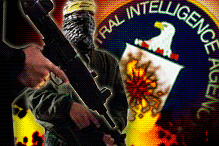 Technically, al-Qaeda became fully formed only in 1988 after the 10-year war. These facts alone should help discredit conspiracy theorists who see an American plot behind every wrong.
Conspiracy theories push people away from useful information and insightful analyses. A conspiracy theory obscures the role of Egyptian groups. A 1998 video shows al-Qaeda celebrating a formal alliance with Islamic Jihad, an Egyptian group that broke away from the Muslim brethren.
How do conspiracy theorists explain the role of Egyptian and other groups in the first World Trade Center (WTC) bombing? How do they explain the numerous foiled attacks on the WTC between the first 1993 hit and the final 2001 attack?
Conspiracy theories give too much credit to the intelligence and abilities of the conspirators, and they do not place enough blame on governments. Conspiracy theories divert citizens from seeing governments (including the US but also many others as well) as instruments of terror and from considering government repression as a primary cause of terrorist (with a small 't') organisations.
Don't be fooled
To get a better perspective on the size and character of terrorist organisations, consider the following question: Why does the media use the label "Islamic terrorists" but not "the Catholic Mafia"? In the end, conspiracy theories make citizens powerless.
 Even if people accept all the devious schemes attributed to the US and the CIA, where does that leave them? What can they do about all-powerful master-minds that control the world?
Political events inevitably leave questions unanswered. Conspiracy theorists find puzzling but generally insignificant gaps in the record. Overall, however, conspiracies and scapegoats keep citizens lazy, ignorant, and powerless.
We need to become more familiar with history and better informed about the facts. Most importantly, we need to question all viewpoints. No one has a monopoly on the truth. Everyone can contribute to finding the truth. Don't be fooled by my claims or by those of the conspiracy theorists. A questioning mind is a terrible thing to waste. If an anti-war movement is to have credibility, it must have less rhetoric and more thinking.
The writer is a Fulbright Scholar attached to the Centre for Civilisation Dialogue, Universiti Malaya.


Are you sure you want to delete this comment?
This action cannot be undone.