




The night destiny changed
One night, suddenly and without warning, a special Swat team carrying automatic weapons smashes down the door to your home, and without saying anything, they arrest your husband and take him away.
What would you do?
One night, suddenly and without warning, a special Swat team carrying automatic weapons smashes down the door to your home, and without saying anything, they arrest your husband and take him away.
What would you do?
Your children are crying as these masked men point their weapons at you.
Your husband is arrested under something called the Internal Security Act, an act that the colonial British government used to fight against communist guerrillas in Malaya decades before. But your husband is not a communist, and he has never taken up arms against the government.
This Internal Security Act (ISA) pays no heed to the rights of your husband. Under the ISA, your husband is not allowed to see his lawyers, and he will not be subject to normal court proceedings. You are not allowed to visit your husband, and you have no way of knowing whether he is safe or not.
You don't even know whether he is alive.
What is going on?
This would be a frightening situation for anyone.
But you are not just anyone.
Your husband, Anwar Ibrahim, has been the deputy prime minister of Malaysia. He has been the second most powerful man in the country. Everyone thought that one day he would become the prime minister.
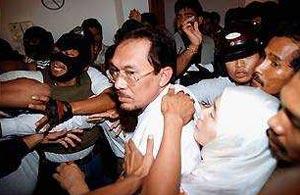 And now, on Sept 20, 1998, he has been taken away from you at gunpoint, before your eyes and the eyes of your children, in your home, in a shocking and brutal arrest.
And on that day, your struggle for justice began.
Anwar's wife, Dr Wan Azizah Wan Ismail described what happened this way:
"At that time, Anwar was holding a press conference. There were many foreign correspondents and Malaysian supporters gathered there. There were about 100 ordinary police with rifles surrounding the house. Then suddenly a SWAT team with rifles broke into the house and kicked down the door.There was shouting and confusion everywhere, and then they pointed a gun at Anwar. They put him into the police car to take him away.
"I thought I needed to follow after my husband. So the children and I got into the vehicle. But in the confusion our youngest daughter Hana was not with us. She ran after us, crying, "Papa! Papa!" I could see her in the darkness, her crying face lit by the taillights. Hana was only six then. From that day she developed a high fever and had to be hospitalised, although now she is at home with us."
That's the way Azizah described the worst night of her life - with her usual soft voice.
House was calm
At that time, I was the wife of the US Ambassador to Malaysia. We heard the same story about the arrest. The press was there as Anwar was arrested. When little Hana was left behind, they rushed to take pictures of her, standing in the street alone, frightened and crying.
Malaysia's three television stations did not report much on Anwar's arrest, so people could only learn the news by watching the international satellite channels, CNN and CNBC. But there were no pictures on CNN of little Hana running after the car with her mother in it. The police confiscated the foreign cameramen's film and tapes. That was a picture the Malaysian government did not want the world to see.
A few days after this happened, my husband and I went to call on Azizah. We went as her friends. The situation in Malaysia was tense, and most of her friends, for understandable reasons, were afraid to go to see her. But we were different. My husband was the American ambassador, and the government and police could not stop us from going.
When we arrived at her house, we saw the hole in the front door where the police had smashed it in, and the windowpane that they knocked out. It made everything seem so real as we thought about what had happened to Anwar and his family in that very room.
Yet the house was very calm. We sat on a simple couch in a room that had a cabinet but not much more. There was a picture of Anwar on the wall.
During our years in Malaysia, we had visited many houses of the "rich and famous." But compared to the rich and elegant homes of other cabinet ministers whom we had visited, Anwar's house was rather modest.
 Within days after Anwar's arrest, we had heard the same rumors that Azizah had heard: that Anwar had been beaten, that he was in a coma, and even that he had been killed. It was hard to believe. Only a month before, her husband was the country's deputy prime minister, and people would rush to be close to her and her husband. And now she heard these stories but was unable to learn anything about his condition.
Anwar was expected by everyone to be prime minister Dr Mahathir Mohamad's successor. His popularity and political power were on the rise. Everyone thought the day was approaching when Mahathir would turn over the prime minister's chair to Anwar. Even Mahathir said that he would do so.
And it wasn't just in Malaysia. Overseas as well, Anwar was seen as one of Asia's new leaders. With my own eyes I saw how many politicians and businessmen, from both Malaysia and overseas, wanted to be close to Anwar.
Now, with his arrest, all of that changed.
At gunpoint
As I spoke to Azizah that day, one of her young daughters peeked around the door.
Azizah has six children, the oldest being 19, and I had brought a present for each of them that I hoped would fit each one personally. So that's why she was peeking - she wanted to come and say thank you.
"Auntie, thank you for the present. Hana is in bed, but she wants me to say thank you for her, too." And then she said, "But is it okay for us to accept this?" She smiled at her mother, who smiled back with a signal that it was okay, and she dashed off to open the gift!
And I thought it was only days before that her father was taken away at gunpoint, and my heart filled with pain.
I visited the house by myself a few times after that. Once I brought some used movie videotapes for the children to watch. I knew that the children could not go out much after their father was arrested. It wasn't just ostracism and what others would say to them; there were rumours that they would be kidnaped.
When I brought the videotapes, Azizah's son Ihsan picked up one of them - I think it was 'Zorro' - and he said, "I always wanted to watch this movie. But is it all right for us to accept this many tapes?" More than anything else, what I remember is how cheerful those children were, how well-mannered, and how strong they were considering everything that had happened. It was clear that the love of their father and mother had made this a strong family and bound them together.
And one more thing. I know children well, as a mother. After Anwar was arrested, his political enemies tried to accuse him of corruption. But children are the most honest people on earth. If Anwar's children were accustomed to receiving presents, and if they lived in a home where presents would suddenly appear everyday, they would not have asked permission to take even a videotape or a small doll.
 After my husband and I left Azizah's house on that first visit, a number of men came rushing up to us. Some had video cameras pointing at us. One of them asked my husband, "Mr. Ambassador, what are you doing here?" And my husband replied, "This was a personal visit."
That's all he said, and he got into the car - which, by the way was not his official car with the American flag on it, but our personal vehicle - a Toyota Camry. That was to emphasise that this was a private visit.
Then they came after me and pointed a microphone and asked the same question. I replied, "Azizah is my friend, so I came to see her."
After we got home, we learned that even as we were talking to Azizah the charges against Anwar had been changed from a violation of the Internal Security Act to criminal charges and that he had been transferred to a regular jail. In a way, this was good news - it meant that now Anwar would have a right to see his lawyers, that his family could see him, and that the government would have to produce him in court.
It did not take long for the prime minister to find out that my husband and I had been to see Azizah. On the television news that night, Mahathir was asked about our call on Azizah. What did he think of that? He replied, "It's OK to visit. Just don't tell lies."
We still wonder what that meant. Don't send false reports to the US State Department?
Honks, waves, smiles
The US State Department's official position on Anwar's arrest was that it hoped for a fair trial, but it took no position on the question of Anwar's guilt or innocence. It was a neutral position, and that was the same official position that my husband took.
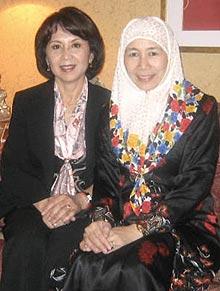 But the fact that we paid a personal and private call on our friend Azizah caused a lot of waves and interest around KL. There was great personal sympathy and concern for Azizah among many other ambassadors' wives as well, for Azizah had always been kind and friendly to all of us.
And something else happened that was very interesting.
As we would travel through Kuala Lumpur on our way to various events, people would see the American flag flying on the front of the ambassador's car. And for the first time during our three year stay in Malaysia, Malaysians would honk and wave and smile at us. It was their way of saying "thank you" for our visit to Azizah.
Malaysians would walk up to us at receptions and other events and whisper in our ear, "Thank you for what you did." They whispered to us, for they dared not say it in public.
The above is an excerpt from a newly release book, 'Struggle for Justice : The Story of Dr. Wan Azizah Wan Ismail' by Hiroko Iwani Malott, wife of the US ambassador to Malaysia when the events of this story began. She has accompanied her husband on diplomatic assignments in Vietnam, India, Japan, and Malaysia. The mother of two grown children, she and her husband now live in Alexandria, Virginia. The book can be bought from amazon.com .


Are you sure you want to delete this comment?
This action cannot be undone.