




The Sound of Money calendar
It has been a year studded with sparkling statements from some of the government's top brass, but for sheer chutzpah, the Inland Revenue Board (IRB) beats the rest of the brainy bunch with its calendar for the public.
The IRB wall calendar carries the memorable legend "Ke manakah wang cukai pendapatan dibelanjakan (Where does your tax money go?). Its audacious answer makes this calendar a collectible classic.
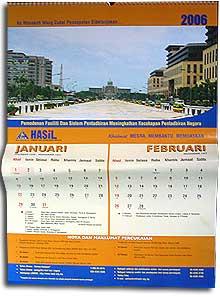
A huge photograph of Perdana Putra, the PM's imposing office complex in Putrajaya, kicks off 2006. The caption below it informs us in bold letters that tax revenue is spent on "modernising facilities and the administrative system to improve government efficiency".
Illustrating the subsequent months are photographs of a school (March-April), hospital (May-June) and highway (Sept-Oct) to indicate development funding, never mind that highways are exorbitantly tolled. Take, for example, the latest one in the offing - the proposed West Coast Expressway linking Banting and Taiping, where road users are expected to fork over a projected RM42 billion to the concessionaire over the next 38 years.
 Gracing the July-Aug page of the calendar are soldiers in jungle fatigues pointing their machine guns at the camera. It's reassuring to know that our troops - supported by expensive military hardware like Skorpion submarines, Sukhoi fighter jets and Super Lynx helicopters - are combat-ready. After all, who knows which tiny neighbouring country may just suddenly decide to attack, eh?
And saving the best for last, the IRB says its expenditure also goes towards helping the local automotive industry - a photograph of a Proton husk closes the year on Nov-Dec. Owners of painfully problematic Protons would be less offended by pretty pictures of cats in the calendar instead, methinks.
It has been a year studded with sparkling statements from some of the government's top brass, but for sheer chutzpah, the Inland Revenue Board (IRB) beats the rest of the brainy bunch with its calendar for the public.
The IRB wall calendar carries the memorable legend "Ke manakah wang cukai pendapatan dibelanjakan (Where does your tax money go?). Its audacious answer makes this calendar a collectible classic.
A huge photograph of Perdana Putra, the PM's imposing office complex in Putrajaya, kicks off 2006. The caption below it informs us in bold letters that tax revenue is spent on "modernising facilities and the administrative system to improve government efficiency".
Illustrating the subsequent months are photographs of a school (March-April), hospital (May-June) and highway (Sept-Oct) to indicate development funding, never mind that highways are exorbitantly tolled. Take, for example, the latest one in the offing - the proposed West Coast Expressway linking Banting and Taiping, where road users are expected to fork over a projected RM42 billion to the concessionaire over the next 38 years.
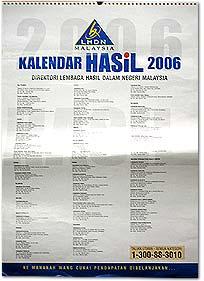 Gracing the July-Aug page of the calendar are soldiers in jungle fatigues pointing their machine guns at the camera. It's reassuring to know that our troops - supported by expensive military hardware like Skorpion submarines, Sukhoi fighter jets and Super Lynx helicopters - are combat-ready. After all, who knows which tiny neighbouring country may just suddenly decide to attack, eh?
And saving the best for last, the IRB says its expenditure also goes towards helping the local automotive industry - a photograph of a Proton husk closes the year on Nov-Dec. Owners of painfully problematic Protons would be less offended by pretty pictures of cats in the calendar instead, methinks.
PM, the keyword
The IRB is the agency responsible for collecting and administering payment of income tax, petroleum income tax, real property gains tax, estate duty, stamp duties and other taxes, such as the Labuan offshore business activity tax.
In its vision statement, IRB states that it "is recognised as the foremost tax administration in the region and the best government agency in the country".
At a glance, the tax calendar is a pictorial representation that speaks volumes on how the country has been shaped in the ex-premier's image. This is understandable as Mahathir Mohamad's nationalistic legacy looms large in the aftermath of his 22 long years in power.
Fittingly, Malaysia's prime movers and shakers over the past two decades can be encapsulated in the initials PM: Petronas, Proton, Putrajaya, megaprojects and Mahathir. Rentier economy, building frenzy and bailouts have, unavoidably, coloured our landscape. Furthermore, the mollycoddling of favoured businesses has created decorative bonsai, as in the case of Proton.
M for masterplan
But first, let's clear the haze on a misleading convention that's recently cropped up. You might have seen the huge billboards and monuments proclaiming "This is a Barisan Nasional (BN) project" at roadwork and building sites. You'd be led to believe BN or its dignitaries have made possible the facilities out of party coffers or personal pocket. Unfortunately, the demarcation line between BN and government and country has become blurred, if non-existent.
However, as the IRB's timely reminder points out, it is tax revenue that goes to these public projects. Tax monies should be used for the good of the rakyat, not treated as the BN's piggy bank to disburse or withhold as they please.
Take Petronas, for instance, in which is vested the entire oil and gas resources in Malaysia natural resources belonging to the country, you'd think. Yet at the behest of an influential coterie in power, it's become the cash cow behind prestige megaprojects like the Formula One circuit and Putrajaya .
 Although unpopular with many quarters, pristine Putrajaya (free of the taint and historical baggage of KL) has nonetheless been raised on the back of overflowing oil money. Wholly government-owned Petronas - of which Mahathir is advisor - holds substantial shares in Putrajaya Holdings, the company that develops and acts as local council for that towering testament to its architect's "vision".
The construction of Putra Perdana - the edifice front-paged on the calendar - has been tagged at RM200 million, according to the Prime Minister's Department. And that is the cost of one complex merely. Multiply that sum by the number of government buildings there, and you'd arrive at an astronomical amount beside which the mythical pleasure dome in Xanadu is but a pale wayang kulit shadow.
For all that money poured into Putrajaya - Khazanah Nasional Bhd, the government investment company is a major shareholder in Putrajaya Holdings too - come dusk, the administrative capital might as well be a near-dead dodo. Putrajaya Holdings president Samsudin Osman estimates the federal centre to house around 50,000 residents. Apparently, population growth has been rather slow there, making Putrajaya a waste of so much money for the benefit of so few.
Samsudin also revealed that Putrajaya's next phase, the construction of commercial complexes, would continue well into 2015. Nonetheless, the existing infrastructure barely a few years old has already shown signs of wear and tear from, oh dear, lack of maintenance. I humbly suggest that the word "Protonesque" be used to describe the clogged drains, dry fountains and cracked tiles in Putrajaya.
Tunnel vision
Dubbed "one man's dream, the nation's collective nightmare", Proton is another of Mahathir's brainchild. Its controlling shares are now held by government investment arm Khazanah, although previously owned by Petronas which took over a 27 percent stake from DRB-Hicom.
The national carmaker is touted by the tax calendar as representing "the development of the manufacturing sector and skilled labour to enhance the country's economic capability"; it employs 10,000 workers mostly in assembly plants.
But what Proton gives through one hand, the government takes away with the other. Millions of ordinary car owners are made to suffer because of the country's artificial pricing mechanisms, and the much abused Approved Permits (APs) indirectly protecting national cars. As a necessity and not a luxury, cars have been jacked out of reach for most Malaysians.
A struggling wage earner may need to reserve up to one-third of his salary to meet his monthly car instalment. The automobile has become the second biggest investment after property. Paying so much for a car, the middle-class has less savings and disposable income. Servicing a car loan for between seven and nine years begs the question: In what other country does an individual ridiculously mortgage one decade's earnings to sustain such a tinny, self-professed national pride?
Proton, being the privileged elder son of indigenous aspirations, is sheltered by the country's policy of handicapping foreign car sales through layers of taxes levied on its rivals. Malaysian prices of imported vehicles - some taxed up to 300 percent - display an additional zero behind the figure compared with their cost in the US; Malaysia has among the highest car prices in the world!
Born in 1983, Proton will turn 23 soon but shows few indications of being able to stand on its own four wheels. Although past the age of majority, Proton's last acquisition was akin to a teenager's shopping outing. Two days ago on Dec 27, Proton announced the disposal of its 58 percent stake in Italian bike maker MV Augusta - for the token sum of 1 (RM4.48) - one year after purchase. Proton chairman Mohd Azlan Hashim was recently reported in The Edge saying that Augusta had already cost Proton RM500 million in terms of overall write-offs and losses.
Proton's MD-designate Syed Zainal Abidin Syed Mohd Tahir, who assumes the post on Jan 1, is quoted as saying the full potential of Proton is yet to be realised. We're left to wonder when Proton finally, if ever, will reach adulthood.
Clowning glory
Proton's founding father and current advisor may have originally wanted his country to stand shoulder-to-shoulder with the giants of heavy industry through wearing a national car badge, just like the big boys. Mahathir obviously didn't anticipate that his "icons" would become the butt of jokes, like that one about the Kancil exported to the US - and sold in Toys 'R' Us.
 Or anticipate Proton and Perodua to guest star as comic relief in the BBC programme
Top Gear
. In one episode (
video clip
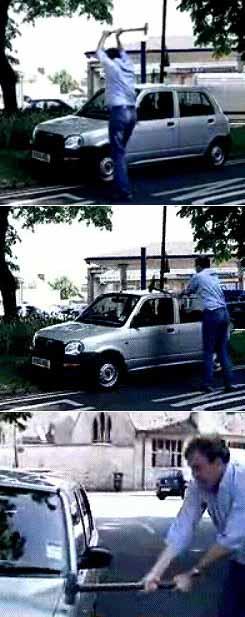
accessible on the Net), the show's acerbic host Jeremy Clarkson takes a sledgehammer to the Kelisa. "That is (whack!) the biggest load of unimaginative JUNK (whack!) ever it's just built with no soul (whack!), no flair (whack!), no passion (whack!). It's like a fridge or a washing machine and this (whack!) is for every time I caught a car like you dawdling around (whack!), indicating left (whack!) and then going right (whack!)", says the British car reviewer to an audience of car salesmen.
Or anticipate Proton and Perodua to guest star as comic relief in the BBC programme
Top Gear
. In one episode (
video clip
accessible on the Net), the show's acerbic host Jeremy Clarkson takes a sledgehammer to the Kelisa. "That is (whack!) the biggest load of unimaginative JUNK (whack!) ever it's just built with no soul (whack!), no flair (whack!), no passion (whack!). It's like a fridge or a washing machine and this (whack!) is for every time I caught a car like you dawdling around (whack!), indicating left (whack!) and then going right (whack!)", says the British car reviewer to an audience of car salesmen.
Clarkson adds, "Because of this car's sins, it will be tortured to death. There's going to be some hanging and quite a bit of drawing, but mostly there's going to be a lot of quartering (on film, we see the bonnet is easily stripped away)." Thereafter, he proceeded to blow up the Kelisa with four sticks of dynamite.
Clarkson's antics were watched by possibly 250 million people, either amused or aghast, around the world. Those viewers are definitely not the demographic Proton and Perodua wish to target in their ambition of expanding abroad.
Clarkson's jibes aside, there is a real issue of safety. How many fatalities on the road involve Proton and Perodua, we may ask, compared to quality cars? How many drivers would of their freewill choose a car that crumples under hammer blows?
What's in store?
Peering into my crystal ball, I see that some things will not change on the road - like the jaded look of the Proton Iswara, for one. 2006 will be another year of living dangerously where motorcyclists ferry wife and two young children on a cub chai. That a whole family would endanger life and limb through want of an affordable car is a sad indictment of our failed protectionist tax policies, seeing that decent cars can be bought cheaply in other countries.
I also predict people who depend on public transport will still stand a higher risk of becoming bald - through tearing their hair out in frustration and despair. If less money had been spent on Proton and bailing out national carrier MAS, perhaps more money could have been diverted to upgrading the public bus network.
Also starting 2006, the cream of society (i.e. people not likely to ever need to catch a public bus) milling around at the grandstand of the Formula One in Sepang will be able to glory in Petronas continuing its sponsorship of the BMW Sauber team. F1 sponsorship is not cheap; Intel has also inked a deal with the same team but will not disclose the cost which pundits say could be anything between US$10-70 million (RM38-263 million). Petronas, BMW Sauber's "premium" partner on a four-year agreement, is also keeping its sponsorship sum under wraps but one thing is for sure, it'll be no small change.
I foresee too that there are no toll hikes. Not because the government through the kindness of its heart resolves to put a lid on escalating prices (as trumpeted by the mainstream media in September) but because none of the toll road concessionaires actually have any scheduled rate increases due in 2006 under their agreements. Why are we enriching toll concessionaires - picked through closed tenders and insulated by very favourable terms - if as the calendar says, our taxes are paying for highways? Ask your BN representative this question the next time he pays a visit to your constituency.
Lastly, gazing into the future, I see that your tax forms will be out in January Oh joy.


