




Angela Merkel: No fair-weather friend?
No-one was more heartened to see the election of Angela Merkel as Chancellor of Germany than President Bush. Not because Merkel hails from the former East Germany, whose ascension to the top executive job in the reunified country embodies the ultimate victory of the American-friendly western camp. In fact, the Social Democratic Party (SPD), deeply opposed to the Iraq War, elected in last November Matthias Platzeck, also from the East, as its new leader, who is clearly an ideological foe of the hawks in the White House.
With her beliefs in greater market flexibility and, more importantly, anxieties towards Russia, Merkel came across as a natural ally for the Bush administration.
But the president could not have felt let down sooner.
No-one was more heartened to see the election of Angela Merkel as Chancellor of Germany than President Bush. Not because Merkel hails from the former East Germany, whose ascension to the top executive job in the reunified country embodies the ultimate victory of the American-friendly western camp. In fact, the Social Democratic Party (SPD), deeply opposed to the Iraq War, elected in last November Matthias Platzeck, also from the East, as its new leader, who is clearly an ideological foe of the hawks in the White House.
With her beliefs in greater market flexibility and, more importantly, anxieties towards Russia, Merkel came across as a natural ally for the Bush administration.
But the president could not have felt let down sooner. When Merkel met with Secretary of State Condoleezza Rice in Berlin early last December, she did not hesitate in bringing up the issue of Khaled al-Masri, a German national wrongly suspected of links to al-Qaeda, with her American guest.
More abhorrent for Bush, Merkel went on to comment at a press briefing that "the government of the US has, of course, accepted (the case) as a mistake", prompting Rice's aides to gripe that "we are not quite sure what was in her (Merkel's) head" .
Which was bizarre. For Rice had indeed conceded that when mistakes were made, the Americans would be ready to correct them. Any seasoned journalist can tell the general statement was tantamount to confession (but not necessarily contrition).
 Last weekend, Merkel again raised Bush's hackles when she, in an interview with
Der Spiegel
, cautiously but boldly suggested "an institution like Guantanamo can and should not exist in the longer term different ways and means must be found for dealing with these prisoners".
Last weekend, Merkel again raised Bush's hackles when she, in an interview with
Der Spiegel
, cautiously but boldly suggested "an institution like Guantanamo can and should not exist in the longer term different ways and means must be found for dealing with these prisoners".
Guantanamo has always been a thorny issue even between the United States and its closest allies. Just last month, a British judge ruled in favour of David Hicks, a Muslim Australian detained in the US-run prison camp on the island of Cuba, and held that Home Secretary Charles Clarke had no power to reject Hicks' citizenship application. Hicks had applied to be a British national in the hope that London would take up the Guantanamo issue with Washington.
Cleaning up inner courts
Czech Interior Minister Frantiek Bublan recently turned down a request by the American government to fly in several people from the Guantanomo Bay for "secure asylum", fearing that such move would be seen as lending legitimacy to the military enclave widely regarded as lawless by the European Union countries, especially when it had dawned on European leaders that the US military could be running a Guantanamo Bay-type detention centre in Kosovo.
As far as Germany is concerned, Murat Kurnaz, a 23-year-old Turk born and raised in Bremen, has been detained in Guantanamo since 2002. Pressure has been applied on the German authorities to pursue his case with the US government.
 All governments are likely to symbolically clean up their inner courts before inspecting guests arrive. This is as true of democracies as well as of autocracies, with the extent of facelift being the only difference. When the United Nations shied away from visiting the Guantanamo Bay on US invitation, the reasons given were only too obvious to all.
And the Bay itself has a very interesting history . Although the US secured a perpetual lease at the end of the Spanish-American War in 1898 and turned the Cuban province into its protectorate, the ultimate sovereignty lies with Cuba. The first Guantanamo detention camp was only established by George Bush Sr. in 1991 to keep a small group of Haitian refugees - children included - who had been tested positive for HIV, with no prospect of release.
The Cubans are certainly piqued at the fact that the remote corner of the territory remains in American hands. Still, Fidel Castro, the longstanding bugbear of the US, probably takes delight in the Bay's negative connotation worldwide. Indeed, keeping Guantanamo alive reminds the world of a pimple on the face of American democracy.
But why should Merkel, just days before her first visit to Washington, have got down to the nitty-gritty and risked the possible cold shoulder on the part of her host?
 To understand this, one must consider the uproar that Merkel had caused while in opposition, when she strongly criticised the then SPD Chancellor Gerhard Schrder for the latter's intransigence over the Iraq War. This was taken to mean, with her in charge, Merkel would be ready to commit German soldiers to the quagmire in Iraq, and the blunder that she made at that time only benefited the man she wanted to unseat.
As reported by Die Tageszeitung , she has been eager to disperse the impression of blind loyalty to the US president now that she is Chancellor. Given that the scepticism of the War on Terror remains widespread among the German public, Merkel has needed no reminder to show the Germans that she is very much her own woman.
Taking open criticisms
The Chancellor also has not lost sight of electoral considerations.
Although it now appears that the cohabitation between Merkel's Christian Democratic Union (CDU) and the SPD is proving much more harmonious than many had predicted, the leadership of both parties are, however, acutely aware that there is an election to fight less than four years from now. And, like many democracies, campaigning usually starts well before the parliamentary term is up.
Unlike Malaysia, a questionable federation in every sense of the word, state elections in Germany often serve as barometers for all political parties vying for federal power. Before September 2009, there will be several vital state elections to contest before the current grand coalition comes to an end (if it does survive at all), including those in Bavaria, Hamburg, Hesse and Lower Saxony in 2008. For many German politicians, too close a rapport with the Bush administration could prove electorally costly.
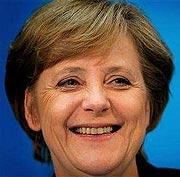 As leader of the largest economy in the EU, Merkel will be no different from other European partners in emphasising that democratic rules and human rights must be upheld even in adversity. By making Berlin's stance on Guantanamo clear, she has again underlined a fundamental difference between her and Bush, who is probably spending increasing amount of time on his knees praying for divine solutions to a plethora of global problems.
Or one can interpret Merkel's candour as a sign of her desire for a genuine but critical partnership with the US, as suggested by Uta Thofern. In the same interview, she also made clear her concerns over Russia, which will surely be to the delight of the White House. While Bush may be preoccupied with the possibly of Germany's economic contribution to the post-Saddam reconstruction initiative, Merkel has, however, stressed that the meeting between them will not be confined to Iraq. With the nuclear controversy in Iran escalating, the US needs more allies, not foes, to respond to the impending challenge.
Whatever the implications of Merkel's latest remarks on Guantanamo are, it is unlikely that President Bush will allow the strategically important relationship with Germany to be ruptured. As the 'Coalition of the Dwindling' shrinks further, Bush will simply have to learn to take open criticisms in stride.


