




In search of protection from Islamic law
Malaysia's ethnic minority groups are banding together for a united front against what they fear is a steady encroachment of Syariah or Islamic law into their lives.
Unsettled by the decision of the Kuala Lumpur High Court last month that it has no jurisdiction in Islamic matters and that a non-Muslim has no remedy under common law, the minorities, led by moderate leaders, are putting up a surprisingly stiff protest.
Observers say the resistance has placed the government of Prime Minister Abdullah Ahmad Badawi in a delicate position because it would need to balance this with competing demands from the majority Muslims.
Malaysia's ethnic minority groups are banding together for a united front against what they fear is a steady encroachment of Syariah or Islamic law into their lives.
Unsettled by the decision of the Kuala Lumpur High Court last month that it has no jurisdiction in Islamic matters and that a non-Muslim has no remedy under common law, the minorities, led by moderate leaders, are putting up a surprisingly stiff protest.
Observers say the resistance has placed the government of Prime Minister Abdullah Ahmad Badawi in a delicate position because it would need to balance this with competing demands from the majority Muslims.
While non-Muslims want the common law and the secular constitution of Malaysia preserved and protected, many Muslims demand a society based on Syariah law.
Syariah denotes the Islamic way of life rather any code of justice although some Muslim countries have instituted it as the law to be enforced the courts. But the actual application of Syariah varies greatly among countries and few enforce it on non-Muslims.
In Malaysia, the protesters are themselves surprised at the support their movement has received. A strong undercurrent of dissatisfaction has been building up among the minority communities against fundamentalists pushing the Islamic way into matters involving the family, education and personal decisions such as religious conversion.
 Two parallel societies - Muslim and non-Muslim - have gradually replaced what was a pluralistic, secular Malaysian society, based on common law that was the legacy British colonials handed over on a platter upon independence in 1957.
Malay Malaysians, nearly all of whom follow Islam, form 60 percent of Malaysia's 24 million people while Chinese Malaysians - mainly Taoists, Buddhists and Christians - make up 30 percent. Indian Malaysians who are Hindus, Sikhs, Muslims or Christians make up another eight percent. There are smaller groups such as Eurasians.
Malay is the official language and Islam the official religion but the constitution guarantees freedom of worship, although this provision, according to the minorities, has been gradually and systematically eroded.
Last straw
The last straw was the burial last December of 36-year-old soldier and mountaineer M Moorthy as a Muslim, over the protest of his Hindu wife S Kaliammal. High Court judge Mohamed Raus Sharif ruled that he had no jurisdiction to hear her application that her husband had been a practising Hindu.
 Mohamed Raus refused to alter an
ex-parte
judgement, obtained from the Syariah Court by the Federal Territory Islamic Affairs Department that deemed the dead man to have converted to Islam - the judgment, in effect, told non-Muslims that they have no remedy in such cases.
Mohamed Raus refused to alter an
ex-parte
judgement, obtained from the Syariah Court by the Federal Territory Islamic Affairs Department that deemed the dead man to have converted to Islam - the judgment, in effect, told non-Muslims that they have no remedy in such cases.
The protest has, thus far, been peaceful - a candlelight vigil outside the court building, a signature campaign and a memorandum to the prime minister.
Also about 30 influential Hindu organisations have formed the umbrella Hindu Rights Action Force to protect the rights of minorities to religious freedom. Last week, it submitted a petition to the King, who is constitutionally the head of Islam, to intervene.
"The presiding judge, by refusing to dwell in the said matter has effectively failed to exercise his legitimate right as an umpire conferred upon him by the Federal Constitution," they said in their petition.
"In our opinion this is nothing but a serious misconduct on the part of the judge. This practice cannot be tolerated and must never be encouraged in a multi-racial society, as it could have far-reaching effects.
"The decision has tarnished the image of the judiciary and brought disrepute. The public wants to have continued assurance that the judicial system would prevail and has supremacy over all other bodies, both Islamic and non-Islamic."
Repeal sought
The crux of their demand is a repeal of Article 121 (1A) of the constitution that was amended in 1988 to state that the civil court has no jurisdiction on matters under the purview of the Syariah Court.
Opposition leader Lim Kit Siang led calls for constitutional change at a forum attended by over 100 politicians, lawyers, activists and representatives of all the minority groups.
"We would like to call for the repeal of the amendment and a restoration of the pre-1988 Article," he said.
However Muslim organisations have warned that any attempt to repeal Article 121 (1A) would be strongly resisted.
Malay National Force or Teras, a Malay non-government organisation, said in a statement that Article 121 (1A) provided specific guarantees that the civil court will not interfere in Islamic matters.
"The Syariah Court should not be seen as an institution that denies justice to non-Muslims. On the contrary, if its laws are fully applied, there is an assurance of better justice here compared to civil laws, which are the heritage of British colonial rule," said its president Mohamad Azmi Abdul Hamid.
Human rights lawyer P Uthayakumar told IPS : "How can anyone even suggest such a remedy to non-Muslims? What becomes of the civil law, the judicial system and the secular constitution?
"We non-Muslims have suffered long enough. The government should intervene immediately and put an end to non-Muslim fears and misery. The uncertainties have gone on for far too long."
Uneasy relationship
The row has highlighted the long standing uneasy relationship that exists between the civil and the Syariah court systems and the potential for an explosive encounter in a multi-ethnic and multi-religious society showcased to the world as a tolerant nation at peace.
Some ministers have gone against the tide arguing for a secular constitutional court to rule on matters involving conversion.
"If we let the Muslim court decide this, justice might not be served because it would decide in favour of Islam," said Mohd Nazri Abdul Aziz, the minister in the Prime Minister's Department who has oversight of parliamentary affairs.
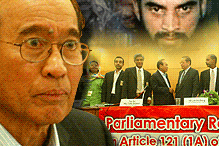 Human Rights Commission chairperson Abu Talib Othman, a former attorney-general, blamed the situation on judges who fear to apply the common law.
"The problem today is created by courts who have no courage to comply with the oath of office they took," he told a recent public forum on the controversy, criticising Mohamed Raus for refusing to overrule the Syariah Court in the case of the dead soldier.
It is common knowledge, though rarely mentioned, that Muslim judges are reluctant to apply common law principles in cases involving Islamic matters.
"They fear Allah's punishment more then the wrath of their country's citizens. It is a growing problem," said a lawyer who declined to be named.
The premier has offered a cautious response via the media: "I am looking into the matter and hope to prevent problems like this from happening."
But non-Muslims, who fear that Syariah is becoming the supreme law of the land, want more than words to soothe their anxiety that the common law and civil justice system are under threat.
- IPS


Are you sure you want to delete this comment?
This action cannot be undone.