




What now, prime minister?
It took a video clip of a mere 71 seconds, an opportunistic instance of pornographic voyeurism, to be the culmination of years of police abuse and ill-treatment of detainees. The power of the pen in the form of countless press reports and public complaints, police reports and memoranda in past decades exposing such abuse was no match for the recording.
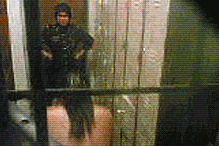
The images of an obviously naked woman doing 10 'ear-squats' in front of a police officer and then innocently turning away to put on her undergarments and outer clothing, inadvertently to face the photographer and further expose herself, has had an impact on the nation rarely seen in modern times.
The eyes do not lie. News of the video clip aroused the senses and fascinated the imagination. Intrigue reigned and outrage multiplied exponentially. This time, unlike the many times before, there could be no doubt or public denial that the incident had taken place.
It took a video clip of a mere 71 seconds, an opportunistic instance of pornographic voyeurism, to be the culmination of years of police abuse and ill-treatment of detainees. The power of the pen in the form of countless press reports and public complaints, police reports and memoranda in past decades exposing such abuse was no match for the recording.
The images of an obviously naked woman doing 10 'ear-squats' in front of a police officer and then innocently turning away to put on her undergarments and outer clothing, inadvertently to face the photographer and further expose herself, has had an impact on the nation rarely seen in modern times.
The eyes do not lie. News of the video clip aroused the senses and fascinated the imagination. Intrigue reigned and outrage multiplied exponentially. This time, unlike the many times before, there could be no doubt or public denial that the incident had taken place.
The government and police scurried around defensively, issuing various media statements seeking to limit the damage. One minister promised that there would be no cover-up. A deputy minister invited foreigners who do not like police procedure this country to leave. He was sternly rebuked but kept his job.
The police defended the procedure and ostensibly sought out the person who recorded the clip. Another minister declared that he was satisfied, upon receiving a full report of the matter from the police.
Teresa Kok, the DAP lawmaker, was criticised for making public the existence of the video clip. Somewhere down the line of communication, it was suggested that the naked woman was a Chinese national. A minister was despatched to China to calm the rising storm.
Unusual alacrity
The prime minister promptly called for a Royal Commission of Inquiry. This was highly unusual in light of the speed at which it was done, considering that the peerless 572-page Report of the Royal Commission to Enhance the Operation and Management of the Royal Malaysia Police Force had just been published (RC Report) and has yet to be fully implemented.
 Why the necessity for another Royal Commission so soon thereafter? The RC Report already acknowledged that intimate and strip searches were not being held in strict accordance with prescribed regulations (paragraph 6.2.2 at page 130 RC Report). Complaints of humiliating and degrading treatment of women detainees were highlighted.
For example, a woman VCD seller was asked to strip and do the ketuk-ketampi (squats) at the Kapar police station (page 340 RC Report). The RC Report observed, inter alia , that "there is gross infringement of human rights in the forced act when the complainant was forced to strip and ordered to do unnecessary acts in the presence of other women detainees" (page 341 RC Report).
But the government historically has a thing for the visual. This move resonated to the establishment of a similar commission to investigate the injuries sustained by former deputy prime minister Anwar Ibrahim when pictures of him and his black eye surfaced when he was first brought to court to be charged.
And the government probably had an eye on its relations with China too - the first term of reference for the Royal Commission was "to determine whether the woman seen in the video clip doing ear squats in the nude was one of five Chinese nationals who were arrested and held by the police".
 From the perspective of rights discourse and best practices, did it really matter whether the detainee was a Chinese national or not?
The other terms of reference were:
1. To investigate the handling of the body search of the woman seen in the video clip doing ear squats in the nude;
2.To determine whether there was any impropriety in the handling of the aforementioned body search; and,
3. To investigate the standard operating procedure, approaches or regulations in the handling of body search in connection with the arrest and detention by the police, and to propose any changes if needed.
Lingering questions
The commission commenced its inquiry on Dec 12, 2005. The assisting officer was Suhaimi Ibrahim, a Deputy Public Prosecutor from the Attorney-General's Chambers. Sankara Nair represented the five Chinese nationals as legal counsel, pursuant to Section 18 of the Commissions of Enquiry Act, 1950. The Bar Council was granted observer status.
The testimonies of the police witnesses did not surprise anyone. All detainees, upon arrest, are forced to strip and then squat, holding their ears. It does not matter whether one is detained for a drug offence or immigration violation or theft.
The practice is apparently founded on "tradition", passed down from generation to generation, similar to how secret recipes of assam laksa are handed down from mother to daughter. Superiors instruct junior officers joining the force of this "heritage". The number of squats is discretionary.
 This practice, part of a system which indiscriminately places all detainees at risk, is thoroughly flawed. The police concede that there is no authorisation in the Inspector-General's Standing Orders or any law or power which permits this.
Deputy Inspector-General of Police Musa Hassan testified that the practice is not unusual because it is done in other countries as well. Any abuse of the practice by police officers is beyond the control of the police because no complaints have been received, he says on oath.
The police had to restate their detention procedures before the commission. They justified the squats. Officers testified to instances of objects being ejected. When probed further, they admitted to such instances being few and far between; in fact, the only one occasion in their line of duty.
The commission is then treated to medical evidence for validation. A doctor was called. She said squats could possibly expel objects from the vagina, depending on the strength of the muscles. But if one stands after squatting, this would possibly nullify the effect of squatting. Scientific medical rationalisation is of little assistance.
Religion was consulted for guidance on the propriety of 'ear-squats' ordered by our human police. Faith and the Word of God to complement man's reason and rationale. After all, one of the principles of Islam Hadhari is the protection and advancement in the well-being of women, children and minority groups, so why not?
Prof Madya Ashraf Md Hashim of the International Islamic University interpreted Islam as disallowing 'ear-squats' by fully nude detainees. It offends the "values of the religion", he articulated, and was unknown during the Holy Prophet's time. A religion so institutionalised in, and dictating, our system of governance says our policing institution is currently practising an immoral tradition.
 Who was the woman in the clip? The police presented a Malay woman arrested in a drug bust, and out on bail pending drug charges. She cried when she saw herself in the clip and identified herself. But does it really matter? Maybe - for the government - if only to stop the drastic decline in tourists from China here and to buttress the show-cause letter to
China Press
, eventually forcing two employees to resign.
Who was the woman in the clip? The police presented a Malay woman arrested in a drug bust, and out on bail pending drug charges. She cried when she saw herself in the clip and identified herself. But does it really matter? Maybe - for the government - if only to stop the drastic decline in tourists from China here and to buttress the show-cause letter to
China Press
, eventually forcing two employees to resign.
The question remains that the police, knowing the identity of the woman much earlier (and no later than Nov 24, 2005), chose not to release the information. Surely, a commission was not necessary to establish this fact?
Who recorded the clip? There is no evidence of this. Lance Corporal Suhaimi Nordin said it was shown to him by Constable Mohd Dzulfatah Saari. Dzulfatah denied it and suggested Suhaimi was lying. Dzulfatah, looking dazed and suffering an eye-sore, said he saw it on the handphone of his colleague, one Zulkarnian.
Zulkarnian was not called to testify. But does it really matter? Maybe the person who took and exposed the clip should be applauded as a "whistleblower" and denigrated as a voyeur at the same time.
Shortcomings of inquiry
While civil society welcomes the inquiry, certain aspects of the commission's work leave much to be desired.
The process of the commission was to be inquisitorial in nature. Its duty was to elicit the truth to make its findings on the terms of reference. The assisting officer was to adduce evidence to assist it. There were no opposing sides, unlike an adversarial process.
Lane CJ in R v South London Coroner; ex parte Thompson (1982) 126 SJ 625 described an inquisitorial process as follows: "In an inquest it should never be forgotten that there are no parties, there is no indictment, there is no prosecution, there is no defence, there is no trial, simply an attempt to establish facts. It is an inquisitorial process, a process of investigation quite unlike a trial where the prosecutor accuses and the accused defends, the judge holding the balance or the ring, whichever metaphor one chooses to use."
Further, the inquiry was to be a public hearing.
With respect, acceptable standards of fairness and equality were not met at the inquiry. The fear is that the opportunity for the commission to deliberate and produce a more comprehensive report was lost.
The commission appeared too eager to conclude the inquiry after evidence that the woman in the clip was not a Chinese national, but of Malay descent. This was only the first term of reference, whereas there were three other terms. The Chinese nationals who were subpoenaed were not asked to appear. They would have confirmed that, inter alia , even for immigration-suspected offences, detainees are ordered to strip and squat. Or would the damage to relations with China have been too difficult to handle if they testified?
Much unlike the previous commission (on the police force) where the same members sat, with others, this commission was not sufficiently inclusive. The previous commission had made an open invitation to members of the public, NGOs and civil society groups to appear and submit their views and/or complaints. This was well accepted.
 Despite the wide-ranging nature of the terms in relation to this commission, it wanted to hear only evidence adduced by the assisting officer. This was unfortunate.
The inquiry was not adequately balanced. The whole tack of the assisting officer, up to and including his oral and written submissions to the commission, was to justify and defend the practice of 'ear-squats' by the police.
Medicine says it is not useful. Religion says it is unacceptable before God. Practice suggests it is rarely, if ever, successful. The assisting officer nevertheless wanted the commission to believe that it is "not unjustified".
If the commission had wished to examine the matter from a human rights perspective, as it should, more evidence should have been heard from a range of different witnesses - medical experts, detainees who experienced similar abuse, rights advocates, foreign police officers and civil society groups.
Stringent measures?
The Bar Council, as the body statutorily charged with upholding justice without fear or favour, should have been permitted to make oral submissions on salient points of the inquiry. It should also have been allowed to fully take part in the inquiry, with an unhindered right to examine witnesses. Documents and exhibits pertaining to the inquiry ought to have been made available for public scrutiny, and not submitted only to the commission.
There was no other party or organisation at the inquiry to balance the defensive spin enacted on the Squatgate evidence by the assisting officer. The transparency of the inquiry was not matched by the transparency of the clip in revealing the humiliation of the woman in it.
It will be difficult for civil society demagogues (as much as I trust they would like to) to defend the work of the commission from an onslaught of criticisms if its report is not a well-balanced one. It was with this in mind that the commission had, for the sake of all Malaysians, to be more all-encompassing in its work.
As it stands, the word on the street is that the commission sat to perpetuate a cover-up of Squatgate. This allegation could easily have been avoided if the commission did not so hurriedly close its inquiry, and had instead opened its doors to all and sundry. Many aspects of this debacle still need an open investigation and examination.
Naked 'ear squats' embody humiliation and personify the erosion of dignity. If it was really necessary to have detainees squat, why are detainees also made to hold their ears? The unwarranted transgression against the woman's person revealed the impotence of our policing principles, and is symptomatic of a failed establishment. An effective mechanism to check police conduct is now absolutely vital.
 Despite its shortcomings, it is optimistically hoped that the commission's report will recommend stringent measures to be undertaken and the erection of strong safeguards to check the abuse of authority in the police force.
The Bar Council, in its written submissions to the commission dated Dec 16, 2005, recommended the following:
- Guidelines/codes of practice for the procedure of body searches to be drawn up and made public by way of legislation.
Squatgate was caused by a singular failure to prevent the unauthorised making of the video recording. Progress in technology, including a heightened use of the Internet, enhanced the speed and breadth of its exposure. Ironically, this drew attention to a form of systemic abuse perpetuated as part of a policing heritage. Insufficient accountability and lackadaisical oversight of the police over the years has contributed to this.
The humiliation of the woman in the recording is synonymous with the shame of our police force. The great hope, post-Squatgate, is that our lawmakers will decidedly resolve to take serious action and not leave the commission's report gathering cobwebs and dust in an office somewhere.
An advocate and solicitor, EDMUND BON was also a member of the Bar Council's team of observers at the Royal Commission of Inquiry into the Standard Operating Procedure, Approaches or Regulations in the Handling of Body Search in Connection with Arrest and Detention by the Police. The Bahasa Malaysia version of this article was posted on the Malaysian Bar website on Jan 16.


