




Half-bridging the troubled waters - scenically
Two months ago, I was asked by a correspondent from Radio Singapore International on the prospects of further improvement in the thawing ties between Malaysia and Singapore in 2006.
In reply, I opined that while the bilateral relations had been moving slowly but steadily in a positive direction, to what extent Prime Minister Abdullah Ahmad Badawi could shape his policy constructively towards the island state would largely depend on how well he coped with or even overcame the jingoistic nationalists within Umno.
In other words, once hard-pressed by the conservative forces in his own party, even a business-friendly and gentle leader like Pak Lah could turn aggressive vis vis "that little red dot" south of the border.
Two months ago, I was asked by a correspondent from Radio Singapore International on the prospects of further improvement in the thawing ties between Malaysia and Singapore in 2006.
In reply, I opined that while the bilateral relations had been moving slowly but steadily in a positive direction, to what extent Prime Minister Abdullah Ahmad Badawi could shape his policy constructively towards the island state would largely depend on how well he coped with or even overcame the jingoistic nationalists within Umno.
In other words, once hard-pressed by the conservative forces in his own party, even a business-friendly and gentle leader like Pak Lah could turn aggressive vis vis "that little red dot" south of the border.
Since taking over the premiership in November 2003, Abdullah has made great strides in his endeavour for better diplomatic ties with Singapore. To show his goodwill and sincerity, he invited the then Prime Minister Goh Chok Tong and some key members of Goh's cabinet to join him in a kongsi Chinese New Year celebration in Johor Bahru.
As the leaders of the two countries were tossing yee sang - the traditional Chinese New Year dish that is said to bring health, wealth and longevity and believed to usher in luck - to a more auspicious and prosperous year ahead in the pouring rain that was anything but unexpected, they were also sending the strongest possible message that the two governments were ready to go through thin and thick, come what may.
And the Malaysian prime minister appeared to mean what he said. Temasek, the Singaporean government's investment arm, has begun its venture into Malaysia. Abdullah even analogised the two neighbours as the two halves of a detached house: while they used to bang on the walls, they now had to share utilities in the face of the increasingly challenging international environment.
In April 2005, both countries signed an agreement under which Malaysia would withdraw its case before the International Tribunal for the Law of the Sea, while Singapore would make greater effort to minimise possible ecological and environmental impact in the wake of its reclamation work.
All well and dandy?
Reciprocating Abdullah's overtures, the government-controlled media in Singapore has been portraying the prime minister as a moderate, quiet and firm leader, a safe pair of hands in the treacherous geopolitical climate of Southeast Asia.
When Endon, Abdullah's wife, passed away last October, President S R Nathan, Senior Minister Goh Chok Tong, as well as Prime Minister Lee Hsien Loong attended her funeral and paid their last respects. There could not have been higher diplomatic protocol than this.
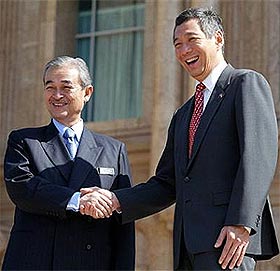 Given the noiseless but amicable relationship between the two countries in the last two years, one could be forgiven to think it all well and dandy. The announcement by Deputy Prime Minister Najib Tun Razak last week that Malaysia would go ahead with the planned new bridge across the Straits of Johor therefore came as a bombshell to many.
In fact, the latest news concerning the stalled project came the day after the Agong Tuanku Syed Sirajuddin had just completed his official visit to the lion city, which clearly caught the Singaporeans by surprise.
That the announcement was made by the deputy prime minister does give room for some overstretched imagination and conjecture. Seeing himself as the heir apparent, Najib, by pre-empting Singapore, has sent out a clear signal that he will do his utmost to safeguard Malaysia's national interests, and will be more of a Malay nationalist, not less.
So, is petty nationalism rearing its ugly head again now that a bogeyman is needed in order for one to rally the ranks and files behind a potential future leader?
Despite the shocking announcement by the Malaysian government, there are however marked differences between the situation now and the acrimonious relations of the two countries in the Mahathir era.
The Malaysian media, for one, has been rather "responsible" by not playing up the issue, choosing only to call for a win-win solution to the fate of the planned bridge, while reiterating the official position of the government in this regard. It is a far cry from the days when Singapore made headlines in Malaysia's English and Malay press on daily basis only for all the wrong reasons.
(At a function some years ago, the Singapore High Commissioner Ashok Kumar Mirpuri remarked that the media in Malaysia and Singapore often blew sensitive issues concerning the two countries out of proportion. I found myself compelled to correct him that the media could only do so with the tacit sanction and connivance of their political masters, and it would be unfair to point his fingers at the journalists only while absolving his government of any responsibility.)
Caught in between
When the prime minister finally commented on the issue, he was careful enough in stating the need to save costs. Unlike his predecessor, there has been neither tit-for-tat nor sarcasm so far while both sides are looking for a way out of the deadlock.
Abdullah is apparently caught between a rock and a hard place. He may not want to jeopardise his image as a responsible and reasonable leader of a political party that is well known for its racist rhetoric, yet further silence on the issue could rekindle the fervent but taxing debate over who best safeguards Malaysia.
And, mind you, even the opposition parties ignore at their own peril the race to be the ultimate torch-bearer of national interests, whether or not the crooked bridge would make real economic sense is only secondary, precisely the reason why leaders from Parti Keadilan Rakyat to PAS have been in haste to welcome the decision of the government on the final green light to the construction work.
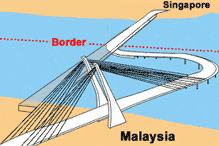 The relative calm in the Malaysian media is perhaps indicative of the prime minister's commitment to solving the impasse at the negotiating table, and he naturally expects his Singapore counterpart to understand the difficult position that he is in. After all, the new bridge could cost between RM640 million and RM1.5 billion. If implemented efficiently and effectively, the substantial benefits might trickle down to the lower layers of the Malay business community.
I must caution that the records of the Johor state government on infrastructural implementation have been mixed: the southern state has given Singapore a run for the money by managing the Tanjung Pelepas Port rather successfully, but the badly maintained Pasir Gudang Highway and the ceaseless clogs at the junction from there into Jalan Tebrau in Johor Bahru have been plaguing the cityfolk for years, not to mention the beautification project that is getting the downtown area nowhere.
Of course, the island republic can sit back, relax and take its own sweet time to decide whether or not it wants a full new bridge, as it is Malaysia which has been obstinate in pressing ahead with the construction of the new Customs, Immigration and Quarantine (CIQ) Complex on the Johor side, thereby forcing itself into a corner.
Nationalistic zeal
When Singapore built its new checkpoints at Woodlands in the 1990s, the government there was smart enough not to touch the causeway sometimes a raw nerve - therefore saving itself from any tricky dealing with Malaysia. In his strong answer to the development across the straits, Mahathir came up with an ill-considered CIQ complex that has been haunting his successor to this very day.
Still, the Singapore government is caught in a dilemma in some ways. For instance, any further delay on the part of the Singapore authorities would invariably be interpreted as a snub to Abdullah, a Malaysian leader that has been rather unusually popular with the Singapore populace, and such "disrespect" could reignite the nationalistic zeal of the Malay masses in no time.
This aside, Prime Minister Lee of Singapore certainly cannot afford to appear weak-kneed when he is contemplating an early election this year. Seen in this light, one could argue that the timing of the announcement by Najib was carefully chosen.
And how far back can Singapore go if all that it could do is to reach one compromise after another when it comes to dealing with its "most testy neighbour"?
It seems that in international politics, greater nationalism often equals lesser achievement. Malaysia still has a long way to go in realising this simple truth.


