




Mob violence - not in our name, please
I am inclined to believe as noted by several commentators that some Muslims are indeed abusing the Jyllands-Posten incident. Caricatures of the Prophet Muhammad were published last year by Danish newspaper Jyllands-Posten on Sep 30. That was a good four months ago.
Some commentators have attributed the escalation of protests from the Arab world led by the Egyptian government and those in power who have found it opportune to shore up their flagging Islamic credentials as their electorates show keenness in voting out old regimes.
There are even assertions in some quarters that the publication of the Danish cartoons was a "Jewish conspiracy" over Israel's discontent over the Hamas election victory in Palestine, despite the fact that Hamas won long after Sept 30, the date of first publication of the cartoons.
I am inclined to believe as noted by several commentators that some Muslims are indeed abusing the Jyllands-Posten incident. Caricatures of the Prophet Muhammad were published last year by Danish newspaper Jyllands-Posten on Sep 30. That was a good four months ago.
Some commentators have attributed the escalation of protests from the Arab world led by the Egyptian government and those in power who have found it opportune to shore up their flagging Islamic credentials as their electorates show keenness in voting out old regimes.
There are even assertions in some quarters that the publication of the Danish cartoons was a "Jewish conspiracy" over Israel's discontent over the Hamas election victory in Palestine, despite the fact that Hamas won long after Sept 30, the date of first publication of the cartoons.
Iran's Hamshari daily owned by the Tehran city council, mooted a retaliatory measure. It announced on Feb 7 that it would run images satirising the Holocaust. These cartoons would be published "to test the arguments of western newspapers which have cited freedom of expression" in printing the Danish cartoons.
We forget that until just after World War II, European Jews were marginal. Some six million Jews were exterminated by the Nazis.
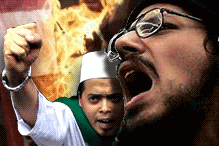 Protests have turned mob rule. Properties were burned by rioting Muslims. Buildings housing international aid agencies in Somalia were not spared. These agencies were probably there in the first place to provide humanitarian assistance where local governments have failed.
Some Muslim community leaders in the Middle East still continue to call for extremist measures like execution of those who have "blasphemed". In my view, they have encouraged the mob to become agent provocateurs rather than protectors of free speech (peaceful protest) and of Islam. We have to realise that the mob violence is being perpetrated by fellow Muslims in the name of the Prophet Muhammad and in the name of Islam.
I would support Tariq Ramadan's call for Muslims to keep an intellectual distance when faced with such provocations. And I would include incitement to destruction to life and property as provocation. Can we hope that fellow Muslims would emulate the Prophet Muhammad and not let themselves be driven by zeal and fervour, which could lead to undesirable consequences?
Offensive images
By and large Muslims who have actually seen the images have found them offensive. Muslim tradition forbids the representation of all prophets to prevent idolatry.
I have viewed the cartoons and could not say that my iman (faith) was shaken by the roots. I was not incited to rush out and burn the nearest Danish flag in town. But I am not living in Europe.
The publication of the 12 caricatures by Jyllands-Posten was reportedly motivated by what it called self-censorship of depictions about the Prophet Muhammad. Human rights defenders have questioned the alleged free expression stand when the target appears to be a disempowered minority in Denmark. It was a bad judgement call. The caricatures, or some of them, vilified Muslims individually and as a group.
Talal Asad, writing in 2003, said that Muslims are clearly present in Europe and yet in an important sense absent from it: "Can contemporary European practices and discourses represent a culturally diverse society of which Muslim migrants are now part?"
Asad mentions an episode in 1995 when Tadeusz Mazowiecki was interviewed ( New York Review of Books ) on the subject of his principled resignation as the UN Special Rapporteur for the Commission of Human Rights in the Balkans. He was asked by two French intellectuals, 'heirs to the secular Enlightenment': "You are Polish and Christian. Is it strange to hear yourself defending Bosnians, many of whom are Muslims?"
We might note that Bosnians are not migrants to Europe, they are in Europe and they are not racially distinguishable from other whites in Europe. Mazowiecki replied, "It bodes ill for us, if at the end of the 20th century, Europe is still incapable of co-existence with a Muslim community."
Asad surmised if Muslims cannot claim a Europeanness, that is because Muslims are external to the essence of Europe that "co-existence" can be envisaged between "us" and "them". To both liberals and the extreme right, the narrative of Europe points to the idea of an unchangeable essence and the argument between them concerns the kind of "toleration" that that essence calls for.
Question of integration?
As if on cue, Fleming Rose, the culture editor of Jyllands-Posten said to the New York Times that "This is about the question of integration and how compatible is the religion of Islam with a modern secular society - how much does an immigrant have to give up and how much does the receiving culture have to compromise."
Asad argues that European history has its roots in the Hellenic world. Muslim populations are also cultural heirs to that world. Civilisational difference is constructed. To be integrated into a "global European civilisation" Muslims are expected to divest themselves of what many of them regard (mistakenly) as essential to themselves.
Asad concludes that if Europe cannot allow for multiple ways of life, not merely multiple identities to flourish, it may be fated to be no more than the common market of an imperial civilisation, always anxious about Muslim exiles within its gates and "Muslim barbarians" beyond.
Jyllands-Posten's belated apology tendered four months later reportedly came after a boycott of Danish products in the Gulf which costs Denmark $27 million. It must take some responsibility for the use of the incident by elements which promote extreme causes in Muslim countries.
One of the more worrying fallouts of the Danish cartoons is the call for greater censorship to free speech and expression in countries where there is already a curtailment of speech rights under several heads including national security, sedition and public order.
The unfortunate publication in the Sarawak Tribune perhaps came too late to pass the test if there is any truth that the images constitute hate speech. When it went to print, the protests are no longer peaceful in some parts of the Muslim world.
Further publications in European press and elsewhere have been seen as adding fuel to fire, although arguably the Sarawak Tribune publication of just one caricature did not result in a violent reaction locally. In its defense, it can be said that the caricatures are easily viewed over the Internet and on mail-lists worldwide. The call to ban the newspaper has to be reviewed in the wider interest of press freedom.
Reference
Talal Asad (2003), Formations of the Secular: Christianity, Islam Modernity (California: Standford University Press).


