




Re-surfacing the Asian Way
I am heading to Hong Kong again soon and have been re-reading Chris Patten's East and West , a good read on his time as the last Hong Kong governor. Even if he is a Tory, he has some useful things to say about Asian business and political economy.
Recently I have been thinking a lot about the presence of something called an 'Asian Way' in business. It is something Patten spends a lot of time discussing, and I am given further cause to give it all some thought as I speak to a few people about the region.
At a simple level, the basis of the Asian Way is supposed to be a blatant denial of the value of equitable or democratic process in the name of bland business/political goals, such as profit growth, winning elections or worse, cost cutting.
I am heading to Hong Kong again soon and have been re-reading Chris Patten's East and West , a good read on his time as the last Hong Kong governor. Even if he is a Tory, he has some useful things to say about Asian business and political economy.
Recently I have been thinking a lot about the presence of something called an 'Asian Way' in business. It is something Patten spends a lot of time discussing, and I am given further cause to give it all some thought as I speak to a few people about the region.
At a simple level, the basis of the Asian Way is supposed to be a blatant denial of the value of equitable or democratic process in the name of bland business/political goals, such as profit growth, winning elections or worse, cost cutting.
It supposedly allows an across-the-board abrogation of environmental and human rights, generally, its critics claim, with the direst consequences for stakeholders from Mother Nature herself to the humblest factory worker.
 Singapore's former prime minister Lee Kuan Yew is considered the Asian Way's greatest proponent, and Singapore its shining light. Family patronage, a major factor in Singapore's current hierarchy, is a significant pillar. It's meant to be anti-individual, pro-collusion, pro-state intervention and anti-disclosure.
Former Malaysian premier Dr Mahathir Mohamad is also a major Asian Way fan, of course. He is always quick to assert the apparent uniqueness of Japan's post-war story and believed the combination of government patronage and local cultural mechanisms were not only intrinsically Asian, but inherently anti-Western.
 The Asian Way view, especially in relation to Mahathir's characteristically aggressive and often blustery approach, got a lot of people off-side, particularly Western investors and policy makers.
So, Patten is not alone is posing himself in counter-poise to the Asian Way, or, as he puts it, 'Asian Values'. While he rightly notes there the term itself is fuzzily defined, he nevertheless holds aloft his Euro-centric, pro-market Enlightenment value-system like a banner, and argues the Asian Way is a shibboleth.
He suggests these values are a faade behind which powerful vested interests can hide, an affront to democracy and a convenient veil under which any range of crimes can be safely hidden.
Consider both sides
To some extent he's right, of course. But critics and deniers of the Asian Way run the risk of getting their heads lost up their own, well let's say, ideals.
Firstly, let's accept there is an Asian Way. While other economies (including those in The West) can be said to have gone through similar phases on the road to economic advancement, Asia's course was and is different.
The historical context, the speed and shape of growth, the geographical and environmental components, the levels of planning and foresight (Is there another version of Japan's MITI for instance?) all have distinct flavours setting them apart from growth cycles in other parts of the world.
Secondly, let's not forget that rights get crushed everywhere, not just in Asia. You only have to look at New Orleans to get the sense that even in the US, people can get squeezed in the name of some politically convenient "greater good".
It's patronising to ignore the inefficiencies and injustices of Western system of government and political economy.
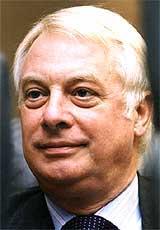 But Patten (
photo
) and other critics of the Asian Way are right to argue they are manipulated to serve minority interests. Confucius (K'ung Fusi), for instance, is often trotted out to justify over-bearing order and thought-control, but this is based on a serious misinterpretation of Master K'ung's thinking.
But Patten (
photo
) and other critics of the Asian Way are right to argue they are manipulated to serve minority interests. Confucius (K'ung Fusi), for instance, is often trotted out to justify over-bearing order and thought-control, but this is based on a serious misinterpretation of Master K'ung's thinking.
But, we must also admit that so are terms like 'market freedom' and 'individualism' abused the around the world, by those parties who profess to adhere to them. We can also admit that Western models of capitalism are based to a large extent on a distortion of the ideas of a similarly revered figure: Adam Smith.
I spoke to one activist while I was in Hong Kong last year and he gave me something I thought was valuable. He suggested that the best proponent of this abused form of the Asian Way is Wal-Mart, an American company. He believes Western companies are better at exploiting their stakeholders, just as Asian companies are supposed to do; they are just less open about it.
I think he's onto something.
The bottom line is that the Asian Way has its strengths, and its weaknesses. When thinking about reforming the business culture in the region, encouraging concepts of greater responsibility, ethics, governance and equity, let's not throw the Asian Way baby out with the bathwater.
Adherence to such ideas as individualism, the primacy of the market, the investors as gods and, societies as redundant economic factors, need not provide the foundations to higher standards of corporate responsibility in Asia.
Cookie cutter templates have sharp edges too.
JAMES ROSE is Asia-Pacific editor for the London-based website and magazine Ethical Corporation.


Are you sure you want to delete this comment?
This action cannot be undone.