




Freedom of expression: A universal dilemma
The Nazi regime, which lasted for 13 years, may look short in the vicissitudes of European history, it nevertheless produced the maddest and cruelest rule in modern times. To make a clean break from this darkest chapter, the successive governments of postwar Germany and the German people have been persistently and consistently fighting against revisionism, including enacting laws that aim to prevent any act that could facilitate the promotion of Nazi ideology.
Thus, Mein Kampf, notoriously written by Adolf Hitler in jail, may be readily available in major bookstores across the globe, but it remains banned in Germany. Haunted by the nightmarish Anschluss, Austria, too, has stringent laws that prohibit the glorification of der Fhrer and attempts to diminish, deny or justify Nazi rule.
(In fact, the land of the Sound of Music also happens to be Hitler's country of birth. A German teacher of mine once joked, rather sarcastically, that Austria's greatest postwar achievement was to have successfully convinced the world that Beethoven was a native of Austria, while Hitler was born in Germany.)
 Still, these preventive legal measures arguably contravene Article 11 of the Charter of Fundamental Rights of the European Union, which stipulates that "everyone has the right to freedom of expression this right shall include freedom to hold opinions and to receive and impart information and ideas without interference by public authority and regardless of frontiers"
So, when David Irving, the discredited British historian, was sentenced to three years' jail for Holocaust denial in Austria, an EU member, it no doubt raises the concern as to whether a person should be incarcerated for exercising his or her right to freedom of expression.
The Nazi regime, which lasted for 13 years, may look short in the vicissitudes of European history, it nevertheless produced the maddest and cruelest rule in modern times. To make a clean break from this darkest chapter, the successive governments of postwar Germany and the German people have been persistently and consistently fighting against revisionism, including enacting laws that aim to prevent any act that could facilitate the promotion of Nazi ideology.
Thus, Mein Kampf, notoriously written by Adolf Hitler in jail, may be readily available in major bookstores across the globe, but it remains banned in Germany. Haunted by the nightmarish Anschluss, Austria, too, has stringent laws that prohibit the glorification of der Fhrer and attempts to diminish, deny or justify Nazi rule.
(In fact, the land of the Sound of Music also happens to be Hitler's country of birth. A German teacher of mine once joked, rather sarcastically, that Austria's greatest postwar achievement was to have successfully convinced the world that Beethoven was a native of Austria, while Hitler was born in Germany.)
 Still, these preventive legal measures arguably contravene Article 11 of the Charter of Fundamental Rights of the European Union, which stipulates that "everyone has the right to freedom of expression this right shall include freedom to hold opinions and to receive and impart information and ideas without interference by public authority and regardless of frontiers"
So, when David Irving, the discredited British historian, was sentenced to three years' jail for Holocaust denial in Austria, an EU member, it no doubt raises the concern as to whether a person should be incarcerated for exercising his or her right to freedom of expression.
Prior to this, two cases related to this fundamental right had confronted Britain. In early February, Nick Griffin, leader of the white supremacist British National Party (BNP), was found not guilty by the Leeds Crown Court despite having uttered racist remarks against the ethnic minorities in the country.
Less than a week after Griffin's acquittal, Abu Hamza, the controversial British Muslim cleric, was convicted of inciting murder and race hate, including urging his fellow believers to "bleed the enemies of Islam".
Subtler menace
Compared to Abu Hamza's attempts to stir up racial hatred, Griffin's remarks may seem "moderate". However, who on earth can be absolutely certain that such "prejudicial' views may not in the long run slowly but steadily make it into the public mind, eventually turning the BNP into a neo-Nazi hotbed?
If history is any guide, even Hitler was not carved out to be an extremist supremo; he was made one later through pervasive public acquiescence. Before the mass anti-Jewish propaganda became uncontrollably ferocious, the Nazis had been "gently" reminding the Germans of the Jewish influence by asking: Who is the most successful banker in the country? Who is the top student in your school? So on and so forth.
Therefore, who in his or her right mind will not shudder at the prospect that Griffin and his party may one day pose a greater and subtler menace to British politics than Abu Hamza's dangerous mind?
Nevertheless, tackling those with extreme views with the long arm of the law is against the sacrosanct position of the EU on freedom of expression. It would appear that, for all its manifest adherence to Article 11 of the Charter, some issues remain taboo even within the broad church of the European grouping, in which heretics may still be ostracised at all costs.
 The most delicate issue is whether one's right to question and challenge certain accepted views will be safeguarded once the historical facts are established. In championing freedom of expression while allowing its individual member states to bring those who present alternative/dissenting arguments before a court, the EU is only making its noble cause a mockery.
In other words, the elevation of the Holocaust to the status of an unquestionable historical fact only harks back to the dark ages dominated by the omnipotent Church, with the EU playing the role of the moral vanguard, which is not conducive to promoting freedom of thought and public debate.
Orhan Pamuk, a well-known Turkish novelist, recalls fondly in his latest book, Istanbul, the high hopes that his grandmother once held for him: "My grandson Orhan came to visit With God's will, one day he'll be very successful and the Pamuk family name will once again be spoken with respect, as it was when his grandfather was alive".
Pamuk did not disappoint his grandmother, but perhaps for a very wrong reason. Unlike many of his countrymen who remain trapped in the erstwhile glories of the Ottoman Empire, Pamuk always feels uneasy over the inability of his country to face up to its ugly chapters in history.
A year ago, he enraged the entire nation by telling Das Magazin , a Swiss publication, that a million Armenians were killed in the dying years of Ottoman rule, and that only he dared talk about it.
Double standards
Unfortunately for Pamuk, Turkey, pretty much as other nation states founded on the debris of imperial ruins, is least willing to own up to its dark history while eagerly seeking to build up its national pride. One way in which this post-empire hangover is embodied is the ban on the public from describing the mass killings of the Armenians as genocide. To set the record straight, the Turkish government dedicates a section on its website to interpreting the incident and refuting the claims by others to the contrary
Rooting for Pamuk, the European Parliament sent a delegation to witness his trial in Ankara, and other European leaders also reminded Turkey, which is eying an EU membership in the not too distant future, of the need to uphold freedom of expression. Strangely enough, when Irving was on trial in Vienna for questioning the Holocaust, no one tried to defend his right to say it.
Such double standards are all the more obvious in light of the recent global Muslim outrage at the publication in a Danish newspaper of a caricature that is said to have blasphemed Prophet Mohammad. Knowing full well the wrathful reaction of the Muslim communities, some European dailies went ahead with republishing the cartoon in solidarity with their Danish counterpart in the name of press freedom.
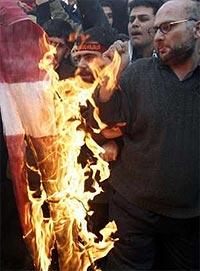 I am, needless to say, alarmed by the death threats issued on the caricaturist by some Muslim fanatics, and was irked to the extreme when PAS, the Islamic Party of Malaysia, called for the closure of the
New Straits Times
which recently published another allegedly "sacrilegious" cartoon. Still, I do believe many of my Muslim friends have felt hurt by the repeat acts of disrespect on the part of the Western media.
I am, needless to say, alarmed by the death threats issued on the caricaturist by some Muslim fanatics, and was irked to the extreme when PAS, the Islamic Party of Malaysia, called for the closure of the
New Straits Times
which recently published another allegedly "sacrilegious" cartoon. Still, I do believe many of my Muslim friends have felt hurt by the repeat acts of disrespect on the part of the Western media.
As rightly pointed out by Robert Fisk, the Middle East expert of The Independent , had the cartoon been anti-Semitic in nature, would any European press be the daredevil by carrying it over and over again in order to reaffirm its commitment to freedom of expression?
I do acknowledge and empathise with the suffering of the Jews during the Nazi era. What I cannot agree is the effort by many a rightwing Jewish scholar to portray this catastrophic experience as a "unique" historical phenomenon that calls for extraordinary attention from the world community. As far as I see it, the scars caused through the persecution of the Jews by a totalitarian and xenophobic regime are as deep as those left on the Palestinians living under Israeli oppression.
Should Western leaders and media fail to come to grip with this understanding and sensitivity to be shown towards the histories and faiths of other nations, it will only strengthen the impression that the ethnic cleansing systematically carried out by the Nazis deserves greater and deeper remembrance because it symbolizes Nazi destruction of the glories of Western civilizations, and the struggle against the Hitler regime therefore lives on as the highest moral paragon.
On the contrary, the Muslim world, despite having trodden a tragic path in the last few centuries, remains shrouded in darkness in accordance with the hierarchical order constructed by the West, hence the ignorance, neglect and even disdain of the Muslim psyche.
Not wisest solution
Still, striking a balance between revisionism and freedom of expression is subject to the internal conditions of individual countries.
The world should continue to commend Germany and Austria for their untiring efforts to root out the noxious blight of Nazism, as years of public education have made the postwar generations aware of the horrible crimes committed during the Third Reich and, more importantly, willing to face up to them.
Anyone who attempts to distort or dispute certain historical incidents will invariably be subject to intense public scrutiny based on facts and arguments. The issue now is whether laws that ban any promotion and glorification of Nazi thoughts, figures and symbols appear anachronistic in the wake of the Irving controversy.
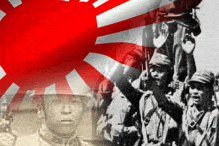 But in Asia, the lack of public reflection on its militarist past has made Japan's wartime atrocities against neighbouring countries much less understood and acknowledged in Japanese society. In view of the differing interpretations of history, there have been calls from the leftwing circle in Japan for the government to enact laws that would make the teaching of wartime atrocities compulsory.
Again, it must always be cautioned that resorting to legal instruments and public authority in dealing with extreme forces may not be the wisest solution, but working for greater public education is.
With advanced technology and modes of transport comes increased interaction but also potential conflict between different cultures and religions. It is high time the world steps back and take stock of recent developments, and ponder if freedom of expression will from now on cease to be a straightjacket, as has long been ardently argued by, for instance, the red guards of Asian values.


