




Give IPCMC a chance
The emphatic 'No' from the police force to the Independent Police Complaints and Misconduct Commission (IPCMC) is to be expected.
This is given the fact that the police force has become used to its entrenched powers, immunity from criticism and its selective use of discretion in investigating and prosecuting cases.
This is to be expected from a force that has been conferred with such wide-ranging and non-reviewable powers under successive emergency and security laws since 1948 at least.
Therefore, the public should remain patient and hope that our boys in blue will see the wisdom of the proposed police watchdog recommended by the Royal Commission to Enhance the Operation and Management of the Royal Malaysia Police and supported in principle by the government.
The emphatic 'No' from the police force to the Independent Police Complaints and Misconduct Commission (IPCMC) is to be expected.
This is given the fact that the police force has become used to its entrenched powers, immunity from criticism and its selective use of discretion in investigating and prosecuting cases.
This is to be expected from a force that has been conferred with such wide-ranging and non-reviewable powers under successive emergency and security laws since 1948 at least.
Therefore, the public should remain patient and hope that our boys in blue will see the wisdom of the proposed police watchdog recommended by the Royal Commission to Enhance the Operation and Management of the Royal Malaysia Police and supported in principle by the government.
The IPCMC is primarily to enhance the image of the police force, improve its credibility, encourage transparency and accountability and more importantly to help the force in reforming itself to face the challenges of a civil society that is maturing in its political confidence, aware of its rights and influenced by global trends.
 It is not designed to be some kind of busybody that will interfere with the day-to-day operations of the police force, in personnel matters, law enforcement and policy decisions.
That will remain the purview of the Police Force Commission (PFC) under Article 140 of the Federal Constitution, the internal security minister who has political control over the police force and the senior police officers who have operational control.
The police naturally are not happy with some of the proposed powers of the IPCMC. I agree to that extent. As the matter is being studied by the Attorney-General (AG), it is too early to speculate on the final form of the IPCMC.
British model
What is important is that such a body should be formed. I would suggest that the proposed IPCMC be modelled on the United Kingdom's Independent Police Complaints Commission (IPCC) that took effect on April 1, 2004 pursuant to the Police Reform Act 2002.
It replaced the old Police Complaints Authority which lacked investigatory powers. The Police Reform Act 2002 is a good starting point because it defines the statutory powers and responsibilities of the IPCC, the chief police officers and the police authorities for the new complaints system.
The IPCC in the UK makes an annual report and other periodic reports (when necessary) to the home secretary and it is he who tables the annual report in Parliament but retains a discretion whether to table and publish any other report sent to him by the IPCC.
Most importantly, the power to remove, suspend and discipline senior police officers is retained by the home secretary, while other ranks are subject to the disciplinary powers of the senior police officers and the police authorities.
However, the IPCC retains the right to bring and conduct, or otherwise participate and intervene in these disciplinary proceedings if necessary. Provisions in the UK Police Acts of 1996 and 1997 regulate disciplinary proceedings of police officers amongst other things and they are worthy of study.
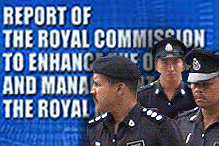 Since the police force is adamant that the IPCMC should not have the power to discipline police officers, I would suggest that this power remains with the PFC but that the IPCMC be allowed to participate and intervene in these proceedings (if necessary), except in cases of senior police officers with the rank of deputy assistant commissioner and above, where the PFC should determine such cases alone.
As for the police force's concern that there will be a replication of functions and powers by the proposed IPCMC and other bodies such as the Public Complaints Bureau, Human Rights Commission of Malaysia (Suhakam) and Anti-Corruption Agency (ACA), the law setting up the IPCMC should set out its parameters as in the case of the IPCC in the UK.
In addition the IPCMC should enter into protocols with the PFC, the police force, the AG's Chambers, the Public Complaints Bureau, Suhakam and ACA to see how each agency can co-operate and assist each other. This is also done in the UK by the IPCC. In addition representatives of the police officers' and staff associations could be allowed to be members of an advisory panel to the IPCMC, also as done in the UK.
Correct deficiencies
As for the other 23 proposals of the Royal commission that have been rejected by the police force, well that is for the government to decide. It is time that the government takes the lead in correcting the democratic and legal deficiencies that are prevalent in so many of our laws.
Following the unfortunate 'nude squat' incident and numerous other cases of death, injury and intimidation in police custody, I would suggest that the relevant laws be amended to incorporate the Codes of Practice as set out in Codes A to E under the UK Police and Criminal Evidence Act 1984 with necessary modifications.
As for the other security laws, the government should revoke the three proclamations of states of emergency that are still in force in the country notably those dated Sept 3,1964, Sept 14, 1966 (Sarawak) and May15,1969.
By implication, it should repeal the:
- Emergency (Essential Powers) Act 1964 and the Emergency Regulations made thereunder;
- Emergency (Federal Constitution and Constitution of Sarawak) Act 1966;
- Emergency (Essential Powers) Ordinance 1969 and the Emergency Regulations made thereunder including the Direction under Article 150 (4) of the Constitution;
- Emergency (Public Order and Prevention of Crime) Ordinance 1969;
- Emergency (Essential Powers) Ordinance No 2 and No 6, 1969;
- Essential (Disposal of Dead Bodies and Dispensation with Inquests and Inquiries) Regulations 1969;
- Essential (Newspapers and Other Publications) Regulations 1969;
- Essential (Prohibition of Activities Relating to Elections) Regulations 1969;
- Essential ( Security Cases) Regulations 1975;
- Essential (Self-Reliance) Regulations 1975;
- Emergency (Essential Powers) Act 1979; and
- Federal Constitution (Amendment) Act 1981.
In addition Article 149 of the constitution should be repealed in its entirety as it is unconstitutional in that it renders all the fundamental freedoms under the constitution illusory and of no effect under the guise of national security.
 Obsolete and archaic laws like the Restricted Residence Act 1933, Banishment Act 1959, Sedition Act 1948 and Public Order (Preservation) Ordinance 1958 should be consigned to the dustbin of history.
Laws that infringe upon fundamental freedoms and human rights and give the government an unfettered discretion to do as it pleases, need to be reviewed and amended so that they conform with the rule of law, equity and fairness, accountability and transparency, good governance and ethics.
These include the Internal Security Act 1960, Printing Presses and Publications Act 1984, Control of Imported Publications Act 1959, Trade Unions Act 1959, Societies Act 1966, Universities and University Colleges Act 1971 (in particular the Discipline of Student and Staff Rules), Industrial Relations Act 1965 (in particular the Essential (Prohibition of Strikes and Prescribed Industrial Actions) Regulations 1965), Official Secrets Act 1971, Immigration Acts 1959 and 1963, and the Police Act 1967.
Powers not affected
I have referred to these plethora of laws to merely remind the police force that the formation of the IPCMC is not going to affect their powers and discretion.
These unfair and undemocratic laws remain entrenched in our legal system, no thanks to a political elite that is reluctant to even contemplate any loss or diminishment of their power, influence and status within a system that is clearly straining under its own weight and leading this country into rack and ruin in the not-to-distant future.
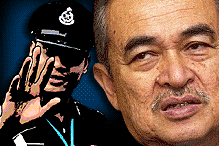 This is increasingly becoming clear from the lonely crusade being waged by the prime minister in his efforts to implement his reform agenda and ideas. It is unfortunate that his mild-mannered temperament, consensus building style, willingness to listen and simple ideas are being judged as signs of weakness, indecisiveness and a lack of vision.
To his detractors, critics and fair weathered friends who are perhaps more used to ruthless and brutal displays of power, might and influence - not to mention all sorts of calumny and political chicanery to silence opponents and non-conformists - I must say that the prime minister is like a breath of fresh air blowing through the decrepit and corrupt bastions of power in this country.
Hopefully, his political will and determination with the support of the people will last and bear fruit for the sake of this nation's survival.
As for his cabinet colleagues and party members, including erstwhile members of Parliament, they should be reminded that they are where they are because of the prime minister's patronage and influence and not necessarily because they are indispensable or have the right qualities.
Therefore, if they fundamentally disagree with him on matters of policy, they should resign gracefully rather than insidiously undermine him just because the wind may be blowing in a different direction right now. The same goes to the well known proponents of political wayang kulit in the government and party.
As for members of the public services including the police force, do not forget that in your zeal to confront and criticise the government, you are still in fact servants of the government of the day and hold office at its pleasure albeit in the person of the Crown.
The public services have no right to question policy decisions of the government in public, their concerns should be voiced in private through the public services department and their staff and union associations. They should not resort to public lobbying and recourse to the media.
In fact, save and except on personnel issues, the public services' only duty is to implement the policies of the government of the day. They should leave public scrutiny and criticism of government policies to the voters, the opposition and the media.
It is unfortunate that the police force and its senior officers have breached this important constitutional convention to the point of insubordination and indiscipline in their public opposition to the IPCMC.
Their actions have not done them any credit in the eyes of the public and only tends to confirm the people's fears that the police have a great deal to hide from those whom they have sworn to protect and defend.
GERARD LOURDESAMY is a lawyer with an interest in constitutional and human rights issues. He also sits on the Legal Profession Committee of the Bar Council and on the Disciplinary Committee of the Advocates and Solicitors' Disciplinary Board.


Are you sure you want to delete this comment?
This action cannot be undone.