
Diving into the possibilities for the disabled
COMMENT | I want to talk about the night that overwhelmed me with so much anger when I was at Perhentian Island recently.
Earlier this year, I became certified as an adaptive support diver. I decided to take up this diving speciality for two reasons. Firstly, I wanted to use my diving skills to give back to the community. Secondly, there aren’t many adaptive divers around and less than a quarter of those certified are women.
The reason for this is unfortunate, but understandable. Unlike other diving specialities, such as photography or wreck diving, where people who dive a few times of year would be able to incorporate the hobby into their holidays, adaptive diving comes with heavy responsibilities, which make the enjoy-ability of the dive a secondary experience.
Adaptive divers are trained to support and assist people who are differently-abled to discover and build self-esteem and confidence through scuba diving. The course anchors itself to four main beneficiary areas: amputees, paraplegics, quadriplegics and the visually impaired...
COMMENT | I want to talk about the night that overwhelmed me with so much anger when I was at Perhentian Island recently.
Earlier this year, I became certified as an adaptive support diver. I decided to take up this diving speciality for two reasons. Firstly, I wanted to use my diving skills to give back to the community. Secondly, there aren’t many adaptive divers around and less than a quarter of those certified are women.
The reason for this is unfortunate, but understandable. Unlike other diving specialities, such as photography or wreck diving, where people who dive a few times of year would be able to incorporate the hobby into their holidays, adaptive diving comes with heavy responsibilities, which make the enjoy-ability of the dive a secondary experience.
Adaptive divers are trained to support and assist people who are differently-abled to discover and build self-esteem and confidence through scuba diving. The course anchors itself to four main beneficiary areas: amputees, paraplegics, quadriplegics and the visually impaired. Adaptive techniques learned also enable us to adapt to other abilities, such as hearing impairment and developmental challenges.
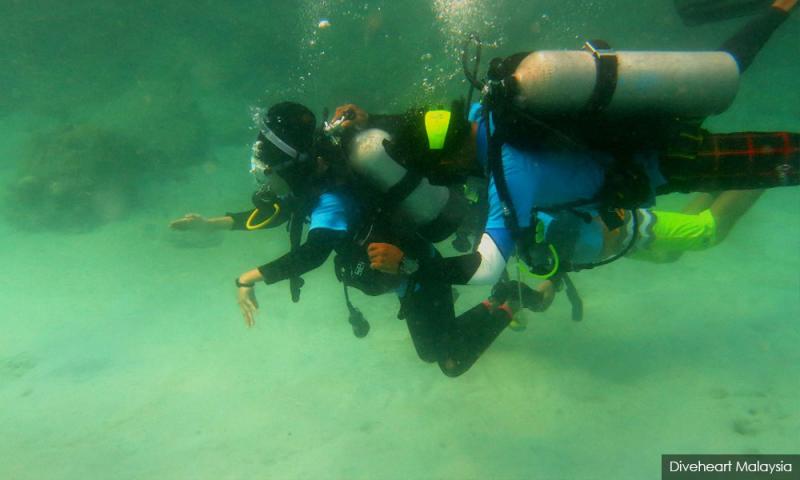
At this point, the questions I usually get revolve around people wrapping their heads around the image of a differently-abled person scuba diving. I am not talking about splashing in shallow swimming pools - I am talking about people with missing or non-functioning limbs breathing through a regulator with tanks on their backs in the open water.

Of course, their journey is not an easy one. The differently-abled women I worked with spent months training and preparing for the dives. Alongside their adaptive support buddies, all of them had to learn techniques customised especially to their strengths and abilities to enable them to safely enjoy the dive.
These techniques include entering and exiting boats, breathing through a regulator, handling the buoyancy control device, equalising to clear pressure built up in their ears and finning in the water.
Not only that, they are also trained in additional skills such as regulator recovery and mask clearing (which poses a difficulty even for able divers).
On this trip, I was proud that we were able to show the world what they could do underwater.
I am proud of how Ain, a wheelchair dependent paraplegic, glided gracefully underwater without her chair. On land, everyone literally has to look down on her to see her. On land, people push past her to get into elevators and park on parking spots meant for drivers like her.
Underwater, Ain was able to hover at the same level as other divers, where she would look straight into your eyes and right into your soul.

I was proud that people were able to see one-legged Ecah and how she cut ferociously through the water. On land, people would stare shamelessly at her missing leg, and yet, would so rarely offer her their place in queues. On land, she needs to look for the cleaning staff in malls, just so that they would unlock the OKU restrooms for her.
Underwater, our team following her had to work hard to keep up as she bravely led us on the expedition in open water.
I was proud that people were able to see Erin, legally classified as blind, because her eyes sparkled underwater.
I asked Erin, with her diminishing eyesight which renders her practically blind, why she wanted to dive.
She told me that she wanted, out of whatever little eyesight she had left, to see beautiful things in the world.
In a world that insists on only seeing the ugliness in others, Erin gently seeks out what makes the world, and sees every being within it as special.
As they say, underwater, we’re all equal.

Which was why I became overwhelmed with anger that night.
Because that night, I had a taste of what it was like to be torn between the world that the ables take for granted and the shrunken version that these differently-abled women live in.
Because after all the celebrations were over, I knew I could walk away from all of this and return to the world that forgets that differently-abled people exist. After all, we were at the beautiful Perhentian Island, where the nightlife happily matches its carefree nature.
Because that night, my choices were either to party with the rest of the divers on the beach, or to be with these women, because crutches and wheelchairs don't work well on the sand.
Knowing this, these women did not ask me or anyone else if they could be included in the after-event plans, or to stay with them for that matter.
These women told me that they were not born differently-abled. It happened to them through accidents and illnesses. Upon finding out that they had become differently-abled, they lost most, if not all, of their friends almost instantly.
The part of their story that people don’t see is how, when all the dives were done and when all the event performances and food and celebrations were done, these women quietly disappeared into their rooms.
They went back to their reality - a reality where the limitations posed by the world is their constant physical and emotional norm.
They still trip over steps. Ramps are still too steep for them. And in too many places, handrails do not exist.
This is a world where a doorway is the difference between going to the bathroom or not.
This is a world of many, many glass walls. If we can shatter the one on scuba diving for people who are differently-abled, we must re-imagine the possibilities of all other barriers to inclusivity coming down as well.
Becoming an Adaptive Diver gave me this experience: of not just customising the sport of scuba diving to the strengths of people who are differently-abled, but also receiving, in return, a glimpse into their reality.
And the reality is, the world is simply not emotionally inclusive for them, and they have accepted this as normal.
(Thanks to Diveheart Malaysia, Kids Scuba PADI Dive Centre and Mimpi Resort, Pulau Perhentian, which organised and sponsored the event.)
MAJIDAH HASHIM is a certified adaptive support diver of PADI (Professional Association of Diving Instructors), a Diveheart Malaysia volunteer and a human rights defender. She can be contacted via Twitter at @majidahhashim


Are you sure you want to delete this comment?
This action cannot be undone.