




Thaksin: I'm out, I'm not
Thai premier Thaksin Shinawatra's brinkmanship won't salve his illegitimate credentials or Thailand's growing economic problems.
Until recently everybody had thought Thaksin had a thick hide, and everybody knew he was a recalcitrant. What he hadn't pre-figured was that, upon winning the April 2 snap poll he had called to bolster his rapidly sliding legitimacy and end the political crisis he had started of his own inanity, the crisis would deepen.
Thai premier Thaksin Shinawatra's brinkmanship won't salve his illegitimate credentials or Thailand's growing economic problems.
Until recently everybody had thought Thaksin had a thick hide, and everybody knew he was a recalcitrant. What he hadn't pre-figured was that, upon winning the April 2 snap poll he had called to bolster his rapidly sliding legitimacy and end the political crisis he had started of his own inanity, the crisis would deepen.
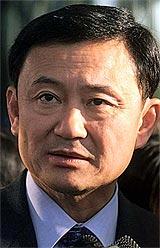 It did, on April 4, as he claimed victory despite mass opposition boycott of the elections. He knew instantly that his head was squarely squeezed onto the chopping block. It was only a matter of time before the axe would fall. On April 5, Thaksin backed away from having earlier offered to step aside. He had read the winds. After an awkward meeting with the King, Thaksin said he won't accept to head government when parliament re-convenes in early May to select the country's interim prime minister. And new elections could be as far as 15 months away.
That's too long to leave a country in limbo while the economy continues to stagnate. Still, it's a long and embarrassing climb-down for Thaksin, who tried to remind those willing to listen that he was democratically elected by a landslide 19 million votes in the 2005 elections. With money politics, the impossible suddenly becomes funnily possible.
Just and justified
The outcomes are just and justified. And no thanks to Thaksin. Thailand owes its brave anti-Thaksin countrymen who used their political democracy to exercise and demand their rights, come hell or high water. They withstood Thaksin's threats, drivel and spin. They could only see that he was corrupt, politically unaccountable, and prone to abusing power by using his office to enhance his personal business interests. This is a throwback to the pre-1997 Asian economic crisis years when Asian political economies the playground of state-backed corrupt business cronies.
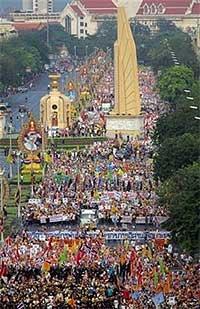 There are lessons here for Asia. Few countries in Asia can still boast the level of political maturity Thais citizens have fearlessly shown against corrupt and incompetent regimes despite political elites boasting their nation's democratic credentials. Bah, humbug. For behind the faade lie vicious and vile forms of ethno-based nationalistic neo-authoritarianism, ones far worse than their previous bureaucratic versions. There's one in Nepal, engineered by an obsolete, despotic monarch. There's another in the Philippines organised around the powerful Makati oligarchy.
But is it game, set and match as far as Thaksin goes. Not by a long shot. Thaksin isn't going anywhere. Thaksin passed his baton to his deputy, Chitchai Wannasathit, a police general overseeing security affairs, a long-time Thaksin loyalist who has played a central role in the government's troubled effort to put down a two-year-old Muslim insurgency in the south of the country, and, worse, Chitchai is an unelected member of Thakins's Thai Rak Thai (Thais love Thais) party. Meanwhile Thaksin will continue as party leader and legislator.
Another whitewash
This is another Thaksin whitewash, a patent attempt by him to again deceive Thais into trusting him. He can't, and shouldn't, be trusted. Just last month, the National Counter Corruption Commission ruled that Thaksin had intentionally concealed his assets when he was as a deputy premier in a previous cabinet in 1997. And if the Constitution Court upholds the ruling, Thaksin will be barred from politics for five years. In January Thaksin sold 49.6 percent stake in his prized family business jewel, telecoms monolith Shin Corp, for 74 billion baht to the Singapore government's Temasek Holdings. Then he tried to defraud the country by decreeing he did not have to pay a single baht in tax from the sale.
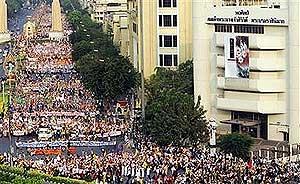 Thinking Thais will continue to vehemently oppose Thakin's fetid political and economic ideologies (Thaksinomics). He's about as conservative as Margaret Thatcher, Ronald Reagan in Britain and America and as Australia's John Howard. They make economies better in the short run. In the long-run they screw them left, right and centre for all their short-sightedness. There's little doubt Thais will resist the Thaksin-controlled caretaker government until Thaksin quits politics altogether and real political reforms are introduced to cleanse the system of Thaksin dregs. Nothing less will do if Thais are to begin undoing the problems Thaksin has left them since taking the helm in January 2001.
If Thaksin had privately hoped that the stockmarket would continue to head south, giving reason that it had no confidence in the political alternative, he had rotten tomatoes thrown at him. Thailand's rural poor, the bulk of whom make up the country's 65 million people, may love him, having been bought over by Thaksin's baht love, but the stockmarket showered him no love whatsoever. In fact, when he announced he was stepping aside, the bourse climbed, and very nicely too. It says Thaksin is not indispensable to Thailand's economic and political future. On the contrary. Indeed.
DBS Vickers Securities said in its report that the current political crisis, if protracted, could hurt investments, confidence and tourism. No kidding. Thailand's gross domestic product could slow to 3.2 percent from a projected 4.5 percent if the conflict isn't resolved. It wouldn't be able to carve out several free trade agreements, including a portfolio of infrastructure mega-projects worth almost US$46 billion, says the University of the Thai Chamber of Commerce.
Nightmarish ride
But Thailand's problems are far from over. In fact they're just beginning a nightmarish ride to freedom. Nightmarish as long as Thaksin remains an influential player behind the scenes, quite like Singapore's founding prime minister Lee Kuan Yew, who took the position of senior minister in the one-party city state upon his retirement, and from where he's still said to call the shots. Thaksin could be ambling for the same.
Asian leaders and economists were romanced by Thaksinomics. They were swooned by Thaksin's growth strategies which were fundamentally a dual-track plan to jump-start domestic demand and export growth while emphasising domestic consumption. On paper Thais seemed to be prospering under Thaksinomics. Growth was spurred, fanned by domestic consumption growth underlined by low-cost loans and tax breaks. These stimulated foreign investment. Thailand's US$184 billion economy expanded 44 percent since 2001, and foreign investment more than doubled to US$2.7 billion in the three years to 2005.
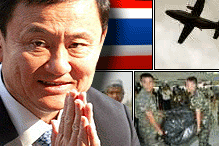 Even Thailand's poor did well. Thaksin had wooed rural Thais, by handing out US$25,000 in soft loans to each of the country's 70,000 villages. Then he extended debt relief to farmers, subsidised crops and rolled out a medical plan for which Thais were to pay only 30 baht, or 70 US cents, to see a doctor.
But free-market economists are a nave lot. They couldn't see Thaksinomics as nothing more than old-fashioned, debt-financed pump priming dressed up as something new and revolutionary. Take Thaksin's policy to raise Thai incomes and make the economy less reliant on exports: it belied by how quickly most of his people fell heavily into serious debt, with household debt rising 53 percent between 2001 and 2004. So much for Thai Rak Thai.
But there's more. The fallout from Thaksinomics began to emerge last July as oil prices skyrocketed, blowing several gaskets and pistons in Thaksinomics coal-fired steam engine. Inflation hit a six-year high. And it wasn't just that inflation exceeded the central bank's interest rates for overnight loans; costs for oil, food and medical care were running at a pace faster than the fastest of Thaksin's hares, screaming beyond the reach of Thailand's lowest earners.
Pied-Piper Thaksin and his merry band of regional economists thought Thaksin could do no wrong., he had the Midas touch. They thought, as Thaksin had, that Thais would soon catch up to the living standards of the United States, Japan or even Singapore, and the ugly vestiges of the the Asian crisis were finally buried. But all this was nothing more than chimera, mirages on the Thaksin landscape of bankrupt policy ideas and strategies.
In 2005 Thai households were closer to the edge than Thaksin's sunny-side up economic pronouncements, and all merely suggested that Thaksin?s penchant for mega-projects may do more in the long run to raise Thailand's growth rate. They did nothing of the sort. They only took Thailand's debt burden more and more to the brink. Shades of an ugly past in post-crisis Asia? You bet. And it isn't over yet. Not by a long shot. Because the old shenanigans are still there, and thickly.
MANJIT BHATIA, an academician and writer, is also research director of AsiaRisk, a political, economic and risk analysis consultancy in Australia. He specialises in international economics and politics, with a focus on the Asia-Pacific.


Are you sure you want to delete this comment?
This action cannot be undone.