




Economic race: Perlis in peril
Many Malaysians know that the Perlis soccer team is a squad to reckon with, some might have been surprised by the tranquility of the highway between Changlun and Kuala Perlis on their way to Langkawi and some might have tasted the famous harumanis mango.
But few Malaysians have an accurate perception of the economy of Perlis. This contribution aims to shed some light on the economic problems of Perlis.
Many Malaysians know that the Perlis soccer team is a squad to reckon with, some might have been surprised by the tranquility of the highway between Changlun and Kuala Perlis on their way to Langkawi and some might have tasted the famous harumanis mango.
But few Malaysians have an accurate perception of the economy of Perlis. This contribution aims to shed some light on the economic problems of Perlis.
Perlis is generally considered as an agricultural state, even among its residents. However, according to data obtained at the Perlis State Economic Development Corporation (SEDC) agriculture only contributes 23% to the gross regional product (GRP).
Instead, services turn out be the main driver of the Perlis' economy, accounting for 67% of the GRP (leaving 10% for manufacturing, mining and construction). Perlis hosts a large independent power plant (IPP), there are considerable dynamics in wholesale (trade with Thailand), but the most important contributor seems to be public services.
Not less than 27% of the total workforce is employed in public services. The most important development strategy of the Perlis state government is to become a ' negeri ilmu ' (knowledge state).
 In recent years Perlis welcomed several new educational institutes, of which Kukum, the Northern Malaysia University College of Engineering, is the most important. The education and other strategies must bring Perlis the status of '
maju
' (developed) by 2015.
In recent years Perlis welcomed several new educational institutes, of which Kukum, the Northern Malaysia University College of Engineering, is the most important. The education and other strategies must bring Perlis the status of '
maju
' (developed) by 2015.
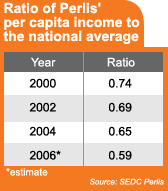
Nevertheless, consider the data presented in the Table 1: the ratio of per capita income to the national average shows a threatening downward trend. So how does the Perlis state government expects Perlis to reach the developed status by 2015, five years ahead of Malaysia?
If the Perlis economy doesn't start booming soon, it will be extremely difficult. The remainder of this contribution discusses three problems affecting the economy of Perlis.
Three problems
1.Comparative disadvantages
Perlis is rather unattractive for domestic and foreign investors. If one wants to start a business in the agro industry, Southern Thailand is more appealing because of relatively low wages and an abundance of natural resources, especially natural rubber and seafood. Even some leading Chinese entrepreneurs in Perlis increasingly look at Southern Thailand. Furthermore, if one wants to set up a firm dealing with high-end manufacturing, Penang or Sungai Petani are obviously more suitable locations, given excellent logistical and IT facilities. Currently, there are three foreign firms in Perlis, but it remains to been seen how many years they wish to stay. A few years ago a rubber firm moved to the province of Songkhla in Thailand and last year the apparel firm Dragon & Phoenix ceased operations.
2. Constraining state finances
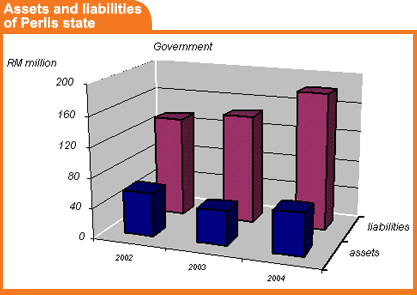
The Perlis state government structurally lacks sufficient financial resources to be able to initiate on its own significant economic projects, either facilitating the private sector or via expanding the activities of the State Economic Development Corporation. Without grants or loans from the federal government virtually nothing happens in Perlis. Figure 1 shows the skewed relation between assets and liabilities of the Perlis state government.
3. Limited and fragmented land
In Malaysia, the complex issue of land rights and land classification is well known. In particular much attention has been paid to Malay-Reservation land. In Perlis this issue is exacerbated by the limited availability of land and its fragmentation. Individuals generally own small pieces of land, there is special regulation for land under the Mada rice scheme in the southern part of the state, there is a national park in the northwestern corner of Perlis and 11% of the total land area is leased out to the Perlis Plantations Berhad Group for the cultivation of sugarcane until 2061! Moreover, the majority of land, classified as non-Malay-Reservation and non-agricultural land, has already been developed. Thus it is no surprise that land prices have become disproportionanally high.
The current development strategies will not make Perlis a developed state by 2015 and it is highly questionable whether the Ninth Malaysian Plan has taken into account the above-mentioned problems for Perlis. Therefore, the economic planning units of the Perlis state Government and the federal government should find innovative ways to embark on a more realistic and sustainable development path. The famous 'harumanis' mangoes of Perlis might turn ' masam ' (sour) if nothing changes.
EDO ANDRIESSE is a PhD candidate at the Department of Human Geography and Urban and Regional Planning, Faculty of Geosciences, Utrecht University, Netherlands.


Are you sure you want to delete this comment?
This action cannot be undone.