




Public transport - is the govt serious?
Where there's a will, there will be a way, so goes the old adage. This wise saying however does not do justice to the government's manipulative tactics in wanting to improve the public transport system.
The government has saved RM4.4 billion from the fuel subsidies and in turn raised fuel prices to 30 sen per litre and liquid petroleum gas to 30 sen per kg.
If the price hike was not painful enough for the people, Deputy Prime Minister Najib Abdul Razak had the audacity to ask them to change their lifestyle. It was clear that Prime Minister Abdullah Ahmad Badawi was caught off guard by the hostility displayed by the people over the hike.
Not knowing how to handle the situation, he thought it best to let his deputy do the talking. And when Najib talked, it was a case of adding salt to injury.
Where there's a will, there will be a way, so goes the old adage. This wise saying however does not do justice to the government's manipulative tactics in wanting to improve the public transport system.
The government has saved RM4.4 billion from the fuel subsidies and in turn raised fuel prices to 30 sen per litre and liquid petroleum gas to 30 sen per kg.
If the price hike was not painful enough for the people, Deputy Prime Minister Najib Abdul Razak had the audacity to ask them to change their lifestyle. It was clear that Prime Minister Abdullah Ahmad Badawi was caught off guard by the hostility displayed by the people over the hike.
Not knowing how to handle the situation, he thought it best to let his deputy do the talking. And when Najib talked, it was a case of adding salt to injury.
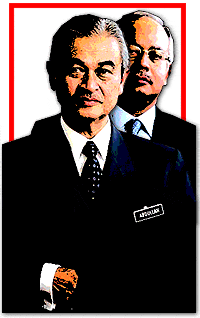 The already burdened public had little sympathy and empathy for the reasons cited by Najib to justify the increase. He should have thought deeply before exclaiming that the people had to change their lifestyle in view of the rise in the price of petrol.
One wonders what lifestyle the deputy premier had in mind and which segment of society he was concerned about.
To pacify the outrage, Najib said the savings gained from the price hike would be used to improve the country's public transport system.
Goodness gracious! The topic of public transport is akin to opening the Pandora's Box. The guffaws the government made in trying to supposedly improve the nation's public transportation has convinced many people that the government is not serious in wanting to restructure or improve the already impoverished system.
The efforts to improve the public transportation system hopefully is not Kuala Lumpur-centred but are looked at from a nationwide point of view.
Deplorable services
It must be admitted that the country's bus and taxi services are deplorable. One reason for this is the absence of monitoring of such basic services. The situation is more critical in big cities like Kuala Lumpur and Johor Baru. As for the taxis, they have their own axe to grind with the government and while doing so, the passengers end up as victims.
As Rangkaian Pengangkutan Deras Sdn Bhd chief operating officer (operations) Mohamad Ali Mohamad Nor disclosed last year, only 50 percent of the Rapid KL buses are operational on any given day, with the rest sitting in work-shops.
(Rapid KL was set up last November with the merging of Star LRT, Putra LRT, Intrakota and Cityliner bus firms and is tasked with providing an integrated public transport system in the Klang Valley, acting as a feeder for the rail and bus services).
As the Transport Workers Union has so well said, the transport sector needs a total overhaul. The union said the core problems facing the transport industry include:
- multiplicity of operating permits and licenses issued to operators having more 'know who' than 'know how' in the industry.
- marked absence of cohesiveness and consistency in policy formulation, implementation and enforcement by the authorities.
- overlapping of jurisdictions over licensing, certification, vehicle testing and enforcement.
- escalating operating costs.
- low passenger loads, particularly on rural and over-serviced urban routes.
The transport consortium conceived by the government in the late 90s failed to deliver. Several Klang Valley bus companies were brought under Intrakota Consolidated and were managed by Diversified Resources Berhad. This was followed by Park May Berhad. Truly said, Intrakota was anything but 'consolidated'.
The over excitement in purchasing very expensive foreign-manufactured buses, expensive spare parts and rising vehicle maintenance costs, inadequate buses to service the various routes, ineffective 'one-man operator' system which results in trip delays and road safety concerns, insufficient drivers and hiring of 'irresponsible' individuals as drivers.
All the above resulted in the once admired Intrakota service turning into a mess. Ask any bus passenger and the reply will be the same: buses are in deplorable conditions, 'boasting' faulty or leaky air conditioning and dirty interiors. Punctuality is a concept not known to Intrakota.
The situation is no better in the case of feeder buses which ply the LRT stations. They too have no notion of punctuality, leaving commuters exasperated awaiting their arrival as scheduled.
Taxi woes
Then comes the problem with the city's taxis. It is no secret that the Road Transport Department has miles to go before city folks and tourists can offer a thumbs-up for the taxi service.
Every other day we read or hear of a taxi passenger who has been overcharged or a taxi driver refusing to use the meter. And in spite of this daily problems, enforcement and checks by RTD officers to areas where errant cabbies wait for passengers have not improved, but instead worsened.
The KTM service, albeit a little better, needs an overhaul too. The trains never arrive on time and notification of delay in schedule is never prompt.
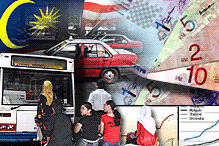 The only saving grace is the Light Rapid Transit (LRT) service which helps city folks commute efficiently from point A to B. As the LRT has been tremendously welcomed, it is only wise that the government extends the line of service to the suburbs or destinations not served by the buses and taxis.
It is hoped that the government is honest in wanting to improve the quality of life for its people and not use the people to improve its lifestyle instead.
Before Pak Lah gets overly excited about revamping the country's transportation system, it would be wise of him to study the reasons why the public transport system, especially in the Klang Valley, has failed to stop people from forking out money to buy cars or to even consider car pooling.
There is no need to rush into making changes just to show to the rakyat how concerned the government is. We do not want a repeat of the Middle Ring Road 2 fiasco where billions after billions are being spent to 'cover' up the mistakes made by some irresponsible government official.
One bitten, twice shy
Najib last year remarked that a survey among the countries that had low accident rates attributed the results to careful drivers and good public transport systems.
Blaming the people for being reckless on the road is a different issue but what is more important is the government's failure in providing for the people an efficient and exemplary public transport system. In short, the government has failed to deliver!
And while the government raves and rants about its sincerity in wanting to improve the public transport system, it has forgotten to look into the welfare of an equally important group, the disabled.
As it is now, buses and trains, especially the KTM Komuter and Monorail are certainly no blessing for the disabled
The newly set up Public Transport Trust Fund - which has a backing of RM4.4 billion saved at the rakyat's expense - must deliver under any cost. The people certainly have had enough of the government's rhetoric in wanting to make life better for them.
The general election is not far away and the rakyat knows this. But Malaysians being a kind lot are willing to give the government the time to improve things.
But as they say, 'once bitten twice shy'. The government must bear in mind there is only so much the people will tolerate. The recent demonstrations objecting to the fuel hike are merely the tip of the iceberg.
JJ RAY started her career with a mainstream publication. A non-conformist, she soon saw the barriers that went up whenever, through her writing, she tried to make the world a home for one and all.


Are you sure you want to delete this comment?
This action cannot be undone.