




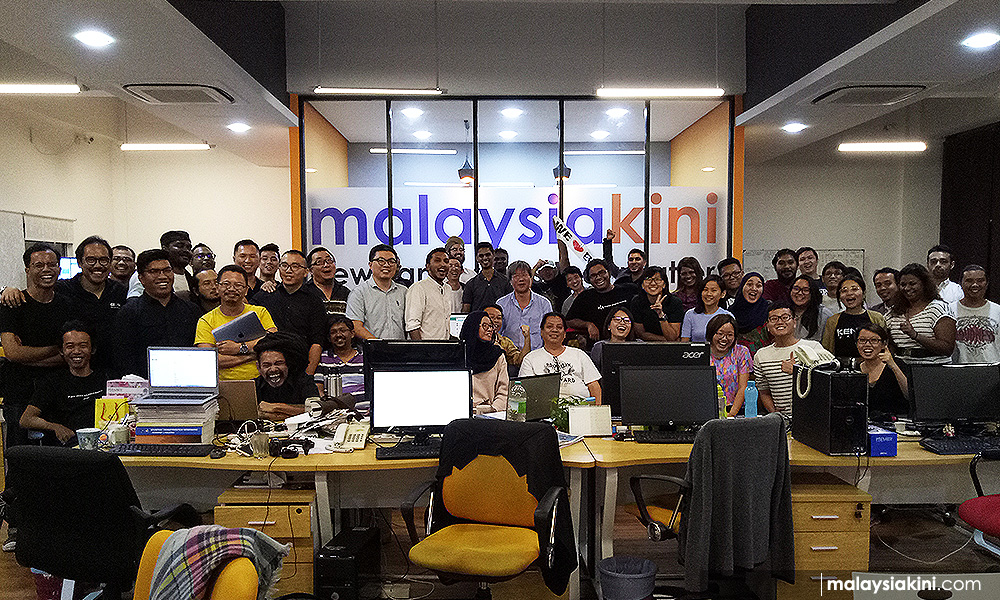
As Malaysiakini crosses its 20th year …
COMMENT | Journalism practice has changed dramatically since my first reporting job in Australia in the late 80s. Today, non-profit organisations and the intelligentsia from the right, centre, left, or somewhere in between, are generating open access materials. These excessive contents of varying veracity do shape our perception of trending issues.
This is where we turn to professional journalists to filter out the junk and conspiracies that we inadvertently throw about as "true" in our daily conversations. But the short news cycle and headlines fanned by trolls, keyboard warriors and "truth-seekers' alike, often pushes reporters into an auto-reaction mode. So, they produce digestible news capsules for readers with increasingly shorter concentration span.
No surprise there with the occasional misquotes, misreading of data and Freudian slips when journalists cover emotive issues impinging on race, religion, and less so, sexual orientation in the Malaysian setting.
It’s admissible that journalists are not infallible observers and recorders of events. They bring to their craft certain beliefs of how things ought to be, of what is important from what is not. When the stories do not align with their thinking, they see them as falsifying ...
COMMENT | Journalism practice has changed dramatically since my first reporting job in Australia in the late 80s. Today, non-profit organisations and the intelligentsia from the right, centre, left, or somewhere in between, are generating open access materials. These excessive contents of varying veracity do shape our perception of trending issues.
This is where we turn to professional journalists to filter out the junk and conspiracies that we inadvertently throw about as "true" in our daily conversations. But the short news cycle and headlines fanned by trolls, keyboard warriors and "truth-seekers' alike, often pushes reporters into an auto-reaction mode. So, they produce digestible news capsules for readers with increasingly shorter concentration span.
No surprise there with the occasional misquotes, misreading of data and Freudian slips when journalists cover emotive issues impinging on race, religion, and less so, sexual orientation in the Malaysian setting.
It’s admissible that journalists are not infallible observers and recorders of events. They bring to their craft certain beliefs of how things ought to be, of what is important from what is not. When the stories do not align with their thinking, they see them as falsifying reality, as misrepresenting and biased against a particular person, community or political party.
Remember how the mainstream press was perceived to be BN’s lapdogs, overly hostile to the opposition while news portals post-1998, especially Malaysiakini, were celebrated as the sought-after alternative voice for reformasi? Confirmation bias applies to the media as well as the reading public.
Utusan Malaysia is now closed largely due to its racialised reporting, tight ties with Umno and dried-out advertising sources. The mainstream media are now seemingly less BN-compliant with greater scope to report. The stage is now set for journalists in the country to produce higher quality “solutions-oriented journalism”, which I have written about.
It is against this background that Malaysiakini now crosses its 20th year with this fundamental question flagging its path forward: How can it do better in covering the “news and views that matter” (to whom and for what purpose?) How can it qualify the indicators of outstanding journalism in the Malaysian setting?
Public trust and confidence in journalists today essentially rests on these pillars, besides their ability to report and write in clear language - transparency, competency, political "balance" and deep research.
Journalistic transparency happens when readers are made aware that there is often another story behind the reported "facts". It’s about journalists providing readers with background research that explains the paper trail, the sourcing, the underlying issues and their clarity of conviction in reporting for the people.

Sidebars and hyperlinks to original datasets are provided to show that journalists are accountable for what they write. Readers can independently verify the factual and contextual accuracy of the stories from the links to external sites.
"Political balance" means a conscious attempt to avoid skewing the coverage to the left or right, but centring the story on clarifying "why" and "how" and ultimately to suss out plausible solutions from across the political divide to systemic problems. It’s about expanding the scope and depth of coverage. It’s about providing a non-partisan space for different writers to articulate their concerns.
"Competency" ensures that journalists are equipped with substantial knowledge, critical skills in deep research and data analysis to delve into issues so that they can convey to readers “the news that matter”. Bigger stories that can potentially shape public policies are usually found lurking in big, unwieldy datasets.
Journalism in this time of high connectivity should be more than just reacting to events and reporting facts. It’s more about processing the raw data, filtering the misinformation and translating deep research into functional knowledge that readers can use to make up their own minds on what really matters.
Malaysiakini is widely-recognised as an "independent" multiple-award winning news operation. This, however, will mean little if Malaysiakini allows hubris to permeate its predominantly political news digests and partisan commentaries that are becoming highly predictable - and which only serve to undermine its impact on the national conversation.
I have been writing for Malaysiakini for years now. Readers’ comments are becoming overly tribal. Column articles explicitly critical of Umno, Ketuanan Melayu institutions and lately, the power struggle within Pakatan Harapan, are usually shared widely in the thousands. Less reactive articles on apolitical issues attract more lukewarm reader reactions.
When everyone sings to the same tune, not much change can happen. Has Malaysiakini evolved into a cyber chamber, a cultural ghetto for readers and partisan writers to echo their political angst?
Has Malaysiakini evolved into an institution that represents the "best" possible form of outstanding journalism in the country, a journalism practice that tempers racial differentiations in politics but delves into plausible solutions to perennial issues?
I know of good journalists who would readily go to jail for their profession. I also know as many who treat journalism as just another salaried job. For now, let’s give a shout out to those true journalists as they work with conviction towards raising the quality of journalism in the country.
ERIC LOO is a senior fellow (Journalism) at the University of Wollongong, Australia. He is also the founding editor of the Asia Pacific Media Educator.
The views expressed here are those of the author/contributor and do not necessarily represent the views of Malaysiakini.




Report this comment
Are you sure you want to delete this comment?
This action cannot be undone.