




Drawing political lessons from Christmas
COMMENT | A friend living with episodes of mental illness emailed me that “Christmas is actually a very difficult time of year for many people”. In an extended blog she wrote that she “rejects the commercialism, the hype, the pressure on us all to gather on one day of the year and tell each other how we care about each other”.
Indeed, Dec 25 carries different meanings depending on our circumstance. From the time-saving economics of Secret Santas and Kris Kringles to the stress of last-minute gift shopping and relatively tensed reunions with extended families, Christmas, nonetheless, releases a certain charitable spirit that lies dormant in many of us.
The commercialised celebration, however, can distract us from the spiritual meaning and, to an extent, the political gravitas of Christmas – the birth of Jesus Christ to Mary and Joseph in Bethlehem, who subsequently fled with their first born to Egypt from the persecution of the Roman Empire under King Herod (Matthew 2:1-23).
Christ was born during a time of political unrest and persecution of the monotheistic Jewish people who refused to worship the many gods embodied in the Roman Empire. The biblical stories recorded in the Gospels point to a divine intervention in the political order that led to the transformation of Roman rule...
COMMENT | A friend living with episodes of mental illness emailed me that “Christmas is actually a very difficult time of year for many people”. In an extended blog, she wrote that she “rejects the commercialism, the hype, the pressure on us all to gather on one day of the year and tell each other how we care about each other”.
Indeed, Dec 25 carries different meanings depending on our circumstance. From the time-saving economics of Secret Santas and Kris Kringles to the stress of last-minute gift shopping and relatively-tensed reunions with extended families, Christmas, nonetheless, releases a certain charitable spirit that lies dormant in many of us.
The commercialised celebration, however, can distract us from the spiritual meaning and, to an extent, the political gravitas of Christmas – the birth of Jesus Christ to Mary and Joseph in Bethlehem, who subsequently fled with their firstborn to Egypt from the persecution of the Roman Empire under King Herod (Matthew 2:1-23).
Christ was born during a time of political unrest and persecution of the monotheistic Jewish people who refused to worship the many gods embodied in the Roman Empire. The biblical stories recorded in the Gospels point to a divine intervention in the political order that led to the transformation of Roman rule.
The spiritual message of Christmas with a political application is simple, yet profound: that only through faith in a loving God would we be free of the political persecution and evil discrimination, that only through our living faith will we likewise be transformed to love our neighbour as ourselves (Matthew 22:36-40) regardless of their race or religion.
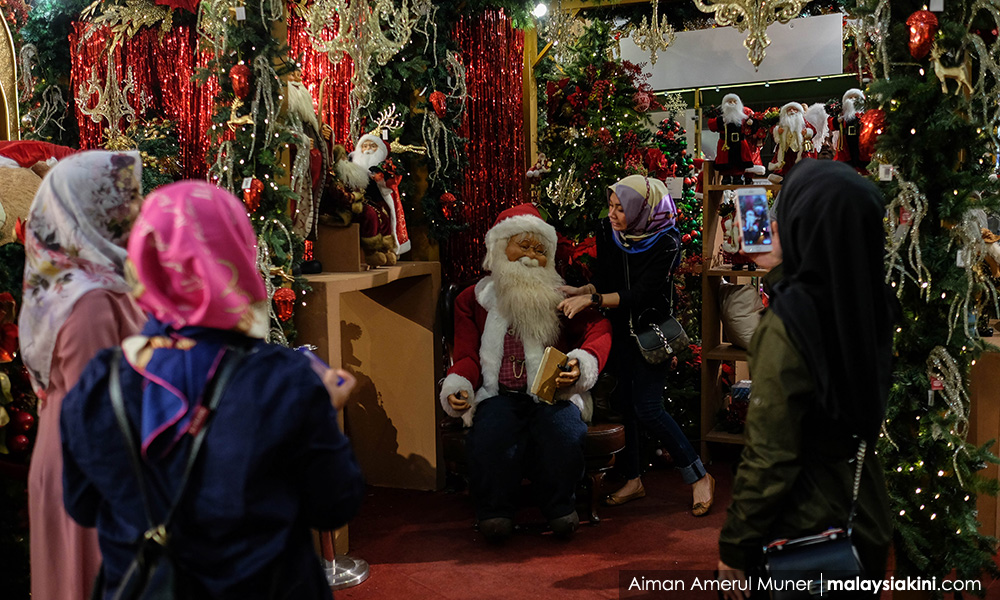
Or, as my friend noted, Christmas is a time to celebrate that we are “alive and well every day of the year”, hence, we ought to take the time “to let people know we care about them every single day”.
One’s faith, and authentic trust in God, is demonstrated in one’s deeds as reflected in a transformed life. How we live reveals whether the faith we profess to follow is a living faith, regardless of its name, sect or denomination.
Hence, after the holiday grazing and merry wishing this Christmas, let us speak up against the racialised politics and corruption that have long been driven by pernicious greed at the expense of the people’s welfare.
We should condemn the current jostles for political power, even as the incumbents and their apparatchiks neglect their obligations to serve the rakyat and, Insyallah, to sacrifice part of their ill-gotten wealth, like Ebenezer Scrooge, for the greater good during these difficult times of increasing living costs and stagnant salaries.
As we delve into the spiritual meaning of Christmas and understand the persecution that Christ suffered throughout his earthly life and how he ultimately triumphed even in death, let us pray that our politicians, through their professed faith, will listen to the ‘better angels of their nature’ to serve the rakyat, instead of themselves and their cronies.
This recurrent thought, as I read the local news, reminds me of my journal notes on political leadership that our politicians should emulate. My notes were taken from 'Mandela’s Way – Lessons on Life', a Christmas gift from my children years ago.
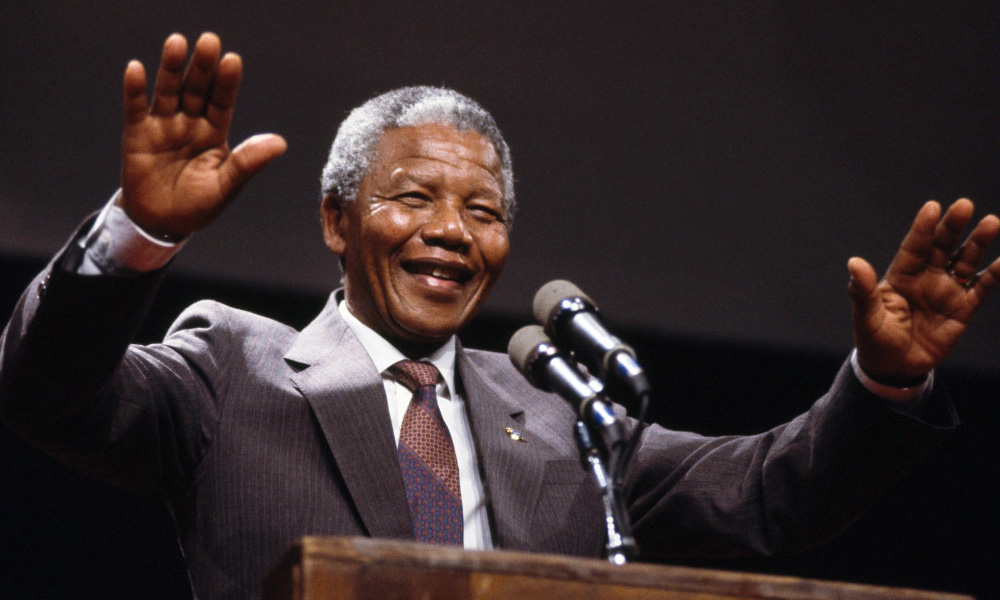
The first lesson that Mandela (above) taught was to “lead from the front”. Leaders must not only lead, but must be seen to lead. At times, it means doing things that don’t necessarily attract attention. Other times, it means taking a defiant stand for the greater good - even if it means a death sentence.
The book alludes to Mandela’s trial in 1963-64 (which reminds me of Jesus’ trial under Pontius Pilate) when he pleaded not guilty to armed struggle and treason.
In his final testimony, Mandela said, “During my life, I have dedicated myself to this struggle of the African people. I have fought against white domination, and I have fought against black domination.
“I have cherished the ideal of a democratic and free society in which all persons live together in harmony and with equal opportunities. It is an ideal for which I hope to live for and to see realised. But my Lord, if it needs be, it is an ideal for which I am prepared to die.”
The second lesson was to “lead from the back.” As a young boy, Mandela used to herd the village cattle with his friends in the afternoon. He says: “You know, when you want to get the cattle to move in a certain direction, you stand at the back with a stick, and then you get a few of the cleverer cattle to go to the front and move in the direction that you want them to go. The rest of the cattle follow the few more energetic cattle in the front, but you are really guiding them from the back. That is how a leader should do his work.”
"Leadership at its most fundamental is about moving people in a certain direction – usually through changing their thinking and their actions. It’s empowering the people to move forward." In Africa, it’s known as 'ubuntu' - "the profound sense that we are human only through the humanity of others; that if we are to accomplish anything in this world, it will in equal measure be due to the work and achievements of others,'” says Mandela.
As we merrily feast through this Christmas, begin the New Year and listen to the usual political platitudes about building a “prosperous and united Malaysia”, our politicians would do better to draw some lessons from the Christmas story, heed Mandela’s philosophy and emulate his leadership which, on our home front leaves much to be desired.
ERIC LOO is a senior fellow (Journalism) at the University of Wollongong, Australia. He is also the founding editor of the Asia Pacific Media Educator.
The views expressed here are those of the author/contributor and do not necessarily represent the views of Malaysiakini.


Report this comment
Are you sure you want to delete this comment?
This action cannot be undone.