




The charming 'firebrand'
In the postwar period of 1946 and 1947, the name 'Ms Eng Ming Ching' frequently appeared in the front pages of many newspapers as an open representative of the non-illegal Communist Party of Malaya (CPM).
She was reportedly invited by many groups in Ipoh, Teluk Anson (now Teluk Intan), Tanjung Malim, Cheras (in Kuala Lumpur) and other places to speak about issues like the role of Chinese Malayan women and intellectuals in the struggle for independence or law and order in postwar Malaya, or to officiate public functions and rallies on behalf of her party which still enjoyed the status and prestige of victorious Allied powers.
In 1946, for example, she was CPM's representative in Ipoh's public rallies welcoming the visit of the leader of India's independence movement, Jawaharlal Nehru to the capital of Perak. At that time, India was officially still a British colony and it was only a year later that independence became a reality.
Eng's public speaking skills, personal charm and beauty and sense of mission did not go unnoticed by the British intelligence.
In the postwar period of 1946 and 1947, the name 'Ms Eng Ming Ching' frequently appeared in the front pages of many newspapers as an open representative of the non-illegal Communist Party of Malaya (CPM).
She was reportedly invited by many groups in Ipoh, Teluk Anson (now Teluk Intan), Tanjung Malim, Cheras (in Kuala Lumpur) and other places to speak about issues like the role of Chinese Malayan women and intellectuals in the struggle for independence or law and order in postwar Malaya, or to officiate public functions and rallies on behalf of her party which still enjoyed the status and prestige of victorious Allied powers.
In 1946, for example, she was CPM's representative in Ipoh's public rallies welcoming the visit of the leader of India's independence movement, Jawaharlal Nehru to the capital of Perak. At that time, India was officially still a British colony and it was only a year later that independence became a reality.
Eng's public speaking skills, personal charm and beauty and sense of mission did not go unnoticed by the British intelligence.
Her eyes ...
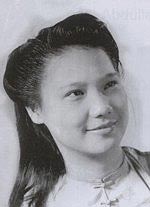 Victor Purcell, a Chinese affairs officer of the British Military Administration (BMA) wrote the following dossier about the communist girl in her early 20s who was previously detained and tortured by the Japanese military police Kempetai for about six months:
"She has a quite good figure beneath her dowdy blue cotton dress, but the fountain pen stuck in her bosom is a sharp reminder that she puts business before allurement. Her most remarkable features are her eyes. At one moment they are flat, brown and dull, at the next revealing in baleful flashes the smouldering fires of fanaticism
"I had heard much of her oratory and of her decidedly unfair behaviour at the meeting in October 1945 during the rice troubles when she had stood at a platform on the (Ipoh) Padang and had worked up the crowd of 3,000 with inflammatory speeches and by beating time for revolutionary songs by her trained choir for an hour or more before Brigadier Willan's arrival, so that when he came the crowd was in no mood to listen to reason.
"There she sat in front of me, and whilst I detected in the occasional flashes of her eyes the eternal Tricoteuse and firebrand of the Revolution, she was surprisingly subdued during the interview."
Her fame reached another height when she was invited by the Indonesian independence movement to tour the then Dutch colony to drum up support among the Chinese Indonesian community for the national liberation war led by a nationalist-communist alliance. Eng, for example, delivered speeches in Madiun University and also over the air on Radio Republik Indonesia. She also met many of the top leaders of the Indonesian independence movement such as Sukarno, Amir Sharifuddin, Siauw Giok Tjhan and Tan Ling Che.
All these exciting and thrilling elements of the true history of one of the most tumultuous period of the history of Malaya and its surrounding region would have been lost from the collective memory in Malaysia, Singapore and Indonesia had people like Eng not been determined enough to survive and write them down for our moral and intellectual benefit and as antidote to anti-communist black propaganda during the Cold War.
Great contribution
 Seen in this light alone, the recently published memoirs of
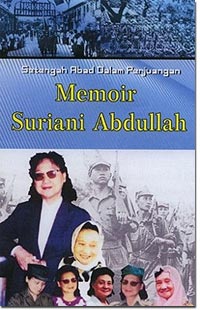
Eng Ming Ching, Setengah Abad Dalam Perjuangan: Memoir Suriani Abdullah
(Kuala Lumpur, SIRD, 2006) is a great contribution to the ongoing process of mental decolonisation and reaffirmation of national as well as regional identity for it is written not from one whose emotive attachment is to the long bygone British or Japanese empires but one of its nemeses.
Seen in this light alone, the recently published memoirs of
Eng Ming Ching, Setengah Abad Dalam Perjuangan: Memoir Suriani Abdullah
(Kuala Lumpur, SIRD, 2006) is a great contribution to the ongoing process of mental decolonisation and reaffirmation of national as well as regional identity for it is written not from one whose emotive attachment is to the long bygone British or Japanese empires but one of its nemeses.
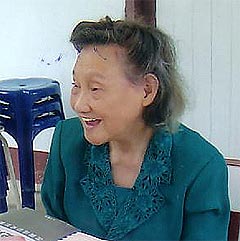
Eng, 82, is, as it is already well known, now Suriani Abdullah, the wife of Abdullah CD, veteran of the Communist Party of Malaya who signed the 1989 Haadyai Peace Accords with the governments of Malaysia and Thailand as the party's chairman. In the years of clandestine existence in the urban underground, jungles and hills, she was also known by her alias Ah Ming.
Setengah Abad Dalam Perjuangan: Memoir Suriani Abdullah - written by Eng herself - clearly shows an amazingly razor-sharp and coherent mind whose power of memory has not declined or decomposed as a result of physical torture, psychological warfare, vicissitudes of fortune or the natural process of ageing. Retelling a tumultuous life journey without mental confusion of spatial pictures and timelines at the age of 82 also certainly testifies to the strength of her character and personality as well as the core values of her belief-system.
From a rich family
Above all, it shows that the author is certain and unapologetic about her self-identity and self-worth as a Sitiawan-born Malayan woman of Chinese origin who had fought the Japanese occupation and British re-colonisation as an armed partisan as well as peacetime activist and who has, therefore, contributed to the struggle for Merdeka in both Malaya and Indonesia.
Of course, she was not born or fated to be communist or guerilla fighter. On the country, she grew up in a well-to-do, harmonious and socially respectable family with links to MCA's ex-President Dr Ling Liong Sik. In Setiawan's Nan Hwa and Ipoh's Methodist Girls' School (MGS), she excelled in her studies and learned to sing and dance. She was, for example, the player of the main character of the Swan Lake in a school opera.
According to her memoirs, Eng was born on Jan 23, 1924 in Sitiawan.
However, like so many people in Malaya and Asia of her generation, the young Eng was radicalised by colonial exploitation and discrimination in British Malaya as well as Imperial Japan's aggressive war against China and later Malaya itself.
 At that time, there was only one multiethnic political party, albeit illegal and clandestine, that provided a platform for her to participate in the anti-colonial and anti-fascist movement and that was the Communist Party of Malaya which was founded on April 30, 1930 in a workers' quarter of a rubber plantation in Negeri Sembilan's Kuala Pilah. In 1940, when she was 16, she was formally admitted as a full member of the Communist Party of Malaya in Ipoh.
Ideology aside, one clear picture that emerges from the 243-page Setengah Abad Dalam Perjuangan Memoir Suriani Abdullah is that Malayan and Malaysian nationhood was not born but made by many personalities and forces over a period of time and Eng is both an epitome and reflection of the making of the nation.
The already trilingual author also reveals that she can write the Malay language not only in Rumi scripts but also Jawi. Of course, she is also now a Muslim who has performed her Haj in Mecca and also expert in Malay traditional culture and history. On Dec 1, 1998, the former Ipoh MGS girl and her Malay husband Abdullah CD were granted audience in a Kuala Lumpur palace by His Royal Highness Sultan Azlan Shah of Perak.
For those who are interested in tragic-romances in history, Setengah Abad Dalam Perjuangan Memoir Suriani Abdullah also offers one: Eng reveals that her first boyfriend and lover Toh Lung San, the mentor of Chin Peng and Rashid Maidin and a resistance hero was beheaded by the Japanese in Ipoh in1943 at the age of 21.
Toh "the Captain" in Chapter 14 of Sybil Kartigasu's No Dram of Mercy or "my mentor" in Chin Peng's My Side of History or " guru politik saya " in Rashid Maidin's Daripada Perjuangan Bersenjata Kepada Perdamaian , was also one of the 165 CPM graduates of guerilla warfare from the Britain-sponsored and Singapore-based Special Training School 101 (STS101) and top leaders of the Malayan People's Anti-Japanese Army in Negeri Sembilan and Perak.
Before the conclusion of an agreement between the CPM and the British military command at Fort Canning in Singapore on Dec 18, 1941, the Setiawan-born Toh (1922-1943), was incarcerated for a while in Kuala Lumpur's Pudu Jail by the colonial authorities as a "subversive". He was released unconditionally on Dec 20, 1941 and trained in STS101 for guerilla warfare.
Setengah Abad Dalam Perjuangan: Memoir Suriani Abdullah is certainly a high-value book for enthusiasts of alternative history. There are many historic and rare photographs selected for publication in the book. Its Chinese translation is also coming out soon.
JAMES WONG WING ON is chief analyst of Strategic Analysis Malaysia. He is a former DAP member of Parliament for Kampar (1990-1995) and a former columnist for the Sin Chew Jit Poh Chinese daily (now Sin Chew Daily). He read political science and economics at Monash University in Melbourne, Australia.


