




Mahathir-Abdullah conflict dissected
The conflict that is brewing between former premier Dr Mahathir Mohamad and his successor Prime Minister Abdullah Ahmad Badawi goes much more deeper than the four issues that the former has raised for the attention of the government.
Essentially, the conflict represents an intra-Malay/Umno conflict over the access to resources, business opportunities and power. In other words, a purely political approach would not be able to decipher the nature and the dimension of the present conflict.
A political economy approach showing the subtle linkages between politics and economics would be a more appropriate approach.
The conflict that is brewing between former premier Dr Mahathir Mohamad and his successor Prime Minister Abdullah Ahmad Badawi goes much more deeper than the four issues that the former has raised for the attention of the government.
Essentially, the conflict represents an intra-Malay/Umno conflict over the access to resources, business opportunities and power. In other words, a purely political approach would not be able to decipher the nature and the dimension of the present conflict.
A political economy approach showing the subtle linkages between politics and economics would be a more appropriate approach.
Only such a methodology will be able to provide better and more realistic assessment of the basis of the present nature of conflict and how race, religion and nationalism have been invoked to hide the clamour for wealth and power between two power bases in Malay society.
 Umno politics in general have become much more materialistic in the last few decades or so. Gone are the days when difference of ideology took a centre stage in the domain of Malay or Malaysian politics.
The struggle in Umno all in the name of religion, God and race is invariably related to acquisition of material wealth and the need to maintain this wealth by seeking access to politics or political patronage.
While money politics was outwardly shunned as the evil that would destroy Malay unity, it has proved impossible to dismantle the operation of money politics. In fact, one could argue that without money politics, Umno would have fragmented a long time ago.
So what drives Umno behind the mask of Malay unity and in opposition to non-Malays is the naked desire for money and wealth. Attempts by Umno leaders to rid the party of money politics have been merely feeble attempts to hide the stark reality of corruption, patronage and moral decay.
Access to resources
Past conflicts in Umno centred on certain key personalities, sometimes leading to splits in the party over the acquisition of wealth and power. For instance, the conflict between Mahathir and Tengku Razaleigh Hamzah in the 1980s was not about higher politics, but about access to wealth and power.
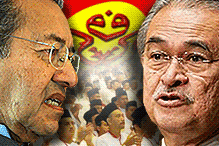 Similarly, the conflict between Mahathir and Abdullah is about forces aligned to these two leaders competing for scarce resources and power. The conflict has become bitter and acrimonious because the side aligned with Mahathir seems to have lost out in access to material wealth by way of contracts, business opportunities and favouritism.
Furthermore, the entry of Abdullah's relatives in the competition for resources has complicated the picture so much so that Mahathir, in an indirect swipe at Abdullah, recently told the media that he had never shown favouritism to his family members or relatives while in office.
It is quite obvious that when Mahathir raised the four issues for the attention of the Abdullah administration, the implicit argument was his friends had lost out in the competition for government contracts and business licences and that the forces aligned to Abdullah had gained unfairly.
The four issues are: the decision to cancel the half-bridge project to Singapore; the sale of Proton's motorcycle company Augusta to an outsider; removal of Proton's former head Tengku Mahaleel; and issuance of Approved Permits (APs) to certain individuals and groups.
In seeking a response, Mahathir invoked both the nationalistic and pro-bumiputra argument to buttress his claims. On the bridge issue, he attacked the government for being not nationalistic and not standing up to Singapore.
 On the other three issues, he raised the spectre of how deserving bumiputras have been sidelined by the present regime and how the present system of awarding APs favour groups or individuals close to ministers. In fact, the AP controversy appeared much earlier when Mahathir criticised International Trade and Industry Ministry Rafidah Aziz for not being transparent about the awarding of such permits.
Mahathir has been consistently raising these issues at different fora not because he wants to criticise the government, but because he has come to be seen as the leader of a group within Umno that is generally dissatisfied with the administration's policies and programmes.
More specially, during the last few years in power, the Abdullah government has contributed to sidelining many Malay entrepreneurs and businessmen, especially those still loyal to Mahathir.
In a more specific sense, the rise ofAbdullah's son-in-law, Khairy Jamaluddin, in the corporate world has been a sore point for many Malay business leaders. Very recently, one of Mahathir's closest aides, Mathias Chang, criticised Khairy and a senior newspaper editor for messing up some of the programmes initiated by Mahathir.
Erosion of image
It is unclear whether Mahathir is raising the issues for altruistic reasons or for nationalistic reasons; however, the absence of this does not negate their validity. First, many of the government's policies and programmes are shrouded in mystery - no one knows the actual beneficiaries.
Second, corruption is still rampant in the government despite the rhetoric adopted by Abdullah's regime on eradicating this. Third, despite many allegations of corruption, there are ministers and officials who have never been investigated or removed from their positions.
Fourth, cronyism and favouritism are still rife especially in the awarding of contracts, tenders and licences. Mahathir's point about the controversial removal of Tengku Mahleel who was apparently doing a good job as Proton head has never been explained to the public. Fifth, the criticism of Rafidah's handling of the APs still begs an explanation.
Abdullah's 'good guy' image is fast eroding in the Malaysian political arena. His policy of silence on controversial matters of societal or public concern might become his liability. While he offered Islam Hadhari as an alternative to the PAS ideology, he has never taken the party to task - unlike Mahathir - for its controversial and highly sensitive matters in a multi-racial and plural Malaysian society.
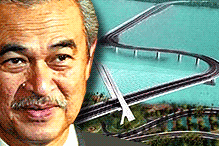 To date, he has refused to be dragged into confronting Mahathir or refuting the statements, although he has said that the ministries would provide appropriate explanations. Abdullah has come to be seen as an ineffective leader. The general public does not want him to confront Mahathir, but surely it expects some kind of rational response to the issues raised.
It is rather unfortunate that it has taken a person like Mahathir to highlight some of the problems of the government. The situation might be new, but the opposition has raised the same issues for many years.
Mahathir is apparently emerging as the new saviour of Malaysia, but the public will never forget that the seeds of decay were sown during his long tenure in office. But Malaysians, being open minded, think that Mahathir should be given a fair hearing by the government.
In many ways, Malaysian politics have not changed. Politics within political parties have not transcended the narrow confines of ethnicity, race, religion and crass materialism. In fact, the revival of ethnicity and religion seems to be invariably related to the way resources are allocated in society.
Politics in Umno are not about taking the country to greater heights and improving race relations, but how certain individuals can gain access to wealth and power in the never-ending game of greed and corruption.
P RAMASAMY is currently editing a book, 'Rising India and Indians In East Asia' and researching to write a book on Malaysian politics.


